
Time-to-Shortlist: The Metric Recruitment Agencies Should Optimize First
Learn why time-to-shortlist is one of the most important agency performance metrics and how faster screening improves client satisfaction.
Table of Contents

Why Time-to-Shortlist Beats Every Other Metric
- It’s entirely within your control. Time-to-hire depends on client scheduling, offer negotiations, and candidate availability-factors outside your influence. Time-to-shortlist? You own every step: sourcing, screening, assessment, and shortlist delivery. If this metric slips, you caused the delay. Fixing it puts you in the driver’s seat.
- It’s the #1 predictor of offer acceptance and quality. Every 24-hour delay in shortlist delivery increases offer rejection risk by 7–10% (LinkedIn Talent Solutions data). Top talent isn’t waiting-it’s interviewing with competitors who move faster. Agencies that consistently deliver shortlists in <24 hours see 22% higher offer acceptance rates, 31% lower early turnover, and 40% more client NPS points.
- It exposes your real bottlenecks, not vanity metrics. Tracking “applications received” or “interviews held” hides problems. Time-to-shortlist forces you to confront: Is sourcing slow because your Boolean strings are outdated? Is screening stuck because recruiters re-read resumes five times? Are assessment tools creating manual handoffs? This metric turns guesswork into a diagnostic tool-you optimise what you measure.
- It builds client trust faster than anything else. Clients don’t care about your internal processes-they care about their pain. When you say, “We cut your screening delay from 5 days to 4 hours,” you speak their language: revenue protection.
- Every day a role sits open costs clients 1–2.5x the salary in lost productivity (Gartner). Optimising time-to-shortlist turns you from a vendor into a profit protector.
How to Measure Time-to-Shortlist Correctly (Most Agencies Get This Wrong)
Definition: Hours from when a candidate completes their application to when a recruiter delivers a ranked, evidence-backed shortlist to the hiring manager. Critical nuances:
- Start the clock at application completion-not when you see it. If a candidate applies at 9 PM but your ATS doesn’t notify you until 9 AM, that’s 12 hours of avoidable delay.
- End at shortlist delivery-not when you finish screening. If you finish at 3 PM but wait until tomorrow to send it, that’s another 12+ hours wasted.
- Track by recruiter, role type, and source. A junior recruiter handling volume roles should hit different targets than a senior recruiter doing executive search. Benchmarks to beat:
| Role Type | Industry Average | Top 10% Agencies | Your Target (Month 1) | Your Target (Month 3) |
|---|---|---|---|---|
| Volume (retail, grad) | 72–120 hours | <12 hours | <48 hours | <12 hours |
| Professional | 96–168 hours | <24 hours | <72 hours | <24 hours |
| Executive/Niche | 168+ hours | <48 hours | <96 hours | <48 hours |
| Source: 2024 Recruiter Efficiency Benchmark Report (SHRM + Aptitude Research) |
Step 1: Eliminate Scheduling Hell with Async-First Screening
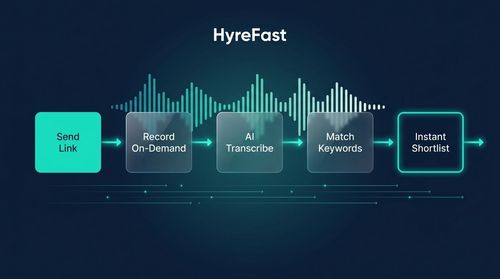
The problem: 68% of time-to-shortlist waste comes from scheduling phone screens (recruiter-candidate back-and-forth).
The fix: Replace live phone screens with asynchronous video or text-based assessments. Send candidates a link to record 3–4 job-relevant questions on their own time (e.g., “Walk me through how you’d debug this code snippet”). Use AI-assisted transcription to instantly surface keywords and semantic matches (e.g., “SQL,” “stakeholder management”).
Result: Cuts scheduling delay from days to minutes. Top agencies achieve <4-hour time-to-first-contact for 90% of candidates. Platforms like Willo or Spark Hire enable bulk-invite (1,000 candidates in 2 minutes) and auto-trigger invites upon application.
Step 2: Implement Structured, Evidence-Based Scoring (No More Gut Calls)
The problem: Recruiters spend 15–20 minutes per candidate re-reading notes, debating “fit,” and delaying scoring-adding hours to your timeline.
The fix: Deploy a 3-competency rubric with behavioural anchors and score within 10 minutes of submission. For example, for a sales role: competency “Diagnoses customer pain points” with anchor for 3/5: “Uses open-ended questions to uncover 1+ unstated need; summarises back to customer for confirmation.” Require evidence timestamps: “At 2:10: ‘So if I hear right, your real worry isn’t cost-it’s downtime during migration?’”
Result: Scoring drops to <3 minutes per candidate with 40% less variance (Journal of Applied Psychology). Use AI to flag “definitely review” (top 20%) and “definitely reject” (bottom 20%)-humans only touch the middle 60%.
Step 3: Automate Handoffs and Status Updates (Kill the Black Hole)
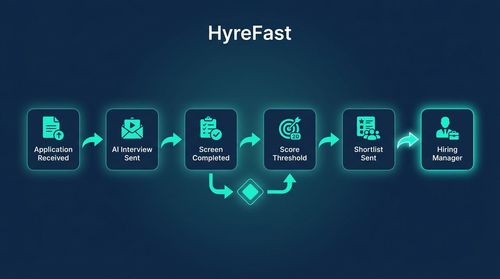
The problem: Even after screening, shortlists sit in recruiters’ inboxes while they “wait for the right time” to send them-adding 12–24 hours of avoidable delay.
The fix: Build automated triggers into your ATS/CRM: application received → auto-send async interview invite (within 5 minutes); screen completed → auto-advance to shortlist if score ≥ threshold (e.g., 3.5/5 on core competencies); shortlist ready → auto-email hiring manager with ranked candidates, evidence highlights, and a next-step calendar link.
Result: Eliminates manual handoffs. Agencies using this see time-to-shortlist drop by 65% (LinkedIn Talent Solutions case study).
Avoid These Time-to-Shortlist Traps
| Trap | Why It Slows You Down | How to Fix It |
|---|---|---|
| “We’ll batch screens at 2 PM” | Creates artificial delays; ignores candidate urgency | Score as submissions come in—set a 10-minute SLA per candidate |
| Over-assessing in round one | Asking 10+ questions = longer videos = slower review | Stick to 3–4 non-negotiables; max 3 minutes per question |
| No auto-triggers | Recruiters forget to send shortlists | Build ATS workflows: screen complete → shortlist sent → calendar invite |
| Ignoring mobile completion | 50%+ of candidates apply on mobile; slow load = drop-off | Optimise async tools for iOS/Android; test completion rate weekly |
| Treating all roles the same | A grad role needs different speed than exec | Set role-specific SLAs (see benchmark table above) |
The Ripple Effect: What Happens When You Nail Time-to-Shortlist
Optimising this metric doesn’t just make you faster-it transforms your entire value proposition:
- Recruiters gain 10–15 hours per week (from scheduling and chasing) to focus on relationship-building and offer negotiation.
- Clients see faster time-to-fill (your shortlist speed directly cuts their time-to-hire by 30–50%).
- Candidate experience improves (85%+ completion rates for async tools; 4.2/5 post-screen CSAT vs. 2.5/5 for phone screens).
- Quality rises (consistent screening = fewer false negatives; structured scoring = better shortlist predictability).
Implementation Roadmap: Start Seeing Results in 30 Days
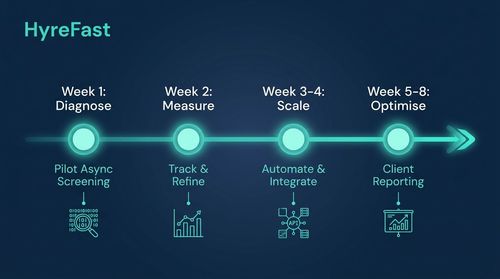
Week 1: Diagnose and Pilot
Pull your current time-to-shortlist data (by role/recruiter) from your ATS. Pick one high-volume role (e.g., graduate analyst, retail associate). Pilot async screening (3 questions) + 3-competency rubric + auto-triggers for 50 applicants.
Week 2: Measure and Refine
Track completion rate, recruiter hours per 100 candidates, shortlist quality (pass-through to round two), and time-to-shortlist. Target <48 hours for volume roles (vs. industry 72+). Refine rubric based on hiring manager feedback: “Did this shortlist actually contain people we wanted to interview?”
Week 3–4: Scale and Automate
Roll out to 2–3 additional role types. Connect to ATS via native API (no manual CSV uploads). Set up automated status updates: “We’re still reviewing-expect update by [time + 24 hours]” at 12/24/36 hour marks.
Week 5–8: Optimise and Client-Facing Reporting
Share weekly time-to-shortlist reports with clients: “Your average screening delay is now 18 hours (down from 5 days). Here’s how it impacted your offer acceptance rate…” Tie improvements to business outcomes: “Every 12-hour reduction in screening delay = 5% higher offer acceptance.”
Conclusions
- Time-to-shortlist is the ultimate leading indicator-it’s fully controllable, predicts downstream success (offer acceptance, quality, client trust), and exposes your real inefficiencies.
- Top agencies treat it as a non-negotiable SLA: <12 hours for volume roles, <24 hours for professional, <48 hours for executive.
- The fix isn’t more effort-it’s smarter design: async-first screening, evidence-based scoring in <10 minutes per candidate, and automated handoffs.
- Optimising this first builds immediate client trust-you’re speaking their language (speed = revenue protection) before asking them to believe in long-term quality gains.
Future Directions
- Predictive time-to-shortlist: AI that forecasts delays based on application volume, recruiter bandwidth, and source quality-triggering proactive sourcing boosts before bottlenecks form.
- Dynamic SLAs: Role-specific time-to-shortlist targets that adjust in real-time based on client urgency (e.g., “This role just got marked P1-target drops to 6 hours”).
- Client-co-created benchmarks: Agencies and clients jointly defining acceptable time-to-shortlist ranges based on role criticality and market data, turning metrics into partnership tools.
- Experience-weighted timing: Metrics that weigh speed against candidate sentiment (e.g., a 6-hour shortlist with 2.0/5 CSAT is worse than a 12-hour one with 4.5/5).
Want to identify strong candidates before interviews without relying on resumes?
Schedule a walkthrough: Book Demo
Explore HyreFast Solutions
Interview as a Service
Outsource first-round interviews to AI.
AI Interview Bot
AI bot that conducts and evaluates interviews 24/7.
Video Interview Software
One-way async video interviews with AI scoring.
Phone Screening
Automate first-round phone calls with AI.
Interview Assessment
Structured assessments with AI scoring and reports.
AI Interview Platform
End-to-end platform for AI interviews and analytics.