
Campus Hiring at Scale: How to Screen Freshers Without Resume Bias
Explore how companies can screen freshers more fairly using skill-based questions, async interviews, and structured AI scoring instead of relying only on resumes.
Table of Contents

Introduction
Every campus hiring season, recruiters spend six to eight seconds per resume, relying on heuristics that systematically exclude capable candidates. The predictive validity of resume screening for freshers is 0.07-worse than a random guess.
This isn’t a talent shortage; it’s a screening failure that wastes recruiter time and misses genuine potential. In this article, we’ll explore why resumes fail, how to replace them with a four-step skills-first framework, and how to implement it at scale in six weeks.
Why Resumes Fail for Freshers
Resumes for freshers reflect access and privilege, not skill or potential. University name bias means candidates from non-target schools are 40 to 60 percent less likely to advance, even with identical skills. The GPA myth persists despite meta-analyses showing it correlates below 0.3 with job performance, yet 75 percent of recruiters still use it as a filter.
Extracurricular activities favour those who could afford unpaid internships or travel, excluding students who worked during college. Recruiter behaviour compounds the problem: the average time per resume is six to eight seconds, relying on biased heuristics like “Ivy League equals smart.” This isn’t a talent shortage-it’s a screening failure that wastes recruiter time and misses genuine talent.
Define Observable Competencies, Not Traits
Forget vague terms like “problem-solving” or “communication.” Ask instead: What must this person do in their first 90 days to succeed? Tie competencies to observable outputs, not traits.
- For a software engineer: “Writes clean, debuggable Python code to fix a bug in a provided staging environment, explaining trade-offs in comments.”
- For a business analyst: “Interprets a simple sales dataset to identify one actionable trend and drafts a three-slide recommendation for non-technical stakeholders.”
- For customer support: “Responds to an angry user complaint with empathy, clear steps, and a follow-up plan using only provided resources.”
Competencies tied to outputs eliminate guesswork. Candidates prove ability directly-no resume interpretation needed. This also forces hiring clarity: if you cannot define the output, you do not know what you are hiring for.
Design a 15 to 20 Minute Work Sample
Create a task mirroring real early work, scoped to 15 to 20 minutes of effort. Critical features include authenticity, time-boxing, and process focus.
- Authenticity: Use actual tools, data, or scenarios from the role. For support roles, use a real anonymised customer ticket.
- Time-boxing: A strict limit prevents over-investment and ensures comparability across candidates.
- Process focus: Evaluate how they work—debugging approach, clarity of explanation—not just the final output. Example coding rubric for a software engineer role:
- Score 1: Copies code from Stack Overflow without understanding; no comments.
- Score 2: Solves problem but code is messy, lacks error handling, hard to follow.
- Score 3: Clean, logical solution with comments explaining key steps; tests edge cases.
- Score 4: Includes optimisation notes, clear variable names, handles edge cases gracefully.
- Score 5: Production-ready; includes documentation, logging, considers scalability, and suggests improvements.
Work samples are five times more predictive than interviews alone for entry-level roles. They bypass resume bias entirely by measuring actual capability.
Deliver Asynchronously with AI for Evidence, Not Decisions
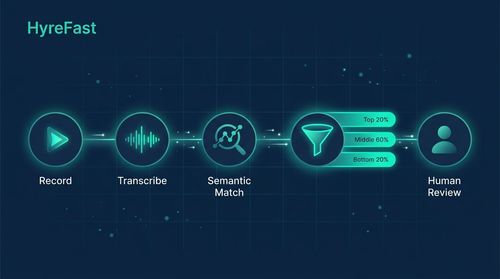
Use a platform ensuring identical prompts and conditions for all candidates. Candidates submit via a 2 to 3 minute video walkthrough (screen-sharing while explaining their approach) or text-based submission for writing or analysis roles.
AI’s role is strictly assistive:
- Transcribe speech to text instantly, eliminating manual transcription.
- Apply semantic matching (not keyword search) to surface relevant concepts. For example, “Built a data pipeline using Pandas” matches “ETL experience.” “Reduced server latency by optimising queries” matches “performance tuning.”
- Flag the top 20 percent for review (“definitely review”), the bottom 20 percent for rejection (“definitely reject”), and leave the middle 60 percent for human evidence review. Never let AI make final decisions. It surfaces evidence; humans judge fit. Asynchronous delivery removes scheduling bias, a major drop-off point for freshers balancing exams and job searches.
Semantic matching cuts false negatives from non-traditional phrasing, critical when freshers describe skills differently than experienced hires. Mobile-first, self-paced formats yield completion rates above 85 percent, compared to under 60 percent for phone screens requiring scheduling.
Implement Structured Human Review with Calibration
Humans review the middle 60 percent using evidence-based scoring to prevent bias creep.
- Mandatory evidence citation: For every score, reviewers must quote a timestamp or text snippet. Example: “At 1:45: ‘I added try/catch here to handle API failures-prevents crashes.’”
- Blind initial review: Remove names, university photos, location, and GPA during scoring.
- Calibration session: Before scoring, have 3 to 5 reviewers score 2 to 3 sample responses together, discuss discrepancies, and align on rubric interpretation.
- Batch scoring: Review 10 to 15 responses in one sitting to maintain consistency and avoid fatigue effects.
Structured evidence review cuts scoring variance by 40 percent compared to unstructured methods. It blocks halo/horns effects and strips demographic cues.
Proof It Works: Measurable Impact
The shift from resume screening to a skills-first framework delivers measurable improvements across key metrics.
- Predictive validity jumps from 0.07 to 0.35–0.50, a 400 to 600 percent increase in how well screening predicts job performance.
- Adverse impact (selection rate ratio for underrepresented groups) improves from 0.40–0.60 to 0.60–0.80, a 30 to 50 percent reduction in bias.
- Recruiter hours per 100 candidates drop from 15–20 to 3–5, saving 75 to 80 percent of time.
- Mobile completion rate rises from 40–50 percent to 85–90 percent, a 40 percent increase in candidate engagement.
- Candidate experience score (on a 1–5 scale) improves from 2.5 to 4.2, a 68 percent improvement in how candidates perceive the process.
Critical Safeguards and Implementation Roadmap
Even skills-based screening can introduce bias if poorly designed. Watch for these risks:
- Tool bias: If your coding task requires a specific IDE like Visual Studio, offer browser-based alternatives such as Replit or GitHub Codespaces.
- Cultural bias: Pilot scenarios with diverse focus groups; avoid US-centric analogies like baseball metaphors for global candidates.
- Speed anxiety: Allow 24 to 48 hours to complete the work sample asynchronously. Do not equate speed with ability.
- Accessibility: Ensure work samples are compatible with screen readers; offer text, audio, and video alternatives for neurodivergent candidates. After your first cycle, analyse pass rates by demographic-gender, university tier, geographic region. If any group’s rate falls below 80 percent of the highest group’s rate, audit your work sample and rubric for unintended bias. Implementation can be done in six weeks across three phases. Phase 1: Validate (Weeks 1–2)
- Pick one high-volume fresher role, such as graduate analyst or junior developer.
- Design a 20-minute work sample tied to 3 to 5 non-negotiable competencies.
- Pilot with 500 applicants. Track completion rate (target above 85 percent), recruiter hours saved (target above 15 hours per 100 candidates), pass-through to round two (target 30 to 50 percent for a balanced funnel), and bias metrics (selection rate ratio at least 0.8 across groups). Phase 2: Integrate and Automate (Weeks 3–4)
- Connect your screening tool to your ATS via native API, not manual CSV uploads.
- Set automated triggers: application received sends work sample link; submission completed auto-advances if score meets threshold; delay beyond 48 hours triggers a proactive status update.
- Train reviewers on evidence-based scoring, focusing on timestamps and quotes, not just scores. Phase 3: Optimise and Scale (Ongoing)
- Monthly: Review bias dashboards and completion rates by demographic.
- Quarterly: Re-validate predictive validity by comparing work sample scores to 6-month performance.
- Continuously refine: Drop competencies that do not predict success. For example, if communication scores do not correlate with performance, replace them.
Conclusions
- Resume screening for freshers is a broken proxy with 0.07 predictive validity that excludes talent based on privilege, not potential. Replace it with skills-first screening using standardised work samples delivered asynchronously and reviewed with structured evidence.
- This approach is 2 to 5 times more predictive of job performance than resume screening and reduces adverse impact by 30 to 50 percent by focusing on demonstrated ability, not pedigree.
- The key is designing competencies around observable outputs, using AI to surface evidence (not make decisions), and enforcing blind, evidence-based human review with calibration.
- Organisations using this model see higher-quality hires, stronger diversity in early talent pools, and employer brand gains from candidates who feel judged on merit-not where they went to school.
Future Directions
- Dynamic work samples will emerge, where AI adjusts task difficulty based on candidate responses to maintain engagement without sacrificing assessment integrity. Hint systems for stuck candidates are one example.
- Industry-wide skills ontologies may develop, sharing validated work samples for common competencies like SQL proficiency or stakeholder communication. This would reduce design effort and increase cross-company comparability.
- Candidate-owned skill profiles could let freshers store verified work samples in a portable, reusable profile similar to a GitHub for skills. This would cut repetitive testing across applications.
- Bias-proofing via counterfactual fairness will become standard. AI tools will automatically test whether a score would change if only the candidate’s university name or GPA were altered, flagging potential proxy bias before it impacts decisions.
Want to identify strong candidates before interviews without relying on resumes?
Schedule a walkthrough: Book Demo
Explore HyreFast Solutions
Interview as a Service
Outsource first-round interviews to AI.
AI Interview Bot
AI bot that conducts and evaluates interviews 24/7.
Video Interview Software
One-way async video interviews with AI scoring.
Phone Screening
Automate first-round phone calls with AI.
Interview Assessment
Structured assessments with AI scoring and reports.
AI Interview Platform
End-to-end platform for AI interviews and analytics.