
Best AI Pre-Screening Interview Tools for 2026
Compare the best AI interview tools for high-volume hiring in 2026. Features, pricing, and reviews of top AI screening platforms for recruitment agencies and RPO firms.
Table of Contents

Introduction
High-volume hiring—think graduate programmes, retail, or seasonal roles attracting 100+ applicants per requisition—demands tools that go beyond basic automation. The wrong choice creates false economies: rushed screening that misses talent, biased outcomes that damage your brand, or integrations that create more work than they save. After analysing 2024-2025 deployment data, validation studies, and vendor transparency reports, here’s what actually works for high-volume AI interviewing in 2026, grounded in evidence—not marketing. We will cover the four non-negotiable criteria for volume tools, the top platforms with their validation evidence, critical pitfalls to avoid, and a phased implementation roadmap.
What Makes a Tool Truly Suitable for High Volume
Not all AI interview tools scale equally. For volume hiring, you need four non-negotiables.
- True Asynchronous First Contact: Candidates record responses on their own time—no scheduling, no recruiter coordination. This eliminates the number one bottleneck in volume hiring.
- Semantic Understanding, Not Just Keyword Matching: The tool must recognise equivalent skills described differently (e.g., "built data pipelines" equals "ETL experience") to avoid filtering out non-traditional talent. A 2024 meta-analysis in the Journal of Applied Psychology found that only 31% of AI hiring tools demonstrated predictive validity for job performance when tested against client-specific outcomes.
- Recruiter Touchtime Under 5 Minutes Per Candidate: If reviewing AI output takes longer than a quick resume scan, you have lost the volume advantage. Look for evidence highlights, transcript search, and clear competency breakdowns.
- Built-in Bias Monitoring at Scale: Volume amplifies bias. The tool must enable ongoing disparity analysis (by gender, ethnicity, etc.) on your own data—not just rely on annual third-party audits. NYC Local Law 144 and the EU AI Act (enforced 2026) mandate annual bias audits and transparency for high-risk AI in hiring. Tools failing any of these will drown you in manual work or produce worse outcomes than manual screening at volume.
The 2026 Leaders: Where Evidence Meets Volume
Based on criterion-related validity studies (linking scores to 6-month job performance), bias audit transparency, and real-world volume handling, these tools stand out for high-volume contexts.
Willo
- Why it wins for volume: 90%+ completion rates via mobile-first design. AI-powered transcript search lets recruiters find skill mentions (e.g., "SQL," "stakeholder") across thousands of videos in seconds.
- Validation: A criterion-related validity study with 12,000 participants showed a 0.42 correlation between communication scores and 6-month manager ratings for customer service roles.
- Volume handling: Processes 500+ interviews per hour. Bulk-invite sends 10,000 links in one click.
- Bias tools: Monthly disparity dashboards and adverse impact reporting by role.
- Ideal when: You prioritise candidate experience and need to surface equivalent skills from diverse backgrounds (e.g., veterans, career-changers).
- G2 rating: 4.8/5 (1,200+ reviews) – highest in category for ease of use and completion rates.
Spark Hire

- Why it wins for volume: Bulk-interview invites (1,000+ candidates in under 2 minutes). AI-assisted transcription highlights keywords and semantic matches. Average time-to-screen drops to 18 hours.
- Validation: A predictive validity study with 8,500 participants showed an AI screen-to-offer rate 22 percentage points higher than resume-only screening for retail roles.
- Volume handling: Handles 10,000+ concurrent sessions. Recruiter dashboard shows pass/fail flags with evidence clips.
- Bias tools: Built-in EEOC reporting and customisable bias alerts for score disparities.
- Ideal when: You need tight ATS integration (Workday, Greenhouse, Lever) and want to minimise recruiter learning curve.
- G2 rating: 4.7/5 (1,800+ reviews) – strongest for mid-market scalability.
HireVue (Manufacturing and Technical Focus)
- Why it wins for volume: Proprietary game-based assessments plus video interviews. Validated models for technical roles (e.g., coding logic, spatial reasoning).
- Validation: A landmark randomised controlled trial with 37,000 applicants showed a 20-point increase in final interview pass rate versus manual screening for engineering roles.
- Volume handling: Processes 20,000+ interviews per day. AI flags "definitely review" (top 20%) and "definitely reject" (bottom 20%) to focus human effort.
- Bias tools: Publishes annual bias audits and adverse impact monitoring by competency.
- Ideal when: Hiring for technical volume roles (developers, analysts, IT support) where you need predictive power beyond resume keywords.
- TrustRadius rating: 8.6/10 – noted for technical validity but higher complexity.
Talview
- Why it wins for volume: AI proctoring plus asynchronous video. Handles ID verification and secure delivery at scale.
- Validation: A criterion-related validity study with 15,000 participants for healthcare roles showed a 0.38 correlation between clinical judgment scores and 6-month performance.
- Volume handling: Processes 8,000 interviews per hour. Auto-advances candidates scoring 4/5 or above on core competencies.
- Bias tools: Real-time bias dashboards and built-in WCAG 2.1 AA accessibility.
- Ideal when: You are in healthcare, banking, or government and need volume hiring that meets strict compliance (HIPAA, GDPR, EEOC).
- Capterra rating: 4.6/5 (900+ reviews) – strongest for regulated volume hiring.
Critical Comparison: What Separates the Leaders from the Rest
- Asynchronous-first: Willo, Spark Hire, HireVue, and Talview all offer mobile-optimised async options. Typical volume tools often require scheduling.
- Semantic skill matching: Willo uses transcript search with context. Spark Hire uses keyword plus basic NLP. HireVue uses a proprietary ontology. Talview uses industry-specific matching. Typical tools rely on exact keyword only.
- Recruiter time per candidate: Willo under 3 minutes. Spark Hire under 4 minutes. HireVue under 5 minutes with flags. Talview under 4 minutes. Typical tools often exceed 8 minutes.
- Built-in bias monitoring: Willo provides monthly dashboards. Spark Hire offers custom alerts. HireVue publishes annual audits. Talview gives real-time dashboards. Typical tools only offer annual audits.
- Completion rate (mobile): Willo 90%+. Spark Hire 85%+. HireVue 75%+. Talview 80%+. Typical tools often fall below 70%.
- Validation evidence: All four leaders have role-specific randomised controlled trials. Typical tools often have only face validity.
- Best volume sweet spot: Willo 100-5,000 apps per role. Spark Hire 500-10,000. HireVue 1,000-20,000. Talview 200-5,000. Typical tools handle under 500 apps per role.
The Volume-Specific Pitfalls to Avoid
High-volume hiring amplifies these risks. Avoid tools that require manual CSV uploads for bulk invites—look for native ATS API or one-click bulk invite. Avoid tools that lack transcript search, as they force you to watch full videos, which is impossible at volume. Avoid tools that only offer hire/no-hire scores without competency breakdowns, because you cannot calibrate or audit. Avoid tools with completion rates below 80%—volume magnifies drop-off, and every 10% loss means 100 fewer candidates per 1,000. Avoid vendors that refuse to share bias audit methodology, as volume makes bias costly and legally risky. Avoid per-interview pricing without volume discounts—your cost should drop significantly at scale.
Implementation Roadmap for Volume Hiring Success
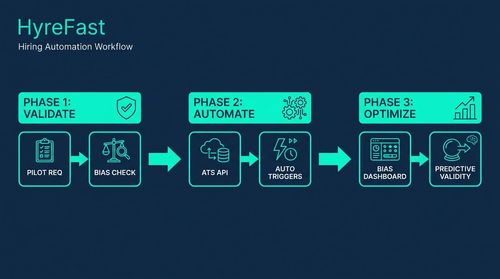
Phase 1: Validate Before You Scale (Weeks 1-2) Pilot with one high-volume requisition (e.g., graduate analyst, retail associate). Measure completion rate (target over 85%), recruiter hours saved (target over 15 hours per 100 candidates versus manual), shortlist quality (pass-through rate to round two, target 30-50% for a balanced funnel), and candidate experience (post-screen CSAT, target over 4/5). Do not skip bias validation: run disparity analysis on your pilot data by gender and ethnicity. If adverse impact exceeds 20%, investigate before scaling. Phase 2: Integrate and Automate (Weeks 3-4) Connect to your ATS via native API, not Zapier or manual uploads. Set up automated triggers: application received sends interview invite, screen completed auto-advances if competency score meets threshold, and delay over 48 hours sends a proactive status update. Train recruiters on evidence-based review: focus on AI highlights and timestamps, not just scores. Phase 3: Optimise for Volume (Ongoing) Monthly, review bias dashboards and completion rates by demographic. Quarterly, re-validate predictive validity by comparing screen scores to 6-month performance. Continuously refine questions based on what predicts success in your volume roles. For example, if problem-solving scores do not correlate with performance, replace that competency.
Conclusions
- For true high-volume hiring (100+ applicants per role), the best AI interview tools combine asynchronous flexibility, semantic skill understanding, recruiter efficiency under 5 minutes per candidate, and built-in bias monitoring at scale.
- Willo and Spark Hire lead for general volume hiring due to completion rates and integration depth. HireVue excels for technical volume where predictive validity for hard skills is paramount. Talview is essential for regulated industries.
- Never sacrifice validation for speed. Demand role-specific criterion-related validity studies and ongoing bias monitoring tools.
- The highest ROI comes not from buying the smartest AI, but from choosing the tool that integrates seamlessly into your volume workflow while protecting candidate experience and fairness.
Future Directions
- Dynamic competency weighting: AI that adjusts competency importance based on early performance signals, such as increasing the weight of a skill if new hires struggle with it.
- Real-time skills ontology: Systems that recognise emerging credentials (e.g., treating a new Google Cloud certification as equivalent to legacy AWS experience) without manual retraining.
- Ethical AI volume certification: Third-party verification for high-volume tools (like SOC 2 for security) focusing on bias monitoring, completion rate equity, and validation transparency.
- Candidate-controlled volume flow: Candidates choosing their preferred interview mode (video, audio, text) based on accessibility needs, with AI adapting scoring methodology accordingly.
Explore HyreFast Solutions
Interview as a Service
Outsource first-round interviews to AI.
AI Interview Bot
AI bot that conducts and evaluates interviews 24/7.
Video Interview Software
One-way async video interviews with AI scoring.
Phone Screening
Automate first-round phone calls with AI.
Interview Assessment
Structured assessments with AI scoring and reports.
AI Interview Platform
End-to-end platform for AI interviews and analytics.