AI Candidate Screening: How It Works and Why It Replaces Manual Screening
How AI candidate screening works in 2026. Learn how AI-powered screening replaces manual resume screening, reduces bias, and screens 500+ candidates in a day.
Table of Contents
Recruiters spend an average of 23 hours per hire on sourcing and screening alone, and 71% of recruiters identify candidate screening as their single biggest time sink. When your agency handles hundreds of open roles simultaneously, phone screens and resume reviews become a bottleneck that limits growth and frustrates both clients and candidates. AI candidate screening is fundamentally changing this dynamic by automating the most repetitive and judgment-heavy parts of the hiring pipeline. In 2026, these platforms don't just parse resumes — they conduct interviews, evaluate responses, score candidates against role-specific rubrics, and deliver ranked shortlists in hours instead of weeks. This guide explains what the technology is, how it works step by step, how it compares to manual screening, and how your agency can implement it to reduce time-to-hire while improving placement quality.
What is AI Candidate Screening?
AI candidate screening is the use of artificial intelligence to evaluate job applicants automatically — conducting interviews, assessing responses, scoring candidates on role-relevant criteria, and producing ranked reports that recruiters can act on immediately. Unlike traditional applicant tracking systems that simply filter resumes by keywords, modern screening platforms engage candidates in conversational interviews, analyze the substance of their answers, and apply consistent evaluation rubrics across every applicant.
The candidate screening process has historically been the most labor-intensive stage of recruitment. A recruiter or hiring manager reads each resume, schedules a phone screen, conducts a 20–30 minute conversation, takes notes, and then subjectively decides whether to advance the candidate. At scale, this process is expensive, inconsistent, and slow. AI screening replaces this manual workflow with an automated system that can evaluate thousands of candidates simultaneously without sacrificing depth.
HyreFast's AI interview screening platform exemplifies this shift. An AI interview bot conducts structured interviews with each candidate, evaluates their responses against a role-specific rubric, and delivers a scored, ranked report to the recruiter — all without human intervention during the screening stage. The result is a shortlist of qualified candidates ready for final human review, produced in a fraction of the time manual screening requires.
How the Screening Process Works
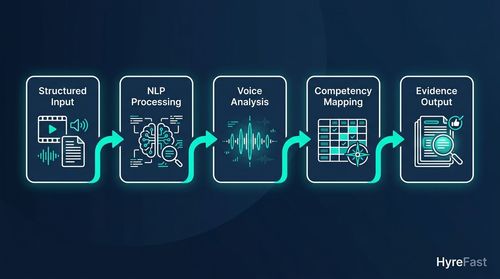
The technology follows a structured, multi-step workflow that mirrors what a skilled recruiter does — but with greater consistency, speed, and scale. Here's how it works in practice:
Step 1: Role Configuration
The process begins with role setup. The recruiter defines the position's requirements — required skills, experience level, must-have qualifications, and preferred attributes. The system uses this input to generate a structured interview outline tailored to the role. This includes competency-based questions, technical probes, and situational scenarios aligned with what the hiring manager actually needs.
Step 2: Automated Interview Conduct
Once the role is configured, candidates are invited to complete an AI-conducted interview. The AI interview bot asks questions in a conversational format — via text, voice, or video depending on the platform — and adapts follow-up questions based on the candidate's responses. This dynamic interviewing capability means the system can probe deeper when a candidate mentions relevant experience or pivot when answers are vague, much like an experienced human interviewer would.
Step 3: Response Evaluation and Scoring
After the interview concludes, the AI evaluates each response against the role-specific rubric. It assesses factors like technical accuracy, depth of experience, communication clarity, and problem-solving approach. Each candidate receives a score across multiple dimensions, and these scores are aggregated into an overall ranking. This is where automated screening fundamentally outperforms manual evaluation: every candidate is assessed against identical criteria, eliminating the variability that creeps in when different recruiters conduct phone screens on different days.
Step 4: Ranked Report Delivery
The final output is a ranked candidate report. Recruiters receive a dashboard showing each candidate's overall score, dimension-level breakdowns, interview transcripts, and a recommendation (advance, maybe, decline). This report becomes the starting point for human decision-making — recruiters review the top-ranked candidates, validate the assessment, and proceed to final-round interviews or client submission. The AI interview screening process thus compresses what used to take weeks into hours.
AI Screening vs Manual Screening
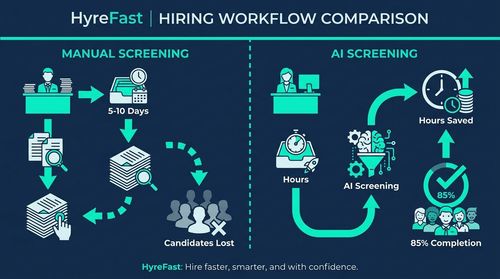
The contrast between AI screening and manual screening is stark across every dimension that matters to recruitment agencies. Here's a detailed comparison:
| Dimension | Manual Screening | AI Candidate Screening |
|---|---|---|
| Speed | 20–30 min per phone screen; weeks for high-volume roles | Hundreds of interviews conducted simultaneously; results in hours |
| Cost per Candidate | $15–$50 per screen (recruiter time + scheduling overhead) | $1–$5 per screen (automated, no human time required) |
| Consistency | Varies by recruiter mood, energy, time of day, and individual bias | Every candidate evaluated against identical rubric, every time |
| Bias | Susceptible to affinity bias, halo effect, and first-impression bias | Structured rubric reduces bias; auditable evaluation criteria |
| Scalability | Linear — more candidates require proportionally more recruiters | Near-infinite — same system screens 10 or 10,000 candidates |
| Candidate Experience | Scheduling delays, limited availability, inconsistent quality | On-demand interviews, immediate feedback, consistent experience |
| Documentation | Handwritten or typed notes; incomplete records | Full transcripts, scored rubrics, searchable archives |
| Time-to-Shortlist | 2–4 weeks for high-volume roles | 24–48 hours |
The table makes the case clearly, but the real-world impact is even more pronounced. Consider a recruitment agency handling a client request to fill 50 similar roles with 300 applicants each — 15,000 candidates total. With manual screening at 25 minutes per candidate, that's 6,250 recruiter-hours, or roughly 32 full-time recruiters working for a month. With automated screening, the same 15,000 candidates can be evaluated in under 48 hours with a single recruiter managing the process.
Benefits of Automated Screening
Dramatic Time Savings
The most immediate benefit is speed. The technology collapses the screening stage from weeks to hours, which means faster shortlists for clients, faster feedback for candidates, and faster placements for your agency. In competitive hiring markets, the agency that delivers a qualified shortlist first wins the mandate. AI candidate screening gives you that speed advantage consistently.
Improved Consistency and Quality
Human screening is inherently variable. Two recruiters evaluating the same candidate may reach different conclusions based on their individual perspectives, energy levels, or unconscious preferences. The automated approach applies the same evaluation criteria to every candidate, producing consistent, comparable results. This consistency also improves placement quality — when every candidate is assessed against the same rubric, the shortlist genuinely reflects the best-fit candidates rather than the ones who happened to get the most attentive recruiter.
Cost Efficiency at Scale
For high-volume recruitment agencies, screening costs scale linearly with candidate volume when done manually. AI screening changes this to a near-flat cost model. Whether you evaluate 100 or 10,000 candidates, the incremental cost per candidate is minimal. This makes the technology particularly valuable for agencies handling bulk hiring, seasonal recruitment spikes, or large-scale RPO contracts.
Better Candidate Experience
Candidates increasingly expect fast, responsive interactions during the hiring process. Manual screening often involves days of scheduling back-and-forth, limited interview slots, and long silences between stages. The automated alternative enables on-demand interviews — candidates complete their screening interview when it's convenient for them, receive faster feedback, and experience a more professional, streamlined process. This matters for employer brand and for candidate conversion rates.
Data-Driven Decisions
Every AI-conducted interview generates structured data — transcripts, scores, rubric evaluations, and comparative rankings. This data becomes a strategic asset. Agencies can analyze patterns across roles, identify which screening criteria correlate with successful placements, and continuously refine their evaluation rubrics. Manual screening produces scattered notes that are rarely searchable or analyzable at scale.
Common Concerns About AI Screening
Does the Technology Introduce Bias?
This is the most frequently raised concern, and it deserves an honest answer. Automated screening systems can introduce bias if they are trained on biased data or if their evaluation rubrics are poorly designed. However, a well-designed system is actually less biased than manual screening. Here's why: the AI evaluates every candidate against the same structured rubric, eliminating the affinity bias, halo effect, and first-impression bias that plague human interviews. The key is transparency — agencies should choose platforms that allow rubric customization, provide audit trails for every evaluation, and enable human review of scoring decisions. HyreFast publishes its evaluation criteria for each role and allows recruiters to override AI scores, ensuring human judgment remains in the loop.
What About Candidate Experience?
Some worry that candidates will feel dehumanized by an automated interview. In practice, the opposite is often true. Candidates appreciate the flexibility of on-demand interviews, the speed of feedback, and the consistency of the experience. The key is transparency — candidates should know upfront that they're completing an AI-conducted screening interview and understand how their responses will be evaluated. When framed as a fair, structured process that gets them a faster answer, candidate satisfaction with the experience is consistently high.
Is It Suitable for All Roles?
AI candidate screening works best for roles with well-defined competency requirements — which covers the majority of high-volume hiring. It is less ideal for highly creative or senior executive roles where evaluation criteria are more nuanced and subjective. For most agency recruitment workflows, where volume and consistency matter most, the technology is a strong fit. For specialized or senior searches, it can still serve as an initial filter while reserving human judgment for final evaluation.
How to Implement It in Your Agency
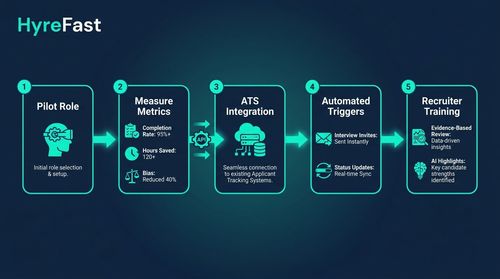
Implementing the technology is a straightforward process, but doing it well requires attention to a few key steps:
-
Identify high-volume roles first. Start with the roles where screening volume is highest and the competency criteria are most clearly defined. This is where you'll see the fastest, most measurable ROI.
-
Configure role-specific rubrics. Work with your hiring managers to define the evaluation criteria for each role. The quality of your output depends entirely on the quality of the rubric you configure. The platform allows you to create custom rubrics per role, ensuring the system evaluates candidates on what actually matters to your clients.
-
Pilot with a single client or role type. Run automated screening alongside your existing manual process for one role or client. Compare the AI's shortlist against your recruiter's shortlist. This parallel run builds confidence and surfaces any rubric adjustments needed.
-
Review and refine. After the pilot, analyze the results. Were the top-ranked candidates the ones your recruiters would have advanced? Were there false positives or false negatives? Adjust the rubric and re-run as needed.
-
Scale across the agency. Once you're confident in the results, roll the technology out across all high-volume roles. Train your recruiters to use the ranked reports as their starting point rather than conducting manual phone screens from scratch.
For agencies that want to offer screening as a standalone service to clients, an interview as a service model powered by automation can become a new revenue stream — delivering evaluated candidate shortlists to clients who handle their own sourcing.
Screening Tools Comparison
The market has matured significantly by 2026. Here's how the leading approaches compare:
| Platform Type | Core Capability | Best For | Pricing Model |
|---|---|---|---|
| HyreFast | AI-conducted interviews + scored ranked reports | Recruitment agencies doing high-volume screening | Per-candidate or subscription |
| Traditional ATS with AI filters | Resume keyword matching + basic scoring | Low-volume, resume-centric workflows | Per-seat SaaS |
| Video interview platforms | Recorded video responses + analysis | Roles where communication style is critical | Per-interview |
| Chatbot screening tools | Text-based Q&A + qualification filtering | High-volume, low-complexity roles | Per-conversation |
The platform distinguishes itself by combining the full screening workflow — interview conduction, response evaluation, scoring, and ranked reporting — into a single system designed specifically for recruitment agencies. Unlike resume filters that only parse keywords or video platforms that require candidate video setup, the AI interview screening approach conducts dynamic, adaptive interviews and delivers actionable ranked reports that recruiters can immediately use.
Frequently Asked Questions
What is AI candidate screening?
AI candidate screening is the use of artificial intelligence to automatically evaluate job applicants through AI-conducted interviews, response analysis, and scored rankings. It replaces manual phone screens and resume reviews with a consistent, scalable process that produces ranked candidate shortlists in hours rather than weeks.
How accurate is the technology compared to manual screening?
Studies and real-world deployments show that well-configured automated screening matches or exceeds human screening accuracy for most roles, particularly when evaluation criteria are clearly defined. The key advantage is consistency — the system applies the same rubric to every candidate, eliminating the variability inherent in human evaluation.
Will AI screening replace recruiters?
No. The technology automates the most repetitive part of the recruiter's workflow — initial screening — but human judgment remains essential for final evaluation, client relationship management, and placement decisions. Recruiters who adopt these tools become more productive, not obsolete. They focus on high-value activities like candidate closing and client strategy rather than spending 23 hours per hire on phone screens.
Is the process fair to candidates?
When implemented with transparent rubrics and auditable evaluation criteria, AI screening is fairer than manual screening because every candidate is evaluated against identical standards. The risk of bias arises from poorly designed rubrics or biased training data, which is why leading platforms allow full rubric customization and human review of all scores.
How much does it cost?
Costs vary by platform and volume, but automated screening typically costs $1–$5 per candidate, compared to $15–$50 per candidate for manual screening. For high-volume agencies, this translates to cost savings of 70–90% on the screening stage alone, with the added benefit of dramatically faster turnaround times.
Can it handle technical roles?
Yes. Modern platforms can conduct technical interviews with coding questions, scenario-based probes, and role-specific competency assessments. The system evaluates both the correctness of technical answers and the candidate's problem-solving approach, producing a more comprehensive assessment than a typical recruiter phone screen for technical roles.
Ready to Transform Your Screening Process?
AI candidate screening is no longer experimental — it's a proven approach that high-performing recruitment agencies are using to win more mandates, place candidates faster, and reduce screening costs by up to 90%. If your agency is still spending thousands of recruiter-hours on manual phone screens, it's time to see what the technology can do.
Book a demo with HyreFast today and discover how our platform can deliver ranked, scored candidate shortlists for your roles in under 48 hours.
Explore HyreFast Solutions
Interview as a Service
Outsource first-round interviews to AI.
AI Interview Bot
AI bot that conducts and evaluates interviews 24/7.
Video Interview Software
One-way async video interviews with AI scoring.
Phone Screening
Automate first-round phone calls with AI.
Interview Assessment
Structured assessments with AI scoring and reports.
AI Interview Platform
End-to-end platform for AI interviews and analytics.