
AI Interview Screening: Complete Guide for Recruiters (2026)
Complete guide to AI interview screening in 2026. Learn how AI-powered interview bots automate candidate screening, reduce bias, and cut time-to-hire by 80%.
Table of Contents

Introduction
A Gartner survey reports that 86% of HR leaders now incorporate some form of AI or automation into their talent acquisition processes.
Yet for every success story, there is a cautionary tale about biased algorithms or candidates feeling alienated by a faceless system.
If you are a hiring manager or founder trying to scale your team without sacrificing quality, understanding what AI interview screening actually does under the hood is no longer optional.
This article breaks down the technology, the evidence behind it, and the contexts where it genuinely helps versus where it introduces new risks.
What AI Interview Screening Is and How It Works
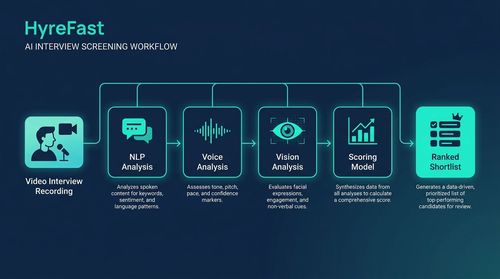
AI interview screening uses machine learning, natural language processing, and computer vision to evaluate candidates during the earliest stages of hiring. Unlike a human recruiter who watches a video and takes notes, an AI system extracts signals from language content, vocal tone, facial expressions, and speech patterns, then generates a structured score or ranking.
The process typically begins with an asynchronous video interview where candidates record answers to pre-set questions. The AI then applies multiple analytical layers:
- Natural language processing transcribes responses and evaluates them for relevance, keyword alignment, sentiment, and coherence. Advanced systems go beyond simple keyword matching to understand semantic meaning, addressing the limitations of older ATS filters that research shows create artificial barriers to fair screening.
- Voice and speech analysis examines tone, speaking pace, hesitation patterns, and filler word frequency. Some vendors claim these correlate with confidence or leadership presence, though the academic literature finds effect sizes are small and highly context-dependent.
- Computer vision analyzes facial expressions, eye contact, and posture. The scientific community has raised serious concerns about this approach, with research in Psychological Science in the Public Interest finding limited evidence that facial expressions reliably indicate personality or emotional states in real-world settings.
- Scoring models aggregate all signals into a composite score, often with breakdowns by competency dimension such as problem-solving, communication, and cultural alignment. The arXiv paper on a multi-agent LLM framework for resume screening demonstrates how modern systems use retrieval-augmented generation to enhance contextual relevance of candidate assessments.
The technology stack includes cloud infrastructure for video storage, transcription services, NLP pipelines, speech processing modules, and ensemble models. Most enterprise platforms integrate with applicant tracking systems and offer some form of explainability, though transparency varies widely across vendors.
The Evidence: Does AI Screening Actually Improve Hiring Outcomes?

A large-scale study randomly assigned 37,000 applicants to either traditional or AI-assisted recruitment pipelines. The AI-assisted group had a 20 percentage point higher pass rate at final interviews (54% versus 34%), suggesting that AI screening can surface stronger candidates more effectively than manual review alone.
This is not a small effect; it represents a meaningful improvement in the quality of the candidate pool reaching later stages.
However, the same study noted that the quality of the underlying model and the representativeness of training data were critical moderating factors.
Another arXiv paper formalises how keyword-based screening creates artificial frictional unemployment through semantic misinterpretation of candidate competencies.
In other words, poorly designed AI systems can filter out excellent candidates simply because they use different language to describe the same skills.
The key takeaway is that AI screening works when it is built on well-validated, bias-aware models and deployed with clear evaluation criteria. Without these foundations, the speed gains come at the cost of accuracy and fairness.
When to Use AI Interview Screening
AI interview screening is not a universal solution. It performs best in specific contexts where speed, consistency, and scalability matter most.
- High-volume recruitment: When a single role attracts hundreds or thousands of applications, human-only screening becomes a bottleneck. AI can process and score every submission consistently, surfacing top candidates within hours. This is particularly valuable for graduate recruitment drives, retail seasonal hiring, and entry-level corporate programmes.
- Remote and distributed hiring: Organisations that recruit across geographies benefit from asynchronous AI screening. Candidates complete recorded interviews on their own schedule, eliminating scheduling friction and reducing time-to-decision significantly.
- Structured competency assessment for technical roles: For roles requiring specific technical knowledge, AI systems can be configured to score responses against domain-specific rubrics, ensuring every candidate is evaluated on identical questions and criteria.
- Reducing unconscious bias in initial screening: When designed carefully, AI can standardise evaluation criteria across all applicants, reducing the impact of name recognition, educational pedigree bias, or demographic cues. However, this benefit depends heavily on whether the model was trained on bias-aware datasets and is regularly audited.
AI screening is less appropriate for executive-level positions where personal relationships and nuanced experience matter more than keyword matching, for creative roles where traditional metrics may not capture a candidate's full potential, and for candidates with disabilities where video or voice-based analysis may inadvertently disadvantage them.
The Bias Problem: Why Human Oversight Is Non-Negotiable
A resume-screening experiment with 528 participants revealed that humans adopt AI racial biases up to 90% of the time when collaborating with biased AI systems. This finding from an arXiv paper underscores a critical risk: AI does not eliminate bias; it can amplify it if the training data reflects historical discrimination.
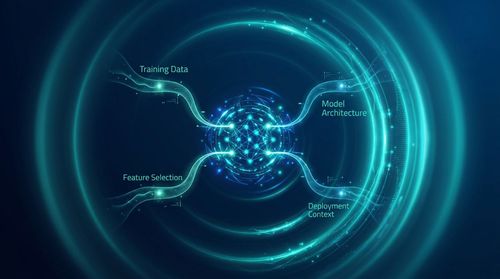
Bias can enter at multiple points: through the training labels, the feature selection, the model architecture, and the deployment context. For example, if past hiring favoured candidates from certain universities or demographic backgrounds, the model may learn to treat those signals as predictive when they are merely reflective of historical exclusion.
The systematic review on fairness in AI-driven recruitment categorises these biases and outlines mitigation techniques such as adversarial debiasing and counterfactual fairness.
Regulatory frameworks are catching up. The New York City Automated Employment Decision Tools law requires annual bias audits of AI tools used in hiring.
The EU AI Act classifies employment-related AI systems as high-risk, requiring transparency, human oversight, and robustness. Organisations deploying AI interview screening must stay current with these requirements and ensure their vendors provide the documentation and audit results needed for compliance.
Best Practices for Responsible Implementation
If you decide to adopt AI interview screening, follow these practices to maximise benefits while minimising risk.
- Define the problem before selecting a tool. Is the issue volume, quality, speed, or bias? Each points to different solutions.
- Evaluate vendors rigorously. Request evidence of validation studies, ideally third-party audits, that demonstrate the tool predicts job performance for your specific role type. Ask about training data demographics and bias testing methodology.
- Pilot before scaling. Run the AI screening process alongside your existing human screening for a defined period. Compare outcomes, track adverse impact, and collect recruiter and candidate feedback.
- Maintain human oversight throughout. Every AI-generated score should be reviewed by a qualified human before a candidate is advanced or rejected. AI should inform judgment, not replace it.
- Monitor continuously. Track demographic parity in candidate pools and hiring outcomes quarterly. If disparities emerge, investigate the source and address it.
- Communicate transparently with candidates. Inform them that AI will analyse their responses, explain what the system evaluates, and provide a mechanism to request human review or accommodation.
Conclusions
- AI interview screening uses NLP, voice analysis, and computer vision to evaluate candidates automatically, generating scores that inform hiring decisions.
- Large-scale studies show AI-assisted pipelines can improve final interview pass rates by 20 percentage points, but only when models are well-validated and bias-aware.
- The technology is most effective for high-volume, remote, and structured competency screening; it is less suitable for executive roles, creative positions, or candidates with disabilities.
- Responsible deployment requires rigorous vendor evaluation, continuous bias auditing, human oversight, and transparent communication with candidates.
Future Directions
- Generative AI is enabling more dynamic, conversational screening that adapts follow-up questions based on candidate answers, moving beyond rigid scripted formats.
- Research into semantic matching and large language models will reduce false negatives from unconventional backgrounds, addressing the algorithmic friction problem.
- Regulatory frameworks such as the EU AI Act and NYC bias audit law will mandate greater transparency and accountability, pushing vendors toward explainable models.
- Integration with broader talent intelligence platforms will extend AI's role beyond screening into predictive analytics for candidate quality, retention risk, and cultural fit.
Book a demo
Want to identify strong candidates before interviews without relying on resumes?
Schedule a walkthrough: Book Demo
Explore HyreFast Solutions
- Interview as a Service — Outsource your first-round interviews to AI
- AI Interview Bot — Deploy an AI bot that conducts and evaluates interviews 24/7
- AI Interview Platform — End-to-end platform for AI-powered interviews
- Video Interview Software — One-way async video interviews with AI scoring
- Phone Screening — Automate first-round phone calls with AI
- Interview Assessment — Structured assessments with AI scoring
Explore HyreFast Solutions
Interview as a Service
Outsource first-round interviews to AI.
AI Interview Bot
AI bot that conducts and evaluates interviews 24/7.
Video Interview Software
One-way async video interviews with AI scoring.
Phone Screening
Automate first-round phone calls with AI.
Interview Assessment
Structured assessments with AI scoring and reports.
AI Interview Platform
End-to-end platform for AI interviews and analytics.