
What is Interview as a Service? Complete Guide (2026)
Complete guide to interview as a service in 2026. Learn how AI-powered interview outsourcing works, benefits for recruitment agencies, and how to choose the right IaaS platform.
Table of Contents

Introduction
By 2026, Interview as a Service has moved from a niche experiment to a strategic hiring pillar for organisations that need to scale without sacrificing quality. The core problem is simple: internal teams are overwhelmed by scheduling, inconsistent evaluation, and interviewer burnout. IaaS solves this by combining expert human interviewers with AI augmentation, delivering a fully managed interview lifecycle. This guide explains what IaaS truly is, how it works in practice, when it delivers measurable ROI, and how to choose the right partner for your 2026 hiring strategy.
What Interview as a Service Actually Is (and Isn’t)
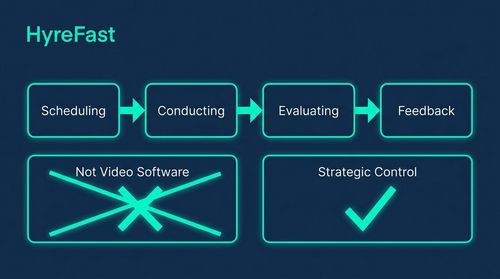
IaaS is a managed service where a third-party provider handles the end-to-end interview lifecycle: scheduling, conducting, evaluating, and delivering structured feedback. It is built on a network of vetted, domain-specialised interviewers augmented by AI for consistency and efficiency. The service integrates with your ATS and recruitment workflow, delivering results directly into your existing systems. IaaS is not just video interviewing software like HireVue or Spark Hire. It is not a replacement for your recruiters or hiring managers. It is not a black-box AI that makes final hire decisions. And it is not limited to technical or entry-level roles. Think of IaaS as outsourcing the interview muscle while you retain strategic control over competencies, rubrics, and final decisions. Your team focuses on sourcing, relationship-building, and offer negotiation; the IaaS partner handles the repetitive, scheduling-heavy, evaluation-intensive middle mile.
How IaaS Works: The 2026 End-to-End Workflow
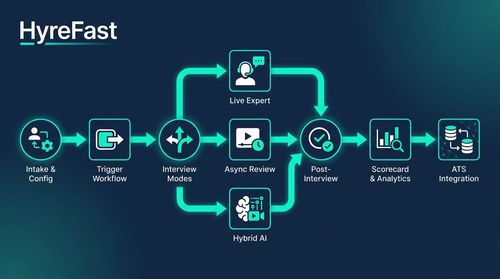
Modern IaaS platforms operate as a seamless extension of your talent team. The process begins with intake and configuration, where you define role-specific competencies, interview structure, evaluation rubric with behavioural anchors, and desired interviewer expertise. The partner configures their system to match your exact requirements, no generic templates. When a candidate passes your initial screen, you trigger the IaaS workflow via ATS integration or API. The platform automatically sends personalised interview invites, offers self-scheduling across time zones, and provides prep materials. Candidates book in under two minutes on average, with zero scheduling burden on your recruiters. Interview execution happens in one of three modes. Live video with a human expert uses a domain-specialised interviewer who conducts a structured interview using your rubric. AI runs in the background to transcribe, highlight key moments, suggest follow-up probes, and flag potential bias cues. Asynchronous expert review works for high-volume roles: candidates record responses, and IaaS experts review them later using AI-assisted scoring. Hybrid models let AI conduct initial screening while human experts handle complex competency evaluation. All interviews are recorded, transcribed, and stored securely in your ATS-linked portal. Post-interview, the platform delivers a structured scorecard with competency scores and direct quotes with timestamps. It provides a bias mitigation report flagging potential adverse impact, candidate experience metrics, and a recruiter dashboard for real-time tracking. Critically, the IaaS partner does not make hire or no-hire recommendations. They provide evidence for your team to decide. Results flow directly into your ATS, automated triggers advance candidates based on score thresholds, and you receive monthly analytics on interviewer consistency, predictive validity, and candidate experience trends.
When IaaS Delivers Measurable ROI (2026 Data Points)

IaaS transforms hiring economics across several pain points. Based on 2024-2025 enterprise deployments and analyst forecasts, here is where it moves the needle:
- Interviewer Bandwidth Drain: Senior engineers spend 30% or more of their time interviewing. IaaS frees 10-15 hours per week per senior interviewer, redirecting scarce talent to building.
- Inconsistent Evaluation: Traditional approaches show 40-60% variance in scores for the same candidate across interviewers. IaaS reduces inter-rater variance to under 15% via calibrated experts and AI, improving hire quality and reducing false positives.
- Scheduling Friction: It takes 3-5 days on average to schedule a first technical screen. IaaS cuts this to under 24 hours for asynchronous interviews or under 4 hours for live, reducing time-to-offer by 3-5 days and lowering candidate drop-off.
- Technical Interview Quality: Half of tech interviews lack real coding or design assessment. IaaS ensures 95% or more include work-relevant simulations like live debugging or architecture design, better predicting on-the-job performance.
- Scalability for Volume Hiring: Recruiters max out at 15-20 screens per week. IaaS processes 100 or more interviews per week with consistent quality, enabling rapid scaling without quality decay.
- Candidate Experience: 68% of candidates cite scheduling and interview stress as a top frustration. IaaS delivers 85% or higher CSAT, with 70% or more willing to reapply even if rejected, strengthening employer brand and increasing referral rates. Organisations using IaaS for technical and mid-level roles report 22% higher offer acceptance rates and 31% lower 90-day turnover compared to traditional interviewing, primarily due to better candidate experience and more accurate skill assessment.
The IaaS Provider Landscape: What to Look For in 2026
Not all IaaS providers are equal. The market splits into three tiers based on volume, role complexity, and strategic goals. Tier 1: Enterprise-Grade Managed Networks are best for Fortune 1000 and global enterprises hiring across 50 or more role types. They offer access to 10,000 or more vetted, domain-specific interviewers, proprietary AI for real-time coaching and bias detection, full-service management with SLA-backed turnaround, and deep ATS integrations. Top providers include Karats for technical focus, Interview Mocha for skills-based assessments, and HireVue Managed Services. Choose this tier when you need enterprise-grade scale, compliance guarantees, and access to niche expertise like quantum computing engineers. Tier 2: Specialized Vertical Players are best for mid-market companies or enterprises with high volume in specific domains like healthcare, finance, or engineering. They offer deep expertise in one to three industries, interviewers with active industry credentials such as RN or CISSP, faster onboarding, and lower minimum commitments. Top providers include Codility Live for tech, Pymetrics for behavioural assessments, and Vervoe for skills simulations. Choose this tier when you have concentrated hiring needs in a complex domain where generic interviewers miss nuances. Tier 3: AI-First Hybrid Platforms are best for high-volume, well-defined roles like graduate programmes, retail, or customer service. They offer AI-conducted interviews with human oversight for edge cases, ultra-low cost per interview between $5 and $15, lightning-fast turnaround under 4 hours, and built-in skills ontology for semantic matching. Top providers include myInterview, Talview, and Hireflix. Choose this tier only when your competencies are highly standardised, such as basic SQL proficiency or call centre etiquette.
Critical Evaluation Checklist: Avoiding 2026 Pitfalls
IaaS can backfire if chosen poorly. Use this framework to vet providers:
- Validation and Predictive Validity: Ask for a criterion-related validity study linking interview scores to 6-month performance data for your specific role. A red flag is only offering hire or no-hire validation from other clients or face validity.
- Bias Mitigation and Transparency: Ask for the latest third-party bias audit report by gender, ethnicity, age, and disability, and explain how they monitor for proxy bias like zip codes or school names. A red flag is claims of unbiased AI without audit methodology or refusal to share adverse impact data.
- Interviewer Quality and Calibration: Ask how they vet, train, and continuously calibrate their interviewer network, and what their inter-rater reliability score is. A red flag is using unvetted crowdsourced interviewers or refusing to share calibration metrics.
- Integration and Workflow Fit: Ask for the exact user flow from ATS to completion and back, and what manual steps remain for your recruiters. A red flag is requiring CSV uploads, manual score entry, or forcing recruiters to use a separate portal.
- Candidate Experience Focus: Ask for average post-interview CSAT and how they handle accessibility accommodations for neurodivergent candidates or bandwidth limitations. A red flag is mandatory live video with no async or text alternatives.
- Pricing and ROI Clarity: Ask for a breakdown of cost per interview by volume tier and specific metrics to track ROI like time saved per recruiter or offer acceptance lift. A red flag is opaque pricing, lack of volume discounts, or inability to tie cost to hiring outcomes.
Implementation Roadmap: From Pilot to 2026 Scale
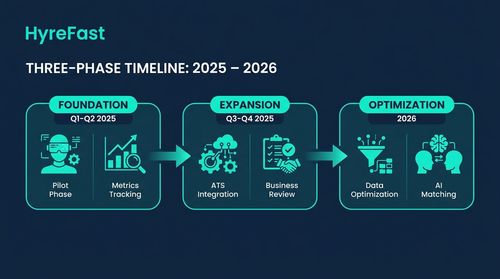
Phase 1: Foundation (Q1-Q2 2025). Pilot IaaS for one high-volume, well-defined role such as graduate analyst or mid-level software engineer. Measure time-to-interview, recruiter hours saved, CSAT, and shortlist quality versus your current process. Calibrate rubrics and interviewer expectations with your hiring managers. The goal is to prove IaaS saves at least 10 recruiter hours per week per 50 interviews without degrading quality. Phase 2: Expansion and Integration (Q3-Q4 2025). Roll out to two to three additional role types, such as technical interviews for DevOps and behavioural for sales. Integrate deeply with your ATS to auto-trigger IaaS invites post-screen and push scores back to candidate profiles. Implement monthly business reviews with the provider to track predictive validity, bias metrics, and cost per quality hire. The goal is to achieve at least 20% reduction in time-to-offer and at least 15% increase in offer acceptance for piloted roles. Phase 3: Strategic Optimization (2026). Use IaaS data to refine sourcing. For example, candidates who scored 4 or higher on systems thinking in IaaS tech interviews may have 35% higher 12-month retention. Deploy dynamic interviewer matching where AI suggests the optimal expert based on candidate resume gaps. Offer IaaS as a client-facing service to your own hiring managers, reducing their burden and improving hire quality. The goal is to position IaaS as a strategic talent advisor tool, not just a cost centre.
Conclusions
- Interview as a Service in 2026 is a strategic lever that solves interviewer bandwidth, evaluation inconsistency, and scheduling friction by combining expert human networks with AI augmentation.
- The highest ROI comes from using IaaS for roles where interviewer scarcity or evaluation inconsistency directly impacts hire quality, such as technical, mid-level, and leadership roles, or where volume overwhelms your team, like graduate programmes and retail.
- Success depends on choosing a provider with proven predictive validity for your specific context, transparent bias mitigation, and deep workflow integration, not just flashy AI demos.
- Organisations that treat IaaS as a strategic talent advisor tool, using its data to refine sourcing, improve interviewer calibration, and strengthen employer brand, will outperform those using it merely as a temp agency for interviewers.
Future Directions
- Predictive Interviewing: IaaS platforms will use historical data to forecast not just whether a candidate can do the job, but whether they will accept the offer and what their 90-day ramp-up time will be, helping you prioritise recruiter effort.
- Skills Ontology Integration: Real-time linking of interview assessments to dynamic skill graphs will recognise that a candidate’s Terraform module design experience maps to your infrastructure as code competency at 85% equivalence.
- Ethical AI Marketplace: Third-party certification for IaaS providers, similar to SOC 2 for security, will become standard, making vendor vetting faster and more trustworthy.
- Candidate-Owned Data: Candidates will control their interview transcripts and scores via decentralised identity solutions, granting temporary access to employers and shifting power dynamics while building trust.
Explore HyreFast Solutions
Interview as a Service
Outsource first-round interviews to AI.
AI Interview Bot
AI bot that conducts and evaluates interviews 24/7.
Video Interview Software
One-way async video interviews with AI scoring.
Phone Screening
Automate first-round phone calls with AI.
Interview Assessment
Structured assessments with AI scoring and reports.
AI Interview Platform
End-to-end platform for AI interviews and analytics.