
Recruitment Automation for Agencies: Full Playbook
How recruitment agencies use automation to streamline candidate screening, client communication, and placement workflows. A complete guide to recruitment automation tools.
Table of Contents

Introduction
AI interview screening is reshaping recruitment, moving from a niche experiment to a mainstream tool that agencies can no longer ignore. The potential is huge-from speeding up applicant review to spotting early red flags-but the real value lies in using it intelligently, not just adopting it blindly.
For agencies in 2026, the challenge is to balance speed with fairness, automation with human judgment, and cost savings with candidate trust. This guide covers what AI screening is, how it works, when to use it, and the five pillars that will define agency success in the coming year.
What Is AI Interview Screening?
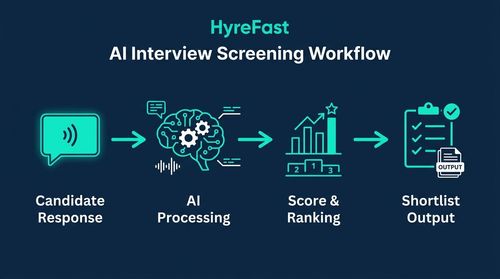
AI interview screening uses natural language processing, speech analysis, and sometimes computer vision to evaluate candidates automatically during the earliest stages of hiring.
Instead of a recruiter manually reviewing resumes or watching live video, the AI extracts signals from a candidate’s recorded or live responses-what they say, how they say it, and non-verbal cues-and produces a score, ranking, or shortlist.
It is not a replacement for human judgment but a tool to accelerate and standardise early-stage evaluation, especially for high-volume or remote hiring.
How It Works: The Core Technology Stack
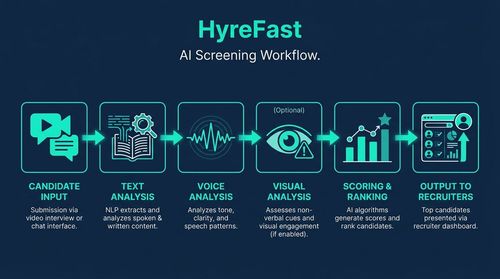
The workflow typically follows six steps, each powered by a specific AI technology:
- Candidate input: The candidate records answers to pre-set questions (one-way video) or engages in a brief conversational AI phone or chat screen. This captures video, audio, or text logs.
- Transcription and text analysis: Automatic speech recognition converts audio to text. NLP models evaluate relevance, keyword and semantic match, sentiment, coherence, and competency-specific language.
- Voice and speech analysis: The system examines tone, pace, pitch, hesitation, filler-word frequency, and energy levels to infer confidence, enthusiasm, or stress. This uses prosody modelling and paralinguistic feature extractors.
- Visual or facial analysis (optional): Some systems analyse facial expressions, eye contact, and posture. This area is scientifically debated and raises privacy and bias concerns, so many agencies are moving away from it.
- Scoring and ranking: Signals from the above modules are combined into a competency score or fit rating, often broken down by dimensions like communication, problem-solving, and cultural alignment. Explainable AI techniques like SHAP or LIME provide transparency.
- Output to recruiters: Recruiters receive a ranked list, a dashboard with evidence highlights (transcript snippets, key moments), and recommendations to move forward or reject. This integrates with the ATS or CRM via APIs.
The key insight is that AI screening depends on four basic technologies: ASR, NLP, voice prosody, and optionally computer vision. Conversational AI is increasingly used for first-round phone screens, making the process more natural for candidates.
When to Use AI Screening for Maximum Impact
AI screening delivers the most value in specific contexts, not as a blanket solution for every role.
- High-volume recruiting: For graduate programmes, retail, or seasonal hiring, AI processes thousands of applications consistently and fast, surfacing top candidates in hours rather than weeks.
- Remote or distributed hiring: Asynchronous interviews eliminate scheduling friction. Candidates record at their convenience, speeding up time-to-decision.
- Early-stage technical or competency screening: For roles where specific knowledge or communication skills can be objectively scored-like coding or customer-service scenarios-AI ensures every candidate is asked the same questions and evaluated on the same rubric.
- Reducing unconscious bias in initial screening: When the model is trained on bias-aware data and audited, AI applies identical criteria to all applicants, limiting the influence of name, school, or demographic cues in the first pass.
- Senior or specialist roles (used judiciously): AI can assess communication, strategic thinking, and domain-specific knowledge via structured questions, serving as a supplemental filter before deep human interviews.
When not to rely solely on AI screening: executive-level hires where nuanced relationship-building matters more than scripted responses, highly creative roles where portfolio review and informal conversation are better predictors, and candidates with disabilities that may affect speech or video interaction unless the tool offers accessible alternatives.
Predictive Talent Intelligence: Moving Beyond Keywords

Legacy Boolean sourcing is obsolete. Leading agencies use multimodal AI that infers skills from projects, GitHub contributions, publications, and micro-credentials-not just job titles. Cultural fit is assessed through linguistic analysis of public communications, while career trajectory modelling identifies stealth candidates open to specific moves.
Audit your sourcing stack for semantic understanding: does it recognise "built scalable ML pipelines" as equivalent to "led TensorFlow deployment"? Prioritise vendors offering explainable AI matching, and train recruiters to interpret match scores as starting points, not final verdicts.
End-to-End Workflow Orchestration: Eliminating Siloed Handoffs
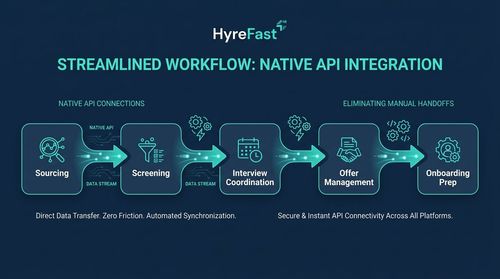
Agencies win by connecting sourcing, screening, interview coordination, offer management, and onboarding prep in a single intelligent flow. Manual handoffs between tools create delays, errors, and lost context-for example, recruiter notes from screening not flowing to interviewers.
Map your current tech stack to identify re-entry points and context loss. Prioritise platforms with native API ecosystems or built-in workflow builders, and implement workflow health dashboards tracking time-between-stages, drop-off points, and recruiter touchpoints per hire.
Ethical AI as a Market Differentiator
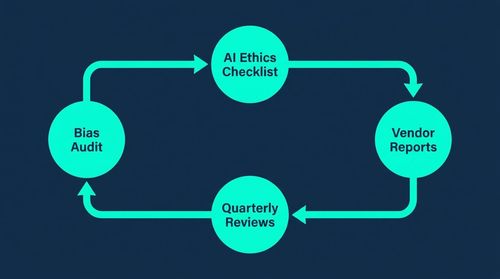
Bias audits are no longer just compliance-they are a sales advantage. Clients increasingly demand AI impact reports before signing contracts. Build an internal AI ethics checklist: can the tool explain why it rejected a candidate?
Can you demonstrate consistent scoring across demographic groups for similar profiles? Document your agency’s AI use policy for clients-transparency builds trust.
Require vendors to provide bias audit reports aligned with standards like NYC Local Law 144 or the EU AI Act, and establish quarterly internal bias reviews using disparate impact analysis on your own placement data.
Hyper-Personalised Candidate Experience at Scale
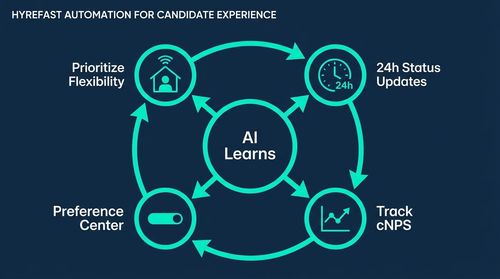
Automation is not about removing humanity-it is about freeing recruiters to deliver high-touch moments where they matter most. Deploy conversational AI that learns from past interactions, such as prioritising flexibility in future communications if a candidate asks about remote work twice.
Use automation to guarantee 24-hour status updates, eliminating the "black hole" period after application or interview. Track experience metrics like Candidate Net Promoter Score per stage, not just overall, and implement preference centres where candidates control communication frequency and channel.
Data-Driven Client Consulting: From Order-Taker to Talent Advisor

Clients do not just want fills they want strategic talent insights. Automation provides the data; agencies provide the interpretation. Translate metrics into client stories: "Your time-to-hire is 22 days versus industry 35-here is where we gained speed" or "Candidates from source Y have 40% higher 12-month retention; let us double down."
Train recruiters to read automation dashboards and connect metrics to business outcomes. Offer automation health checks as a value-added service for clients using legacy systems, and develop predictive models to forecast hiring needs based on historical placement data and business cycles.
Implementation Roadmap and Critical Pitfalls
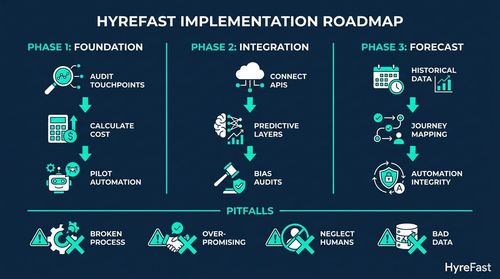
Start with a foundation phase: audit all manual touchpoints, calculate cost-per-touch, and pilot end-to-end automation on one high-volume client role. Measure time saved, shortlist quality, and candidate feedback. Upskill recruiters on interpreting AI outputs and ethical oversight not just tool buttons.
In the integration phase, connect core ATS/CRM with sourcing, screening, and scheduling tools via APIs, add predictive layers for offer acceptance likelihood and ramp-up time, and establish monthly AI bias audits. By 2026, use historical placement data to forecast client hiring needs, deploy dynamic candidate journey mapping, and market your agency’s "automation with integrity" approach.
Avoid these common pitfalls: automating a broken process (fix workflow design first), over-promising AI capabilities (be transparent about what your tools actually do), neglecting the human element (automation handles repetition; humans build relationships and close deals), and ignoring data hygiene (garbage in, gospel out-invest in cleaning candidate and client data).
Conclusions
- AI interview screening is a structured technology stack that accelerates and standardises early-stage evaluation, but it is not a replacement for human judgment.
- The most effective agencies use AI to eliminate administrative drag, uncover deeper talent intelligence, and deliver experiences that turn candidates into brand advocates for their clients.
- Academic research confirms that well-implemented AI screening improves final-interview pass rates by up to 20 percentage points, but only when models are trained on job performance data and audited for bias.
- Agencies that view automation as a strategic investment in their advisory role-not just a cost centre-will command premium pricing and win long-term partnerships.
Future Directions
- Semantic matching 2.0: Advances in LLMs and knowledge graphs will further reduce false negatives from non-traditional backgrounds by understanding skill equivalence and transferability.
- Predictive talent intelligence: Integration of anonymised performance data from past placements will enable agencies to forecast not just who to hire, but who will succeed fastest in specific client environments.
- Explainable AI standardisation: As regulations tighten, vendors offering native, audit-ready XAI showing feature importance and counterfactual explanations will become preferred partners.
- Ethical AI marketplace: Third-party bias auditing and certification services will simplify vendor evaluation for agencies, similar to SOC 2 for security.
Book a demo
[Want to identify strong candidates before interviews without relying on resumes?
Schedule a walkthrough: Book Demo
Explore HyreFast Solutions
- Interview as a Service — Outsource your first-round interviews to AI
- AI Interview Bot — Deploy an AI bot that conducts and evaluates interviews 24/7
- AI Interview Platform — End-to-end platform for AI-powered interviews
- Video Interview Software — One-way async video interviews with AI scoring
- Phone Screening — Automate first-round phone calls with AI
- Interview Assessment — Structured assessments with AI scoring
Explore HyreFast Solutions
Interview as a Service
Outsource first-round interviews to AI.
AI Interview Bot
AI bot that conducts and evaluates interviews 24/7.
Video Interview Software
One-way async video interviews with AI scoring.
Phone Screening
Automate first-round phone calls with AI.
Interview Assessment
Structured assessments with AI scoring and reports.
AI Interview Platform
End-to-end platform for AI interviews and analytics.