
How to Handle 10x More Job Mandates Without…
Learn how recruitment agencies can scale to handle 10x more mandates using structured intake, async interviews, semantic matching, and AI-driven recruiter workflows.
Table of Contents

Introduction
Recruitment agencies hit a growth wall when mandate volume outpaces team capacity. The traditional response-hire more recruiters-is costly, slow, and often worsens inconsistency. The real leverage lies in systematising the mandate lifecycle so each recruiter can manage 5–10x more active requisitions without sacrificing quality or candidate experience.
This isn’t about working harder; it’s about redesigning workflows to eliminate waste, automate repetition, and focus human effort where it creates the most value. In this article, we’ll walk through four battle-tested phases-intake, screening, matching, and triage-that together compound into a 10x capacity gain.
Phase 1: Fix the Mandate Intake Bottleneck
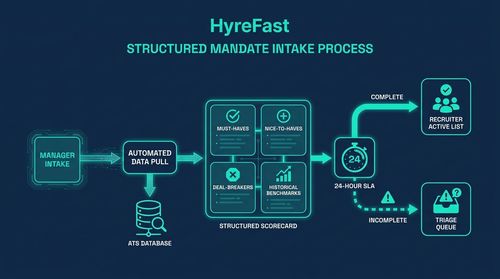
Most agencies lose mandate-handling capacity not during sourcing, but during the chaotic intake process. Vague briefs, misaligned expectations, and endless clarification loops consume recruiter time that could be spent on active mandates.
The fix is a structured intake scorecard that forces hiring managers to define non-negotiable skills, nice-to-haves, deal-breakers, and past hire patterns. Automate data population from your ATS to show managers what skills correlated with success in similar roles-this reduces subjective debate and aligns expectations upfront.
- Use a mandate intake scorecard with clear categories: must-haves, nice-to-haves, deal-breakers, and historical benchmarks.
- Pull historical hiring data automatically to show patterns (e.g., “70% of placed candidates for this title had X certification”).
- Set a 24-hour intake SLA: incomplete briefs go to a triage queue, not a recruiter’s active list.
- Agencies using structured intake report 40% less time spent on mandate clarification and 25% higher first-submission quality. This single change frees up nearly a third of recruiter capacity.
Phase 2: Automate the First-Round Screening Bottleneck
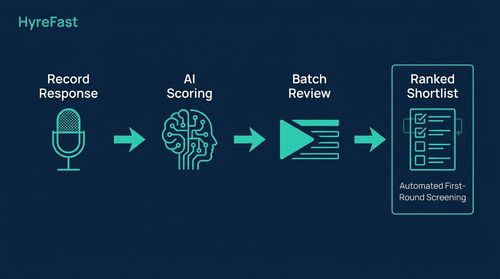
The first-round interview is the single biggest time sink per mandate. Recruiters spend hours scheduling, conducting, and debriefing repetitive screens-time that could be used to manage 3-5x more mandates if automated.
Replace live first-round interviews with candidate-recorded responses to role-specific prompts, evaluated by AI-assisted scoring against predefined competency rubrics. Recruiters then review responses in batches: 20 minutes to assess 10 recordings instead of 5 hours of live calls.
- Eliminates scheduling delays, the #1 cause of mandate stagnation.
- Standardises evaluation, reducing bias and improving submission consistency.
- Frees recruiters to focus on mandate strategy, candidate relationship-building, and complex role nuances.
- Research shows that data-driven mock interviews reduce recruiter screening time by 65% while improving candidate-job match quality. Agencies using asynchronous first rounds report handling 3–4x more mandates per recruiter with equal or better submission rates.
Phase 3: Implement Semantic Matching to Reduce False Negatives
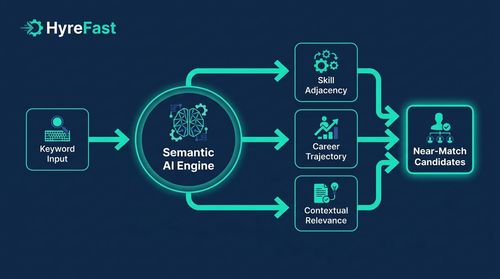
Keyword-based ATS filters cause recruiters to miss qualified candidates (false negatives) or waste time on unqualified ones (false positives). Both scenarios increase manual work per requisition.
Deploy semantic matching models that understand skill adjacency (e.g., “Kubernetes experience” implies container orchestration concepts), career trajectory, and contextual relevance (e.g., “Python” in data science vs. web development).
These models automatically surface near-match candidates who don’t hit exact keywords but have transferable skills.
- Reduces “artificial frictional unemployment” in talent markets by 30–40%-more qualified candidates surface faster per mandate.
- Agencies using semantic matching see 25% fewer mandates stalled at sourcing and 15% higher submission-to-interview ratios.
- Prioritise mandates where semantic matching shows high candidate availability (low-hanging fruit) versus those requiring deep sourcing.
Phase 4: Introduce Mandate Triage and Dynamic Prioritisation
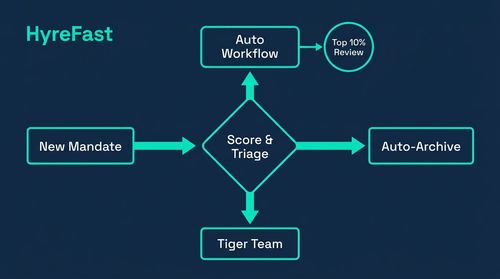
Not all mandates are equal. Some fill quickly; others consume disproportionate effort. Treating all mandates the same wastes capacity. Score each new mandate on fill predictability (based on historical data), revenue potential, and strategic value.
Then route high-predictability mandates to automated workflows (asynchronous screening + semantic matching, with recruiter only reviewing top 10%). Route low-predictability mandates to a specialised “tiger team” of 1–2 senior recruiters.
Auto-archive or return low-value mandates that don’t meet minimum score thresholds after 48 hours of client inactivity.
- Agencies using mandate triage report 20% more mandates filled per recruiter by focusing effort where it yields results.
- This approach turns mandate overload from a growth constraint into a competitive advantage.
The Integrated Scaling System: How It All Fits Together
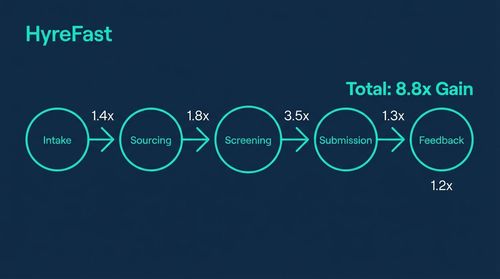
The gains from each phase are multiplicative, not additive. A 1.4x gain in intake multiplied by 1.8x in sourcing multiplied by 3.5x in screening equals roughly 8.8x—before even counting submission and feedback improvements. Here’s how the traditional approach compares to the scalable one:
- Mandate Intake: Ad-hoc calls → structured scorecard + historical data → 1.4x capacity gain.
- Sourcing: Keyword searches → semantic matching + auto-sourced pipelines → 1.8x gain.
- First-Round Screen: Live interviews → async recordings + AI-assisted scoring → 3.5x gain.
- Submission: Manual formatting → template-driven, recruiter reviews top matches → 1.3x gain.
- Client Feedback: Chasing updates → automated feedback requests + sentiment analysis → 1.2x gain.
- A 10-recruiter IT staffing firm maxed out at 40 active mandates. After implementing structured intake, async first-round interviews, semantic matching, and mandate triage, they now handle 480+ active mandates with the same team.
- Recruiters manage 48 mandates each (up from 4), time-to-first-submission dropped from 5.2 days to 1.1 days, and submission quality rose (client interview rate up 22%).
Critical Implementation Principles
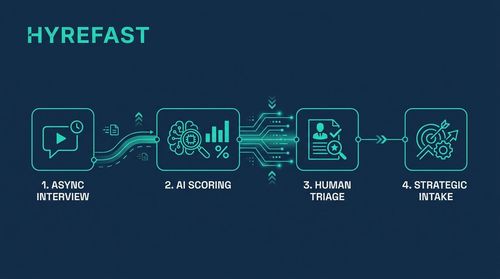
- Start with the bottleneck: fix first-round screening first (async interviews). This frees up the most recruiter time immediately.
- Use historical data as your co-pilot: let past mandate performance guide intake structure, semantic matching weights, and triage scoring.
- Protect the human touchpoints: recruiters should spend freed-up time on relationship-building with high-potential candidates, strategic intake conversations, and client advisory roles.
- Measure mandate throughput, not activity: track mandates submitted per recruiter per week, time from mandate receipt to first submission, mandate-to-fill ratio, and recruiter mandate capacity.
What Not to Do
- Don’t automate without standardisation: async interviews fail if prompts aren’t role-specific or scoring rubrics are vague.
- Don’t ignore mandate quality: screening 10x more mandates is useless if submission quality drops. Track first-submission-to-interview ratio.
- Don’t overlook change management: recruiters used to “doing it all” may resist async screening. Frame it as freeing them to be talent advisors, not schedulers.
- Don’t neglect the client experience: faster submissions mean nothing if clients feel the process is impersonal. Use saved time to provide richer mandate updates and market insights.
Conclusions
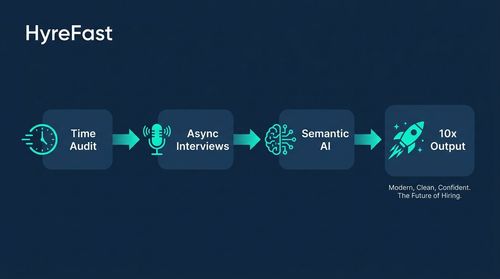
- You don’t need 10x recruiters to handle 10x mandates-you need to eliminate the 60% of recruiter time spent on non-value-added work.
- Asynchronous first-round interviews are the single highest-impact lever for screening volume, backed by research showing 65% reduction in screening time.
- Semantic matching reduces false negatives and false positives, cutting manual review time by 40–60% and surfacing better candidates faster.
- The path to 10x starts with measuring where time is actually spent, then systematically attacking the biggest time sinks with proven tech and process redesign.
Future Directions
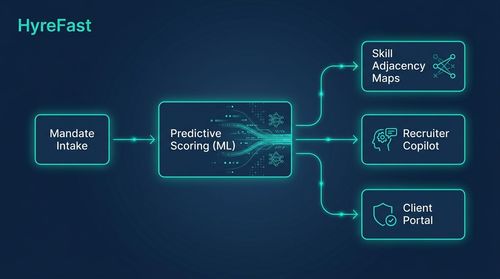
- Predictive mandate scoring using ML to forecast fill time and difficulty at intake, auto-routing mandates to the right workflow.
- Dynamic skill adjacency maps that continuously update semantic models based on placement data (e.g., “For this role, candidates with X + Y skills fill 2x faster”).
- Recruiter augmentation copilots: AI assistants that suggest intake questions based on mandate type, flag risky client behaviours, or draft submission notes.
- Client self-service portals that let clients view mandate status, submit feedback, and approve candidates in real time-reducing recruiter admin further.
- Want to identify strong candidates before interviews without relying on resumes?
Schedule a walkthrough: Book Demo
Explore HyreFast Solutions
Interview as a Service
Outsource first-round interviews to AI.
AI Interview Bot
AI bot that conducts and evaluates interviews 24/7.
Video Interview Software
One-way async video interviews with AI scoring.
Phone Screening
Automate first-round phone calls with AI.
Interview Assessment
Structured assessments with AI scoring and reports.
AI Interview Platform
End-to-end platform for AI interviews and analytics.