
Stop Candidate Drop-Off Before Phone Screen
Candidate drop-off before phone screen is killing your hiring pipeline. Learn why candidates ghost and how AI screening can reduce no-shows by 80%.
Table of Contents

Introduction
Candidate drop-off before interviews is a silent killer of hiring efficiency. Studies show that 60% of candidates abandon applications due to length or complexity, and 52% lose interest if they don’t hear back within two weeks.
In a competitive talent market, every drop-off represents not just a lost hire, but potential damage to your employer brand and future pipeline.
The good news is that most drop-off is preventable with targeted improvements to process, communication, and experience. Here’s why candidates leave-and exactly how to fix each issue.
Application Process is Too Long or Complicated
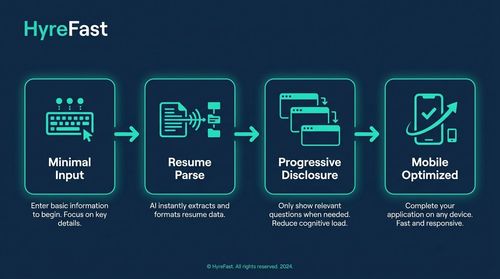
Lengthy forms, redundant fields, mandatory cover letters, and non-mobile-friendly interfaces create friction. For every additional field beyond five, completion rates drop by 50%. Over 50% of applications start on mobile, so a poor mobile experience is a dealbreaker.
- Audit your application and remove every non-essential field. Ask only for what you need at this stage: name, contact, resume upload, and one or two knockout questions.
- Enable resume parsing or LinkedIn import to reduce manual entry. Use progressive disclosure to show only relevant next steps based on earlier answers.
- Ensure mobile optimization. Test your apply flow on iOS and Android-if it’s not thumb-friendly, you’re losing volume.
Lack of Communication and Updates
Candidates apply and hear nothing for days or weeks, leading them to assume rejection or disorganization. 80% of candidates say lack of communication is their top frustration. Silence breeds anxiety and mental disengagement.
- Set automated status triggers at every stage. Application received: “Thanks! We’ll review by [date + 3 business days].” Under review: “Still reviewing-update by [date].” Screening complete: “You’ve advanced to interview stage-here’s how to schedule.”
- For delays beyond 48 hours, send a proactive update: “We’re experiencing high volume but still reviewing-expect update by [new date].” Never let a candidate go more than 72 hours without some form of status communication.
- Personalize merge fields (name, role) to avoid a robotic tone. Add a recruiter’s name and signature to automated emails.
Unclear Job Description or Misaligned Expectations
Vague job descriptions or mismatched role expectations cause 43% of candidates to drop off after realizing the role isn’t what they thought. This feels like bait-and-switch and destroys trust.
- Write job descriptions focused on outcomes, not just responsibilities. For example: “In 6 months, you will have [specific achievement].” Include realistic previews: “This role involves X% time on task A, Y% on task B.”
- During screening, explicitly confirm alignment: “Based on your background, here’s how we see you fitting-does this align with your goals?” Share team structure and reporting lines early.
- Add a salary range in the job description. 80% of candidates won’t apply without it. Transparency reduces early-stage drop-off by 25% and increases offer acceptance.
Slow or Inflexible Scheduling
Back-and-forth emails to find interview times, rigid business-hour-only slots, and no time-zone accommodation signal disorganization. 67% of candidates say scheduling difficulties negatively impact their perception of a company.
- Use self-scheduling tools integrated with your calendar (Calendly, GoodTime, or ATS-native schedulers). This cuts scheduling time by 80%.
- Offer asynchronous video interviews for round one. Candidates record answers on their own time, eliminating scheduling entirely. This reduces scheduling-related drop-off by 50%.
- Provide multiple time options across time zones and clearly state interview duration upfront. For live interviews, send calendar invites with video links and preparation tips immediately after booking.
Poor Screening Experience Feels Disrespectful or Impersonal
Generic questions, no feedback, or feeling like a resume in a stack leads to disengagement. Candidates who rate their experience as poor are 34% less likely to maintain interest in an employer.
- Design screening around three or four non-negotiable competencies. Use behavioral questions that invite storytelling: “Tell me about a time you [specific skill related to the role].”
- Provide micro-feedback for rejects: “We appreciated your experience in X, but we’re moving forward with candidates who demonstrated more direct experience in Y.” Candidates who receive specific feedback are 4x more likely to reapply.
- For asynchronous video, keep responses under 3 minutes per question and acknowledge effort: “Thanks for taking the time to share your thoughts.”
The Ripple Effect and Quick Wins
Every candidate who drops off due to poor experience becomes a detractor. 72% of candidates share negative experiences online or with networks, damaging your ability to attract future talent.
Conversely, a smooth, respectful process turns rejects into advocates: 56% of candidates who had a positive experience would reapply or refer others.
- Reduce application fields to 5 or fewer. Track completion rate before and after.
- Set up automated status emails for “application received” and “under review” using your ATS or a tool like Zapier.
- Add one line to your job description describing a realistic day-in-the-life or first-90-days goal.
- Enable self-scheduling for phone screens-even a simple Calendly link cuts scheduling time by 80%.
- Send a “we’re still reviewing” update at 48 hours if no decision is ready. This alone reduces drop-off by 20–30%.
Measuring Success: Track These Leading Indicators
Don’t just look at hire rates. Monitor these metrics weekly to identify leaks and measure improvement.
- Application completion rate – target >75% for mobile-optimized flows. If lower, simplify the form.
- Time to first communication – target <1 hour for application received, <24 hours for status updates. Automate triggers to meet this.
- Screening stage drop-off rate – target <20%. If higher, audit question relevance or length.
- Candidate experience score – post-screen survey: “How respectful and clear was our process?” target >4/5.
- Offer acceptance rate – indirectly reflects pre-offer experience. Target >80%. Below 70% indicates offer or communication issues.
Conclusions
- The majority of pre-interview drop-off is caused by avoidable friction in application length, scheduling, communication, expectation-setting, and screening experience-not lack of candidate interest.
- Fixing these points doesn’t just increase volume; it improves quality by reducing self-selection bias and attracting candidates who value respect and efficiency.
- Organizations that measure and optimise for candidate experience see 3x higher offer acceptance rates and stronger talent pipelines.
- The most effective fixes are often simple: shorten applications, enable self-scheduling, and communicate transparently-and they compound over time as word spreads about your respectful process.
Future Directions
- Predictive drop-off modelling – using behavioural data (time spent on page, field interactions) to identify at-risk candidates in real-time and trigger personalised interventions.
- AI-powered journey optimisation – systems that dynamically adjust application length or communication frequency based on candidate signals and role complexity.
- Experience-weighted sourcing – allocating budget to channels not just by volume, but by the quality of experience they deliver (measured via post-application surveys).
- Candidate co-design – involving recent hires and rejectees in redesigning the application process to uncover hidden pain points.
Want to identify strong candidates before interviews without relying on resumes?
Schedule a walkthrough: Book Demo
Explore HyreFast Solutions
Interview as a Service
Outsource first-round interviews to AI.
AI Interview Bot
AI bot that conducts and evaluates interviews 24/7.
Video Interview Software
One-way async video interviews with AI scoring.
Phone Screening
Automate first-round phone calls with AI.
Interview Assessment
Structured assessments with AI scoring and reports.
AI Interview Platform
End-to-end platform for AI interviews and analytics.