
How to Design a Better First-Round Screening Process
Discover how to structure first-round candidate screening using clear criteria, interview questions, scoring rubrics, and AI-assisted evaluation.
Table of Contents

Introduction
A poorly designed first-round screen is the silent killer of hiring efficiency. It creates false negatives by rejecting qualified candidates, false positives by wasting time on unqualified ones, and damages your employer brand through inconsistent or impersonal experiences.
Yet many organisations still treat screening as a checkbox exercise-quick resume scans, unstructured phone calls, or generic questionnaires that yield little predictive value.
The good news is that a better first-round screen doesn’t require more budget; it requires smarter design grounded in what actually predicts job success and respects candidates’ time.
This article will walk you through defining non-negotiable criteria, designing structured questions, implementing immediate scoring, leveraging technology wisely, ensuring fairness, and measuring what truly matters.
Start with What Matters: Define Non-Negotiable Criteria
The most common screening failure is evaluating the wrong things. Before designing questions or scoring, answer: What must a candidate demonstrate in this first 15–20 minutes to be worth advancing? For most roles, this falls into three buckets:
- Minimum competency: Can they do the core work? For a developer, ask “Can they write basic SQL?” not “Do they know Kubernetes?”
- Communication clarity: Can they explain their thinking coherently? This is critical for collaboration, client-facing roles, or remote work.
- Motivation/fit signal: Do they understand the role and have a plausible reason to want it? This is not “culture fit” as a vague concept, but specific interest in the work or mission.
For a customer support role, non-negotiables might be clear verbal communication, basic problem-solving logic, and genuine interest in helping people. Screen for these-and only these-in round one. This shifts focus from “does this resume look impressive?” to “can this person do the work?” reducing pedigree bias and increasing validity.
Design Questions That Elicit Evidence, Not Rehearsed Answers
Avoid questions that invite generic responses like “Tell me about yourself” or “What’s your greatest weakness?” Instead, use behavioral or situational prompts tied directly to your non-negotiables:
- For communication clarity: “Walk me through how you’d explain [simple concept related to the job] to someone with no background in it.” This tests ability to simplify and adapt the message.
- For minimum competency: “Describe a time you used [specific tool/skill] to solve a problem. What was the goal, what did you do, and what was the result?” This focuses on concrete behavior, not self-assessment.
- For motivation: “What about this role specifically interests you beyond the job description?” This reveals if they’ve done minimal research or are just mass-applying.
Keep it to 3–4 questions maximum. Every additional question increases drop-off without proportional insight. Record responses via asynchronous video or structured notes for consistent scoring.
Implement Structured Scoring Immediately After Each Screen

Human memory of interview details fades within hours. To prevent bias and inconsistency, use a simple rubric with a 1–3 scale for each non-negotiable, with behavioral anchors defining what each score means. For example, for “Communication Clarity”:
- 1 = Struggles to articulate thoughts; frequent jargon without explanation; listener confused
- 2 = Clear most of the time; occasional vagueness but recovers when prompted
- 3 = Concise, tailored language; checks for understanding; uses analogies effectively Score within 10 minutes of ending the screen while details are fresh.
Delaying scoring by even 2 hours increases reliance on halo/horns effects and first-impression bias. Document specific evidence for each score-for instance, “Candidate explained API concept using restaurant ordering analogy-clear and checked if I followed.” This creates an audit trail and reduces reliance on gut feeling.
Leverage Technology to Remove Friction, Not Humanity
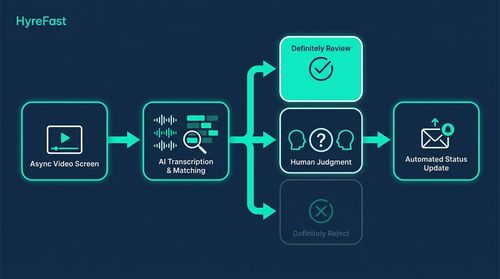
Automation should handle the repetitive parts so recruiters can focus on judgment. Use asynchronous video screening where candidates record answers to your 3–4 questions on their own time.
This eliminates scheduling hell and ensures every candidate gets the exact same questions. Keep videos under 3 minutes per question to respect candidates’ time and improve completion rates.
Use AI-assisted transcription and keyword/semantic matching to quickly surface responses mentioning key skills or concepts like “SQL” or “stakeholder management.” This isn’t about replacing human review-it’s about highlighting where to focus attention.
Never let AI make final pass/fail decisions in round one. Use it to flag “definitely review” (strong evidence of competency) and “definitely reject” (clear lack of minimum requirements), leaving the middle ground for human judgment.
Send automated status updates within 1 hour of submission: “Thanks for completing the screen! We’ll review by [date + 48 hours] and get back to you.” This manages anxiety and prevents drop-off.
Design for Fairness and Candidate Experience from the Start
A good screen feels respectful, not like an interrogation. Offer alternatives to video—phone or written responses-for candidates with disabilities, bandwidth issues, or privacy concerns. State this clearly in instructions. Set realistic expectations upfront: tell candidates how long the screen will take, what you’re evaluating, and when they’ll hear back. Transparency builds trust even if they’re rejected.
Provide micro-feedback for rejects: “We appreciated your experience in X, but we’re moving forward with candidates who demonstrated more direct experience in Y for this role.” This costs little but significantly improves employer perception. Track adverse impact by monitoring pass rates by demographic group at the screen stage. If disparities emerge, audit your questions and scoring rubric for unintended bias.
Measure What Matters: Go Beyond “Time to Screen”
Don’t just track how fast you complete screens. Measure outcomes that predict hiring success:
- Pass-through rate to round two: What percentage of screened candidates do you actually want to interview? If it’s too high (over 50%), your screen isn’t filtering effectively. If too low (under 15%), you’re likely rejecting qualified people or asking overly stringent questions.
- Manager satisfaction with screened candidates: Survey hiring managers after round two: “What percentage of screened candidates did you feel were worth interviewing?” Target over 70%.
- Candidate experience score: Send a 1-question survey post-screen: “On a scale of 1–5, how respectful and clear was our screening process?” Track trends.
- Drop-off rate: What percentage of candidates who start the screen don’t finish? Over 20% suggests length, technical issues, or lack of perceived value.
Conclusions
- A better first-round screen starts with a razor-focused job analysis defining 3–5 non-negotiable competencies, not a laundry list of nice-to-haves.
- Replace resume scanning with structured evidence gathering-behavioral questions and work samples scored immediately against a rubric-which is 2x more predictive of performance and takes only 8–12 minutes per candidate.
- Balance speed and fairness through asynchronous options, batched human review with calibration, and AI used only to surface evidence, not make decisions.
- Treat the screen as a candidate experience moment: set expectations, give specific feedback, and close the loop within 72 hours to protect your employer brand.
Future Directions
- Dynamic rubrics: AI-assisted tools that suggest real-time rubric adjustments based on emerging patterns in candidate responses, such as flagging a new tool mentioned by 80% of applicants for competency review.
- Predictive shortlist scoring: Models that forecast not just pass/fail but likelihood of accepting an offer and 90-day retention, helping prioritise recruiter effort.
- Equity-by-design screening: Built-in bias mitigation at the question level, such as avoiding culturally specific idioms or scenarios that disadvantage non-native speakers.
- Candidate-co-created screens: Involving high-performing incumbents in refining screening questions to ensure they reflect real-world success factors.
[Want to identify strong candidates before interviews without relying on resumes?
Schedule a walkthrough:Book Demo
Explore HyreFast Solutions
Interview as a Service
Outsource first-round interviews to AI.
AI Interview Bot
AI bot that conducts and evaluates interviews 24/7.
Video Interview Software
One-way async video interviews with AI scoring.
Phone Screening
Automate first-round phone calls with AI.
Interview Assessment
Structured assessments with AI scoring and reports.
AI Interview Platform
End-to-end platform for AI interviews and analytics.