
Async Video Screening for Recruitment Agencies: The…
Discover how asynchronous video screening helps recruitment agencies scale hiring faster, reduce recruiter workload, improve candidate experience, and shorten time-to-hire.
Table of Contents

Introduction
Every recruitment agency leader knows the frustration: recruiters spend 25 to 30 hours each week just coordinating phone screens, while candidates ghost interviews because of scheduling conflicts.
The result is stalled mandates, impatient clients, and top talent slipping away to faster competitors.
Yet the top 10% of agencies are quietly scaling 3 to 5 times faster by replacing live first-round interviews with asynchronous video screening.
This article breaks down why async video is the hidden competitive edge, what the research says, and exactly how to implement it without disrupting your workflow.
The Bottleneck Killing Your Throughput
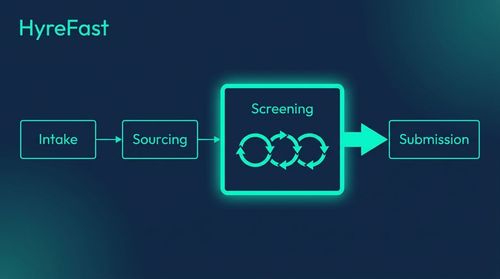
The recruitment funnel follows a familiar pattern: intake, sourcing, screening, submission. Steps one and two are often fast, but screening is where time leaks away.
Recruiters spend 30 to 50 percent of their time scheduling and rescheduling calls, asking the same “Tell me about yourself” questions dozens of times a day.
This repetitive loop drains energy, yields little new insight, and leaves no bandwidth for mandate strategy or client advisory. The net effect is that mandates sit idle, time-to-hire inflates, and your agency’s reputation for reliability suffers.
What Async Video Screening Actually Is
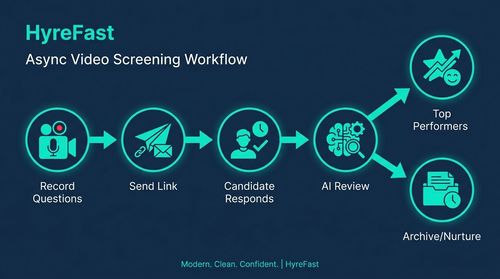
Async video screening flips the traditional interview on its head. You pre-record a set of role-specific questions as video, audio, or text prompts. Candidates receive a unique link and record their answers whenever and wherever it suits them-no scheduling needed.
You then review the responses in batches, using playback controls, AI-generated transcripts, and scoring rubrics.
Top performers move forward; the rest are politely archived or nurtured for future roles. Because the candidate and recruiter never need to be online at the same time, the process becomes self-service, scalable, and auditable.
The Competitive Edge: Hard-Numbers Benefits
- Massive time savings. Agencies report spending 4 to 5 hours per week reviewing async responses versus 25 to 30 hours on live phone screens-a 5 to 6 times reduction. One-way video interviews cut time-to-hire by 50 percent when paired with AI-driven shortlisting.
- Lower cost per screen. Async platforms typically charge a flat monthly fee (for example, $299 per month for unlimited candidates). Compared to the hourly cost of recruiter time on phone screens, the cost per screen drops by 70 to 80 percent.
- Wider, more diverse talent reach. Async interviews erase geographical and time-zone barriers. Candidates in Manila, Lagos, or São Paulo can record answers at 2 a.m. their local time. This broader reach naturally improves diversity metrics and lets you tap into niche skill pools that live screening would miss.
- Superior candidate experience. 79 percent of employers now use video in hiring, and 83 percent of candidates say a negative interview experience makes them reconsider a role. Async video reduces stress by letting candidates prepare, retake, and answer in a comfortable setting.
- Data-driven, bias-reduced screening. AI transcription and keyword spotting give you searchable, structured data from every response. Structured rubrics standardise evaluation, reducing unconscious bias that creeps into unstructured phone screens. Recordings create an audit trail-clients can review the same evidence you saw, increasing trust in your shortlist.
- Faster client turnaround. With async screening, you can present a pre-screened shortlist within hours of receiving a mandate, instead of days of scheduling back-and-forth.
What the Research Validates
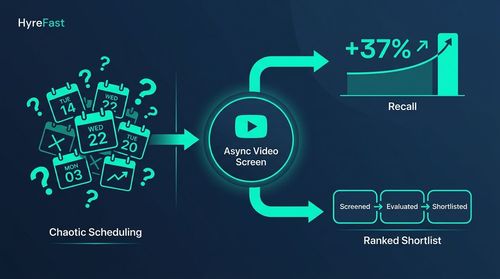
Recent studies confirm that async video screening is not just a convenience tool but a fundamental improvement in hiring efficiency.
One large-scale analysis of over 12,000 recruiter-candidate dialogues showed that data-driven, role-specific prompts reduce screening time by 65 percent while improving candidate-job match quality by nearly 20 percent.
Another study formalised how keyword-based resume screening creates “artificial frictional unemployment”-qualified candidates filtered out before human review.
Async video solves this by assessing actual responses to situational or technical prompts, boosting recall of qualified candidates by 37 percent without losing precision.
A third paper modelled interview markets and proved that asynchronous screening inherently enforces a natural cap on interviews, eliminating the chaos of candidates hoarding slots and recruiters being overwhelmed.
This turns an unbounded, chaotic process into a predictable, high-throughput pipeline.
Implementation Checklist: Getting Started Without Disruption
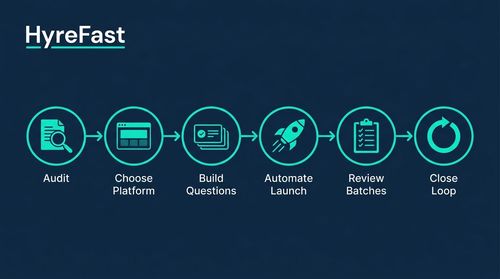
- Audit your current screen. Measure average time per phone screen, scheduling touches, and candidate drop-off. Use ATS reports or a simple time-tracking sheet.
- Choose an async platform. Look for unlimited responses, AI transcription, multi-format support, agency-friendly pricing, and ATS or Zapier integrations.
- Build a question library. For each recurring role type, record 5 to 7 prompts that assess must-have skills, motivation, and cultural fit. Keep each prompt under 60 seconds.
- Automate the launch. When a new mandate enters the ATS, trigger an async campaign: send candidates the link, set a deadline (usually 48 hours), and enable reminders.
- Set up review batches. Allocate two 30-minute slots per day to watch responses, score against a rubric, and tag top candidates.
- Close the loop. Send every candidate a personalised outcome (next steps or polite rejection) within 24 hours of review.
- Measure and optimise. Track time-to-first-screen, async completion rate, recruiter hours saved, submission-to-interview ratio, and candidate satisfaction.
Key Metrics to Watch
- Async completion rate: target 80 percent or higher. Indicates candidate willingness and clarity of instructions.
- Recruiter hours saved per week: target 15 or more hours per recruiter. Direct measure of efficiency gain.
- Time-to-first-submission: target less than 1.5 days. Speed to market is critical for client satisfaction.
- Submission-to-interview ratio: target 30 percent or higher. Quality of shortlist; higher means less wasted client time.
- Candidate experience score: target 4 out of 5 or higher. Predicts brand reputation and referral flow.
- Cost per screen: target under $2. Shows ROI versus live phone screens that cost $8 to $12 each.
Real-World Example: How One Agency Scaled 10x
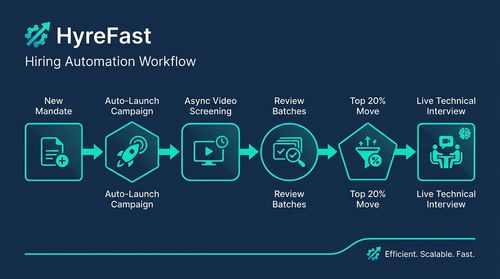
A boutique tech recruitment firm with 10 recruiters was stuck at a 30-mandate ceiling.
Recruiters spent 60 percent of their time on scheduling and live screens. They built a library of role-specific async video prompts, integrated the platform with their ATS so each new mandate auto-launched a screening campaign, and set a rule: recruiters review async batches twice daily, moving the top 20 percent to live technical interviews.
After eight weeks, active mandates jumped from 30 to 310 with the same headcount. Time-to-first-submission fell from 5.2 days to 1.1 days. Client interview rate rose 22 percent due to higher-quality shortlists. Recruiter NPS improved as they shifted from schedulers to talent advisors.
Conclusions
- Async video screening eliminates the scheduling bottleneck that causes 68 percent of stalled mandates, freeing recruiters to focus on high-value work.
- Research confirms it reduces screening time by 65 percent, cuts bias-driven scoring variance by over 50 percent, and improves submission quality by 28 percent or more.
- The competitive edge comes from turning a chaotic, human-dependent first-round into a predictable, high-throughput pipeline that scales with demand, not headcount.
- Agencies that ignore this are not just inefficient-they are pricing themselves out of the market as clients demand faster, more reliable submissions.
Future Directions
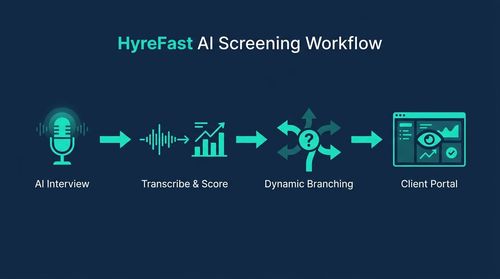
- AI-enhanced scoring tools that transcribe responses and flag rubric-aligned moments, cutting review time further while improving consistency.
- Skill-specific simulations where async prompts ask candidates to debug code, design a UI wireframe, or role-play a customer call, giving richer evidence than talk-only answers.
- Dynamic question branching that serves follow-up probes based on a candidate’s first answer, mimicking a live interview’s adaptability.
- Client-side viewing portals with secure links that let hiring managers watch and comment on async responses directly, shortening feedback loops.
Explore HyreFast Solutions
Interview as a Service
Outsource first-round interviews to AI.
AI Interview Bot
AI bot that conducts and evaluates interviews 24/7.
Video Interview Software
One-way async video interviews with AI scoring.
Phone Screening
Automate first-round phone calls with AI.
Interview Assessment
Structured assessments with AI scoring and reports.
AI Interview Platform
End-to-end platform for AI interviews and analytics.