
What is AI Interview Screening? A Beginner's Guide
New to AI interview screening? Learn what it is, how it works, and why recruitment agencies in India are switching from manual screening to AI-powered interview bots.
Table of Contents

Introduction
If you’ve ever spent hours sifting through resumes, scheduling phone screens, or wondering if you missed a great candidate because you were rushing, you’re not alone. The term “AI interview screening” often conjures images of robots judging candidates, but the reality is far more practical. It is simply a tool that uses artificial intelligence to handle the repetitive, time-consuming parts of early-stage hiring so you can focus on what matters most: building relationships and making nuanced decisions. This guide breaks down what AI interview screening is, how it works under the hood, when it makes sense to use it, and what pitfalls to avoid—all in plain language for beginners.
What AI Interview Screening Actually Is (and Isn’t)
At its core, AI interview screening automates the initial review of candidates. Instead of a recruiter manually reading every resume or conducting every first-round phone call, AI technology analyzes candidate responses—usually from a short video or text-based interview—and generates insights to help humans decide who to move forward. It is NOT:
- A robot that makes final hire/no-hire decisions
- A replacement for human judgment
- A tool that analyzes social media or scrapes the web for dirt on candidates
- Something that works perfectly out of the box without setup and oversight It IS:
- A way to screen hundreds of applications consistently in hours instead of weeks
- A system that applies the same criteria to every candidate, reducing unconscious bias in early screening
- A tool that highlights relevant skills and experiences so recruiters can focus their time where it matters most
- Typically used for the first touchpoint after application—before any live human conversation
How It Works: A Simple 3-Step Flow
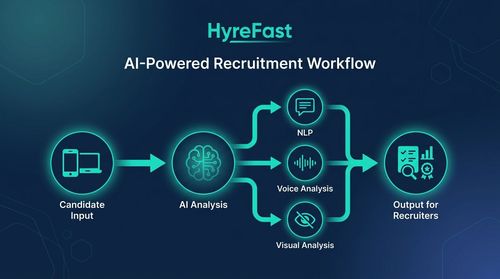
You don’t need a data science degree to understand the process. Here is what happens behind the scenes:
- Candidate Input: You send candidates a link to complete a short, structured interview (usually 3-5 questions) on their own time. They record video or audio answers using their phone or laptop—no scheduling needed. Alternatively, some platforms use conversational AI chatbots that adapt follow-up questions based on responses.
- AI Analysis: Once submitted, the AI reviews their responses using three main technologies:
- Natural Language Processing (NLP) reads the transcript to assess relevance, clarity, and whether they mentioned key skills. It understands synonyms and context, so “built data pipelines” is recognised as equivalent to “ETL experience”.
- Voice and Speech Analysis listens to how they spoke—tone, pace, pauses—to gauge enthusiasm or confidence. This is less reliable than language analysis and many ethical platforms use it sparingly.
- Optional Visual Analysis looks at facial expressions or eye contact. However, major studies show limited scientific validity for using facial cues to predict job performance, and this raises serious privacy and bias concerns. Most reputable tools avoid it.
- Output for Recruiters: The AI does not say “hire” or “reject.” Instead, it gives you:
- A ranked list of candidates with competency scores (e.g., Communication: 4/5, Problem-Solving: 3/5)
- Evidence highlights with timestamps (e.g., “At 2:10, candidate used STAR method to describe reducing client churn by 15%”)
- A transcript and summary of strengths and potential gaps
- Flags for things like “mentioned required certification” or “gave vague behavioural example” You review the AI’s highlights, read the transcript, watch short video clips if needed, and make the final call on who advances. The AI saves time by doing the first pass—you still make the decision.
What AI Interview Screening Can Do Well
Based on real-world studies and deployments, here is where it genuinely helps:
- Saves massive time on volume hiring: For roles with 100+ applicants, AI screening can cut initial review time from weeks to hours. One study showed recruiters saved 15-25 hours per 100 candidates screened.
- Applies criteria consistently: Humans get tired, distracted, or influenced by the time of day. AI asks the same questions and scores every candidate using the same rules—critical for fairness when screening thousands.
- Surfaces hidden talent: Unlike old-school resume filters that only catch exact keywords, modern AI understands synonyms and context. A candidate who said “built scalable pipelines” gets flagged for “ETL experience” even if they didn’t use those exact words.
- Reduces early-stage bias (when designed right): By focusing on job-relevant responses rather than names, schools, or addresses, well-built AI can help minimise snap judgments based on unconscious biases in the first pass.
- Gives candidates flexibility: Asynchronous video lets people complete the interview when it suits them—no more taking time off work for a 9 a.m. phone screen. In a landmark randomised field experiment with 37,000 applicants, AI-assisted screening increased the final interview pass rate from 34% to 54%—a 20-point jump. Candidates from the AI screen were rated 15% higher on job-relevant competencies during live interviews.
What It Cannot Do (And Where Humans Are Still Essential)
Understanding the limits is just as important as knowing the strengths:
- It cannot judge potential or nuance: AI struggles with career gaps, unconventional paths, or transferable skills (e.g., a teacher moving into corporate training). Humans excel at seeing the story behind the resume.
- It cannot assess cultural fit or motivation deeply: While it can detect enthusiasm in tone, it cannot grasp subtle alignment with your mission or team dynamics like a human conversation can.
- It cannot replace reference checks or work samples: AI screening is a first filter. Final decisions still need human interviews, practical tests, and reference conversations.
- It can amplify bias if poorly built: If trained on biased historical data (e.g., past hires mostly from certain schools), AI will learn and scale those biases. One infamous case penalised resumes containing “women’s” (e.g., “women’s chess club captain”).
- It cannot read body language reliably: Claims about AI detecting “lie detection” or “personality” from facial expressions are not scientifically supported—avoid platforms overpromising here.
When to Use AI Interview Screening (Beginner’s Cheat Sheet)
Use it when:
- You are hiring for entry-level, mid-level, or technical roles with clear, measurable skills (e.g., software developer, sales rep, support agent).
- You are getting over 50 applications per role and spending too much time on initial screens.
- You want to reduce scheduling hell for phone screens (asynchronous = no calendar syncing).
- You are committed to fair process design and will audit the tool for bias regularly. Avoid relying on it alone for:
- Executive or senior leadership roles where strategic thinking and relationship-building are paramount.
- Highly creative positions (design, writing) where portfolio and informal conversation matter more than structured answers.
- Roles requiring deep assessment of soft skills like conflict resolution or leadership presence—save those for live human interviews.
- Candidates with disabilities that affect speech or video interaction unless the platform offers accessible alternatives (phone/text options).
Critical Pitfalls to Avoid
AI screening can backfire if implemented poorly. Watch for these red flags:
- Black box scores with no explainability: If the vendor cannot show you why a candidate got a 3/5 on communication (e.g., “Used STAR method in 3 answers, quantified impact 2x”), you cannot trust it, defend it, or improve it. Demand evidence highlights.
- Bias amplified, not reduced: If the AI was trained on biased historical data, it will scale those biases. Ask for third-party bias audit reports (by gender, ethnicity, age, disability) and validation studies linking scores to your job performance data—not just generic “hire/no-hire” labels.
- Over-promising on video analysis: Vendors claiming AI can read “confidence” or “integrity” from facial expressions are selling snake oil. Prioritise platforms focused on language and semantic analysis.
- Ignoring the human-in-the-loop: Letting AI make final reject/advance decisions in round one is dangerous and often illegal under emerging laws (NYC Local Law 144, EU AI Act). Use AI to flag “definitely review” (top 20%) and “definitely reject” (bottom 20%), but always have humans review the middle 60%.
Conclusions
- AI interview screening is a productivity tool, not a decision-maker. Its real power lies in handling repetitive tasks so humans can focus on evaluating judgment, motivation, and fit.
- Success depends entirely on the quality of your questions and rubric. Garbage in, gospel out—if your job description is vague or your questions are poor, AI will just automate mediocrity.
- Bias audits are non-negotiable. Well-designed AI can reduce early-stage bias, but poorly built models amplify discrimination at scale. Demand third-party validation and regular monitoring.
- Start small. Pilot with one high-volume role, measure time saved and shortlist quality, and gather feedback from recruiters and candidates before scaling.
Future Directions
- Explainability 2.0: AI that gives natural-language justifications (“Score: 4/5 for communication—used analogies, checked for understanding, avoided jargon”) instead of just attention weights.
- Dynamic skill matching: Systems that recognise emerging competencies (e.g., treating a new AWS certification as equivalent to legacy experience) in real-time.
- Ethical AI marketplace: Third-party bias auditing and certification becoming standard—like SOC 2 for security—making vendor vetting easier.
- Candidate-controlled data: Platforms where candidates own their interview data and can grant/revoke access, building trust and compliance.
Book a demo
Learn more: Read our complete AI interview screening guide for everything you need to know about automating candidate screening with AI.
Explore: See how HyreFast's AI interview bot can automate your first-round screening — book a demo today.
Explore HyreFast Solutions
Interview as a Service
Outsource first-round interviews to AI.
AI Interview Bot
AI bot that conducts and evaluates interviews 24/7.
Video Interview Software
One-way async video interviews with AI scoring.
Phone Screening
Automate first-round phone calls with AI.
Interview Assessment
Structured assessments with AI scoring and reports.
AI Interview Platform
End-to-end platform for AI interviews and analytics.