
How to Create Candidate Scorecards That Clients Actually Trust
Learn how recruitment agencies can create structured candidate scorecards that improve client confidence and reduce subjective hiring debates.
Table of Contents

Introduction
Most candidate scorecards fail because they feel like HR paperwork—not a tool that helps clients make better hiring decisions. Clients distrust scorecards when they are vague, disconnected from actual job performance, or feel like a black box that overrides their judgment. Yet when designed correctly, scorecards become the single most powerful lever for improving hire quality, reducing bias, and building long-term client partnerships. The key is not more complexity but specificity, evidence linkage, and client co-creation. This article will cover how to build scorecards that clients will actively use and trust, starting with co-creation workshops and ending with measurement of trust.
Start with the Client’s Reality, Not HR Templates
The fatal flaw in most scorecards is using generic competencies like “communication” or “teamwork” without defining what those mean for this specific role at this specific company. A scorecard that works for a SaaS sales rep will not work for a hospital nurse or a manufacturing supervisor. Run a 30-minute job analysis workshop with the hiring manager and one or two top performers in the role. Ask these three questions:
- “Think of your best hire in this role in the last 12 months. What specific thing did they do in their first 90 days that made you think, ‘This person is exceptional’?”
- “What is one thing a weak hire in this role consistently fails to do—not because of lack of skill, but because of mindset or approach?”
- “If you had to explain this role to a smart friend outside the industry in two sentences, what would you say?” From these answers, extract three to five non-negotiable competencies tied directly to observable impact. For example, instead of “Problem-solving” use “Diagnoses root cause of production line downtime using PLC logs and operator feedback, then implements a fix that reduces recurrence by 50% or more within two weeks.” Instead of “Communication” use “Translates technical API constraints into clear, actionable requirements for non-technical stakeholders using analogies and visual aids, confirmed by follow-up understanding checks.” This ensures the scorecard reflects what the client actually values, not what an HR textbook says.
Build Behavioral Anchors That Eliminate Guesswork
A competency without clear behavioral anchors is just an invitation for bias. Clients distrust scores like “4/5 for communication” when they do not know what separates a 3 from a 4. Anchor each competency level to specific, observable behaviors—not traits or feelings. Use this structure for each competency:
| Score | Behavioral Anchor (What You See or Hear) |
|---|---|
| 1 (Does Not Meet) | Struggles to explain basic concepts; relies on jargon without clarification; listener is confused after explanation |
| 2 (Partially Meets) | Explains most steps correctly but omits key details or safety considerations; needs prompting to clarify ambiguous points |
| 3 (Meets Expectations) | Uses clear, structured explanation (e.g., STAR method); checks for understanding; adapts language to audience’s technical level |
| 4 (Exceeds) | Anticipates follow-up questions; uses real-world analogies relevant to stakeholder’s role; documents explanation for future reference |
| 5 (Role Model) | Creates reusable templates or training materials that others adopt; consistently receives unsolicited praise for clarity from stakeholders |
| Every anchor must describe behavior, not internal state. Never write “Shows confidence” or “Seems motivated.” Instead write “Maintains eye contact and steady pace while answering follow-up questions under pressure” or “Volunteers additional improvement ideas beyond the scope of the initial ask.” This transforms the scorecard from a subjective rating sheet into an evidence-collection tool. When clients see a score of “3” for communication, they know exactly what evidence justified it and can verify it themselves by reviewing the transcript or video clip. |
Design for Evidence, Not Just Scores
Clients trust scorecards when they can trace a score back to concrete proof. Your scorecard must force reviewers to cite specific evidence for every rating—not just circle a number. Modify your scorecard to include these elements:
- A mandatory evidence field under each competency: “Quote or timestamp from interview or work sample that supports this score (e.g., ‘At 4:22 in video: “I reduced server costs by rewriting the cache logic—saved $18K/year”’)”
- A section for “Concerns or Mitigating Evidence”: “Note any discrepancies or context that might affect this score (e.g., ‘Candidate struggled with SQL basics but demonstrated strong Python skills—relevant for 70% of tasks’)”
- An overall recommendation field with required justification: “Hire/No Hire/Maybe – One sentence explaining why based on the evidence above (e.g., ‘Hire: Exceeds expectations in core competency X and shows rapid learning in Y; concerns about Z are mitigated by referenced willingness to upskill’)” This does three things. It prevents halo or horns effects where a candidate’s performance in one area bleeds into others. It creates an audit trail clients can review if they question a recommendation. And it teaches recruiters what evidence actually matters, improving future screening.
Co-Create and Calibrate with the Client
Trust is not built in isolation—it is built through shared validation. Before rolling out the scorecard, run a calibration session with the client. Select four to five past candidates for whom you have interview notes, work samples, or performance data. Include two hires who succeeded, two who did not, and one borderline case. Have the client score them independently using your draft scorecard—no discussion yet. Then compare scores and discuss discrepancies. Focus on where your evidence interpretation differed and what behavior the client weighed more heavily. Refine the anchors based on their feedback. For example, if the client consistently gave higher scores for “ownership” when candidates mentioned process improvement (not just task completion), update the anchor to reflect that. This does something powerful: it proves the scorecard predicts their reality. When the client sees that their top past hire scored a 4 or above on “diagnostic thinking” while their worst hire scored a 2, they stop seeing the scorecard as an HR imposition and start seeing it as a hiring advantage.
Integrate Seamlessly into Their Workflow
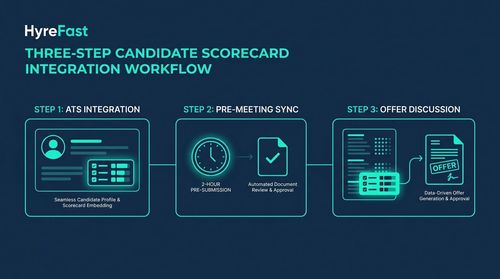
A scorecard clients trust is one they actually use. If it creates extra work or feels disconnected from their decision process, they will ignore it. Embed it where decisions happen.
- In the ATS: Make the scorecard a native part of the candidate profile—not a separate document. Recruiters fill it out immediately after the interview; hiring managers see it alongside the resume and video.
- As a pre-read for debriefs: Require everyone to submit their completed scorecard two hours before the calibration meeting. The meeting then focuses only on resolving discrepancies in evidence interpretation, not rehashing the whole interview.
- Linked to offer discussions: When making an offer, reference the scorecard. Say “We are offering X based on your 4.5/5 in diagnostic thinking and 4/5 in learning velocity—here is the evidence that stood out.” This shows the scorecard drives real outcomes.
Measure What Builds Trust (Not Just Compliance)
Stop tracking whether scorecards were “completed.” Track whether they are used and trusted.
- Client usage rate: Percentage of debriefs where the scorecard is referenced to resolve a disagreement. Target above 80%.
- Predictive validity correlation: After 90 days, compare scorecard competency scores to manager performance ratings. Target r greater than or equal to 0.4 for key competencies (moderate-strong predictive power).
- Client NPS on screening: Add one question to your post-hire survey: “How much did the scorecard help you feel confident in this hiring decision?” Use a scale of 1 to 5. Target 4 or above.
- Score override rate: Percentage of times the client changes a recruiter’s recommended score during calibration. Target 10 to 20%—shows engagement without indicating broken trust. If clients are actively using the scorecard to challenge and refine recommendations—not just rubber-stamping them—you have built trust.
Avoid These Trust-Killing Traps
| Trap | Why It Erodes Trust | How to Fix It |
|---|---|---|
| Over-engineering (8+ competencies) | Feels like busywork; clients cannot focus on what matters | Limit to 3–5 non-negotiables. If it is not critical for the first 90 days, it does not belong in round one. |
| Vague anchors (“Good communication”) | Scores feel arbitrary; clients suspect bias | Every anchor must describe a specific, observable behavior (see table above). |
| No evidence requirement | Enables “gut feeling” scoring masked as structure | Mandate evidence quotes or timestamps for every score. No evidence equals invalid score. |
| Ignoring role level | Same scorecard for junior and senior roles creates mismatch | Tailor anchors to seniority. For junior “ownership” use “Identifies one small process improvement”; for senior use “Designs and pilots a cross-departmental workflow change.” |
| Never updating | Scorecards become stale as roles evolve | Review and refine with the client after every 5 hires or quarterly—whichever comes first. |
The Trust-Building Workflow in Practice
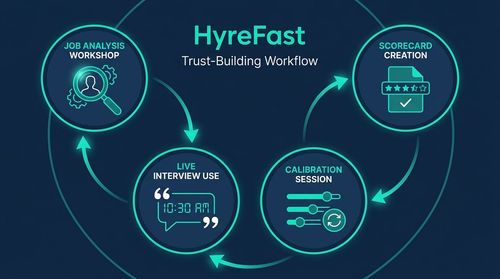
Here is how this looks in real time for a client hiring a mid-market account manager. First, the job analysis workshop reveals the client’s top performer’s superpower: “She does not just renew contracts—she uncovers hidden usage patterns in the data and proposes expansion ideas that increase ACV by 30% or more.” The scorecard is built with a competency called “Revenue expansion diagnostic.” Its anchors range from “Only discusses renewal terms; misses usage data signals” at level 1 to “Creates a repeatable framework for expansion hunting adopted by the team” at level 5. In the calibration session, the client scores past hires and realizes their “missed hire” scored a 2 on this competency—the client admits they overlooked this signal in the interview. During live use, the recruiter fills the scorecard after each interview, quoting timestamps: “At 6:18: ‘I noticed their enterprise clients underuse Feature X by 40%—I built a pitch showing how activating it could save $200K/year.’” The client sees the evidence and trusts the score. The outcome: the client uses the scorecard to reject a strong interviewee who lacked diagnostic depth but hire a quieter candidate who demonstrated it in their work sample, resulting in a 28% higher expansion rate in the first six months.
Conclusions
- Scorecards clients trust start with role-specific, impact-driven competencies derived from the client’s top performers—not HR templates.
- Behavioral anchors that describe observable actions (not traits) eliminate guesswork and make scores defensible.
- Mandatory evidence linkage (quotes, timestamps) transforms scorecards from opinion sheets into audit-ready proof points.
- Trust is measured by usage in decision-making, not completion rates—clients must actively reference scorecards to resolve disagreements.
Future Directions
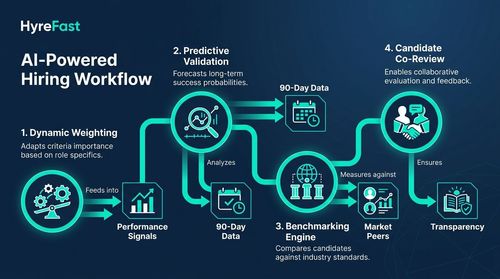
- Dynamic competency weighting: AI-assisted tools that suggest adjusting competency importance based on early performance signals, such as if new hires struggle with a particular skill, increase its weight in the scorecard.
- Predictive scorecard validation: Platforms that automatically correlate scorecard scores with 90-day performance data to flag which competencies need anchor refinement.
- Client-specific benchmarking engines: Anonymous aggregation of scorecard data across similar roles and clients to show where a candidate stands relative to market peers.
- Candidate co-review: Letting candidates see and comment on their own scorecard (with recruiter guidance) to increase transparency and reduce perception of bias.
Explore HyreFast Solutions
Interview as a Service
Outsource first-round interviews to AI.
AI Interview Bot
AI bot that conducts and evaluates interviews 24/7.
Video Interview Software
One-way async video interviews with AI scoring.
Phone Screening
Automate first-round phone calls with AI.
Interview Assessment
Structured assessments with AI scoring and reports.
AI Interview Platform
End-to-end platform for AI interviews and analytics.