
Why Top Recruitment Agencies in India Are Ditching Manual Screening in 2025
Top recruitment agencies in India are moving beyond manual resume screening to AI-powered hiring. Discover how automation, intelligent screening, and bias reduction are improving speed-to-hire, candidate quality, and recruiter productivity in today’s competitive talent market.
Table of Contents

Introduction
In the fast-evolving talent landscape of India, the recruitment industry is undergoing a quiet but profound transformation. The days when a recruiter’s value was measured by the number of resumes they could manually review in a day are fading fast.
Today, the top agencies in Bengaluru, Hyderabad, Pune, and beyond are no longer competing on who can screen the most CVs-they’re competing on who can screen the smartest.
Manual screening, once the backbone of recruitment, is being abandoned not as a cost-cutting measure, but as a strategic imperative driven by inefficiency, bias, and the relentless pace of modern hiring demands.
This shift isn’t about rejecting human judgment-it’s about recognizing that manual screening, in its traditional form, is a broken process. It’s slow, inconsistent, prone to unconscious bias, and woefully inadequate for handling the volume and complexity of today’s requisitions.
In its place, forward-thinking agencies are adopting intelligent, AI-powered screening systems that don’t just automate tasks-they enhance decision-making, improve candidate quality, and restore the recruiter’s role as a strategic talent advisor.
The catalysts for this change are clear: the explosion of applications per role, the rise of specialized and niche skill demands, the increasing importance of speed-to-hire, and a growing awareness of the limitations of human cognition when faced with information overload.
In 2025, the agencies that cling to manual screening aren’t just falling behind-they’re actively undermining their own effectiveness, client trust, and ability to compete in a market where precision, speed, and fairness are no longer optional.
In this article, we’ll explore the core reasons why India’s top recruitment agencies are leaving manual screening behind.
We’ll examine the hidden costs of manual processes, the transformative power of AI and automation in screening, and how this shift is redefining what it means to be a great recruiter in India’s dynamic talent market.
This isn’t just about technology-it’s about reclaiming the human element of recruitment by freeing it from the drudgery that has long obscured its true value.
The Application Avalanche
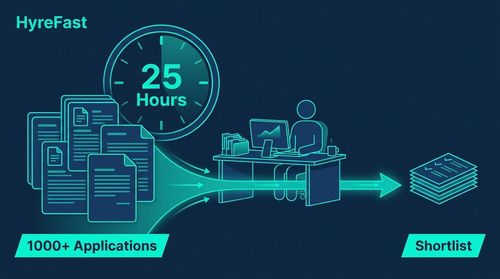
One of the most immediate and overwhelming pressures driving the abandonment of manual screening is the sheer volume of applications per role. In India’s competitive job market-especially for entry-level, mid-level, and high-demand tech roles-a single requisition can attract hundreds, even thousands, of applications.
- The Reality: A mid-level software engineer role in Bangalore might receive 500-800 applications. A customer service or BPO role can easily exceed 1,000. Even specialized roles in AI/ML or cybersecurity often see 200-400 applicants due to the popularity of upskilling programs and online courses.
- The Manual Screening Burden: At a conservative estimate of 90 seconds per resume (which is often unrealistic for a meaningful review), screening 500 applications takes 6.25 hours-nearly a full workday-before a single human interaction has occurred. At a more realistic 2-3 minutes per resume (to actually comprehend and judge suitability), that’s 16.5 to 25 hours-over three full days.
- The Consequence: This creates a massive bottleneck. Recruiters spend days just to get to the point of making first contact, delaying the entire hiring cycle. Clients needing to fill roles urgently-for project starts, seasonal spikes, or replacement hires-grow frustrated and turn to faster alternatives. The recruiter, meanwhile, is trapped in a cycle of repetitive, low-judgment work that feels like data entry, not talent acquisition.
The Signal-to-Noise Crisis: Most Applications Aren’t Viable
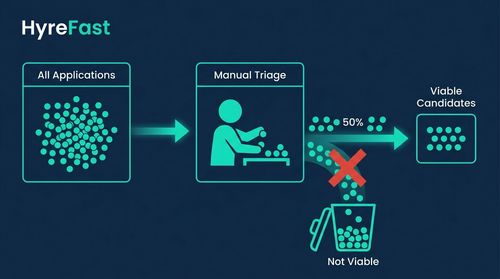
The volume problem is compounded by a harsh truth: the vast majority of applications for any given role are not genuinely viable candidates-not because the applicants lack potential, but because they don’t meet the objective, baseline requirements of the specific job.
- The Data: Internal agency audits and industry studies consistently show that 40-60% of applicants fail basic eligibility screens based on objective criteria: not authorized to work in the required location, lacks a non-negotiable certification (e.g., forklift license, nursing registration), has less than the minimum years of experience, or is unavailable for required shifts (nights, weekends).
- The Waste: When a recruiter spends time reviewing these applications, they’re not evaluating talent-they’re performing administrative triage.
- This is work that, in principle, doesn’t require human judgment and is highly susceptible to automation. Yet, in manual systems, recruiters often review these profiles out of habit or lack of trust in automated filters, wasting precious time on candidates who have no realistic chance of progressing.
- The Consequence: The recruiter’s valuable time is diluted by low-signal activity, reducing the proportion of their day spent on high-value tasks like assessing cultural fit, evaluating motivation, and building relationships-all of which directly impact placement quality and client satisfaction.
The Human Limits: Why Manual Screening Fails on Quality and Consistency
Even if volume weren’t an issue, manual screening suffers from fundamental flaws that undermine its reliability and fairness-flaws that become impossible to ignore in a market where clients demand precision and consistency.
1. Cognitive Fatigue and Decision Fatigue

The human brain is not designed to make hundreds of nuanced, binary decisions in a row without degradation in performance.
- The Reality: After reviewing 50-100 resumes, decision fatigue sets in. The recruiter’s ability to focus, weigh evidence, and apply consistent criteria diminishes. They begin to rely on heuristics, first impressions, or irrelevant details (like resume formatting or a familiar company name) rather than substantive qualifications.
- The Consequence: The same resume might receive a different evaluation in the morning vs. the afternoon. Qualified candidates are missed due to oversight, while unqualified ones slip through due to a momentary lapse in attention. The process becomes noisy, inconsistent, and increasingly dependent on the recruiter’s mood and energy level-not on the candidate’s actual suitability.
2. Unconscious Bias: The Invisible Distorter

Manual screening is highly susceptible to unconscious bias, which can systematically distort outcomes and undermine Diversity, Equity, and Inclusion (DEI) goals.
- The Reality: Recruiters, despite their best intentions, are influenced by factors like a candidate’s name (which can trigger ethnic or gender assumptions), educational pedigree (e.g., bias toward IITs or Ivy Leagues), photo, or even the order in which resumes are reviewed.
- A candidate with a “foreign-sounding” name or a non-metro college might be unfairly downgraded, while a candidate from a prestigious institution gets the benefit of the doubt-even if their actual skills are comparable.
- The Consequence: This leads to homogenous shortlists, missed opportunities to tap into talent from Tier-2/3 cities or non-traditional backgrounds, and reputational damage as clients and candidates perceive the process as unfair. In a market where DEI is increasingly a business imperative, biased screening is not just unethical-it’s commercially damaging.
3. Lack of Standardization and Comparability
Manual screening lacks the consistency needed for fair and reliable comparisons between candidates.
- The Reality: One recruiter might focus on years of experience, another on specific project details, another on communication style inferred from the resume. Without a standardized framework, evaluations are subjective, inconsistent, and difficult to audit or defend.
- The Consequence: When a client questions why Candidate A was shortlisted over Candidate B, the recruiter struggles to provide a clear, objective rationale. This erodes trust and makes the agency appear arbitrary or opaque. It also makes it nearly impossible to improve the process over time, as there’s no consistent data to learn from.
The Cost of Delay: How Manual Screening Loses Placements and Clients
The inefficiencies of manual screening don’t just waste time-they directly cause agencies to lose placements, damage relationships, and lose to faster competitors.
1. Slow Time-to-Hire Loses Top Talent
In today’s candidate-driven market-especially for in-demand tech, healthcare, and specialized roles-top talent moves fast.
- The Reality: A LinkedIn Talent Solutions report found that while the average time to hire for skilled roles is 42 days, top candidates are frequently off the market in 10 days or less. They often receive multiple offers within days of applying.
- The Consequence: If your agency takes 5-7 days just to screen and present a shortlist (due to manual review bottlenecks), you’re likely to lose the best candidates to competitors who can move faster. As one HR Director from a Pune-based SaaS company noted:
- “We switched agencies because our old partner took two weeks to screen for a senior data scientist role. By the time they sent us three candidates, we had already hired someone through a competitor who delivered in five days.”
- The Result: The agency doesn’t just lose a placement-it loses the opportunity to prove its value, and the client begins to question its ability to deliver speed.
2. Poor Candidate Experience Damages the Talent Pool and Brand
Manual screening often leads to long silences, generic communication, and a frustrating applicant experience.
- The Reality: Candidates who submit applications and hear nothing for days or weeks assume they’ve been rejected and disengage. They may share negative experiences on platforms like Glassdoor or LinkedIn, damaging the agency’s employer brand and making future sourcing harder and more expensive.
- The Consequence: High drop-off rates, low show-up rates for interviews, and negative word-of-mouth reduce the effectiveness of sourcing efforts. In a market where top talent has choices, a poor experience is a direct driver of offer rejections and lost placements.
3. Clients Lose Trust in the Agency’s Ability to Deliver
When screening is slow, inconsistent, and opaque, clients begin to doubt the agency’s competence and commitment.
- The Reality: Clients don’t just want candidates-they want confidence. They want to know that the agency understands their needs, is moving with urgency, and is presenting candidates based on a rigorous, fair process.
- The Consequence: After repeated experiences of slow, unclear, or seemingly arbitrary shortlists, clients start to micromanage (demanding more interview rounds, insisting on early involvement), seek alternatives, or relegate the agency to low-priority requisitions. Trust, once eroded, is incredibly hard to rebuild-and in the referral-driven world of recruitment, reputational damage spreads fast.
The AI and Automation Solution: Not Replacement, but Augmentation
The top agencies in India aren’t abandoning screening-they’re transforming it. They’re replacing the broken manual process with intelligent, AI-powered systems that don’t eliminate the recruiter-they liberate them from the drudgery that has long obscured their true value.
This isn’t about replacing human judgment with algorithms. It’s about using technology to handle the eliminable-so recruiters can focus on what they do best: building relationships, assessing motivation and cultural fit, and providing strategic counsel.
1. Automating the Eliminable: AI-Powered Eligibility Gates and Semantic Search
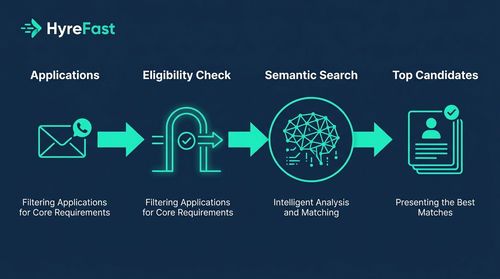
- How It Works: Instead of letting all applications flow into a manual review queue, agencies now use automated eligibility gates (knockout questionnaires via SMS/email) to filter out candidates who fail objective criteria (location, certifications, availability, right to work) before any human time is spent.
- Then, AI-powered semantic search and ranking (using NLP models like BERT or Sentence-BERT) parse resumes and job descriptions to understand meaning, not just keywords. They surface the top 10-20% of candidates based on conceptual fit-recognizing that “built recommendation engines” implies ML expertise, even if the exact phrase isn’t present.
- The Impact: This can reduce initial resume review time by 50-70%, shifting the recruiter’s focus from volume triage to quality assessment of a pre-vetted pool. One agency in Bengaluru reported that after implementing AI screening, their submission-to-interview ratio improved from 1:8 to 1:3-meaning hiring managers spent less time weeding out mismatches and more time evaluating genuine contenders.
2. Enhancing Consistency and Reducing Bias: Structured Assessment and Blind Screening
- How It Works: Agencies are combining AI with structured assessment tools to ensure fairness and consistency.
- Blind Screening: NLP is used to automatically redact names, photos, genders, ages, and university names from resumes before human review, reducing unconscious bias based on demographic factors.
- Structured Assessments: Tools like Pymetrics (neuroscience-based games), Harver (situational judgment tests), or Codility/HackerRank (coding challenges) provide objective, standardized measurements of cognitive abilities, behavioral traits, and technical skills.
- AI-Assisted Scoring (With Caution): For video interviews or written responses, AI can analyze responses against predefined rubrics for communication, problem-solving, or other competencies-but only after rigorous bias auditing to ensure the models themselves don’t perpetuate inequality.
- The Impact: This creates a more reliable, defensible evaluation process. Clients see that candidates are being assessed on merit, not on irrelevant factors. Recruiters gain confidence that their shortlists are based on consistent criteria-not gut feeling.
3. Eliminating Scheduling and Communication Friction: AI Orchestration
- How It Works: AI scheduling assistants (Calendly, X.ai) sync with recruiters’, hiring managers’, and candidates’ calendars to autonomously find and book optimal interview slots. Trigger-based SMS/email workflows keep candidates informed at every stage (application received, passed gate, interview scheduled, post-interview, rejected).
- The Impact: This eliminates the 3-5 email/message exchange typically needed to schedule an interview, saving 2-4 hours per requisition. Candidates feel informed and respected, reducing anxiety and no-show rates. Recruiters are freed from administrative hell to focus on high-value work.
4. Elevating the Recruiter Role: From Screener to Strategic Advisor
- How It Works: By automating the eliminable, AI allows recruiters to reclaim time for high-value activities:
- Deep Candidate Engagement: Investing time in understanding motivation, discussing career goals, providing feedback, and coaching candidates through the process.
- Strategic Client Partnership: Consulting with hiring managers on team dynamics, unspoken needs, long-term talent strategy, and sharing market intelligence (e.g., “We’re seeing salary expectations for this skill set rise by 15%-should we adjust the scope?”).
- Proactive Talent Pool Building: Nurturing relationships with passive candidates in niche communities, attending industry events, and building long-term talent pipelines.
- Quality Focus: Assessing nuanced fit, cultural alignment, and potential-areas where human judgment truly excels.
- The Impact: The recruiter shifts from a transactional processor to a trusted advisor-restoring their sense of purpose, reducing burnout, and increasing the perceived value of their service.
The Competitive Advantage: Why the Best Agencies Are Making the Shift
The agencies that have embraced AI-powered screening aren’t just surviving-they’re thriving. They’re seeing tangible improvements in speed, quality, client satisfaction, and recruiter well-being.
- Speed to Hire: Agencies report reducing time-to-first-qualified-candidate from days to hours. One Hyderabad-based GCC cut its average screening time for tech roles from 5 days to under 8 hours.
- Placement Quality: Submission-to-interview ratios have improved dramatically (e.g., from 1:10 to 1:4), meaning hiring managers spend less time on unsuitable candidates and more on genuine contenders.
- Client Trust and Retention: Clients appreciate the transparency, speed, and consistency. Agencies using AI scoring report higher satisfaction scores and lower churn, especially for high-volume and specialized requisitions.
- Recruiter Satisfaction: Surveys show that recruiters using AI-augmented processes report lower emotional exhaustion, higher sense of accomplishment, and greater intent to stay-they feel their expertise is finally being used effectively.
- DEI and Fairness: By combining blind screening, structured assessments, and bias-audited AI, agencies are able to present more diverse shortlists without compromising on quality-meeting client DEI goals while maintaining rigor.
The Road Ahead: Screening as a Strategic Function, Not a Chore
The shift away from manual screening in India’s top recruitment agencies isn’t a trend-it’s a fundamental redefinition of what recruitment can be. It’s a move from a process defined by volume and manual effort to one defined by precision, speed, fairness, and strategic value.
The agencies that will lead in 2025 and beyond aren’t just those with the biggest databases or the loudest marketing.
They’re the ones that have recognized that the true value of a recruiter isn’t in how many resumes they can read-but in how well they can understand a candidate’s potential, assess their fit, and build the relationships that win the war for talent.
By ditching manual screening, they’re not losing the human touch-they’re finally freeing it to shine.
The Future of Screening in India’s Top Agencies
- AI as a Co-Pilot, Not a Replacement: The focus will remain on augmented intelligence-using AI to handle volume and initial filtering, while recruiters focus on judgment, empathy, and strategy.
- Explainable AI (XAI) for Trust: Growing demand for models that don’t just score but explain why a candidate ranked highly-building trust with clients, candidates, and regulators.
- Skills-First, Credential-Less Hiring: Continued shift away from pedigree and toward verified skills, project portfolios, and potential-powered by AI inference from GitHub, Kaggle, and project work.
- Ethical AI Governance: Emergence of internal audit frameworks, bias bounties, and possibly industry standards around transparency, data privacy, and fairness in automated screening.
- The Recruiter as a Talent Strategist: The most successful recruiters will be those who use the time saved by AI to become indispensable partners-understanding business context, assessing nuanced fit, and guiding clients and candidates with insight and care.
Conclusion: The End of an Era, the Beginning of a Better One
Manual screening in recruitment isn’t just outdated-it’s actively harmful. It wastes time, introduces bias, slows down hiring, damages candidate experience, and obscures the true value of the recruiter’s expertise.
In 2025, the top agencies in India aren’t just moving away from it-they’re leaving it behind for good.
They’ve realized that the future of recruitment isn’t about sifting through more paper-it’s about using technology to see the signal clearly, quickly, and fairly.
It’s about using automation to eliminate the eliminable so that human judgment can be applied where it matters most: in understanding people, assessing potential, and building the connections that turn a requisition into a placement-and a placement into a partnership.
The agencies that have made this shift aren’t just more efficient. They’re more effective, more fair, and more human. And in an industry built on trust and connection, that’s not just an advantage-it’s the only way to win.