
Why Recruitment Agencies Lose Clients to Competitors Who Screen Faster
Speed in recruitment is no longer optional. Discover how AI-powered screening, automation, and semantic matching help agencies deliver faster hiring, reduce vacancy costs, and win clients in a competitive talent market.
Table of Contents

Introduction
In the high-stakes world of talent acquisition, speed has transformed from a competitive advantage into a survival mechanism.
Recruitment agencies that once built their reputation on deep industry relationships and meticulous processes are discovering that clients are leaving not because of poor candidate quality, but because competitors are screening candidates faster.
This shift isn't about cutting corners-it's about leveraging technology to compress timelines while maintaining, and often improving, quality standards.
When a client needs to fill a critical role-whether it's a senior AI engineer in Bangalore or a cybersecurity specialist in Singapore-every day the position remains vacant translates into delayed projects, overburdened teams, and measurable revenue loss.
Agencies that can deliver a qualified shortlist in 48 hours instead of two weeks aren't just winning individual mandates; they're fundamentally resetting client expectations about what's possible in recruitment.
The Cost of Vacancy Calculus
The financial impact of slow screening isn't theoretical-it's quantifiable and increasingly visible to clients. For a mid-level software engineer role in India with an average salary of ₹15 LPA, the daily productivity cost of vacancy amounts to approximately ₹8,200. A 30-day delay translates to nearly ₹2.5 lakhs in direct costs, not accounting for the ripple effects on project timelines and team morale.
Clients are becoming increasingly sophisticated in calculating these costs. When presented with data showing that Agency X delivers candidates in 5 days versus Agency Y's 1.5 days, the decision becomes straightforward-especially when quality metrics remain comparable.
The Society for Human Resource Management (SHRM) estimates the average cost per hire at nearly $4,700, but for specialized roles, this can exceed three times the annual salary.
Agencies that prolong the hiring cycle inadvertently inflate these costs, making themselves less attractive partners.
The Talent Window Closes Quickly
In today's candidate-driven market, especially for in-demand tech, healthcare, and executive roles, top talent often receives multiple offers within days.
A LinkedIn Talent Solutions report found that while the average time to hire for skilled roles is 42 days, top candidates are frequently off the market in 10 days or less.
As one HR Director from a Bengaluru FinTech startup noted: "We switched agencies because our old partner took three weeks to screen for a senior data scientist role.
By the time they sent us three candidates, we had already hired someone through a competitor who delivered in five days."
This reality creates a brutal selection pressure: agencies that can't screen quickly don't just miss deadlines-they miss the entire candidate pool.
From Keyword Matching to Semantic Understanding

The fundamental shift lies in how modern screening technologies process candidate information.
Traditional agencies rely on manual resume reviews and basic keyword matching-processes that inherently create bottlenecks and miss relevant candidates whose skills are described differently but are equally applicable.
Modern AI-powered tools use natural language processing (NLP) and semantic understanding to infer skills from context.
Instead of looking for the exact phrase "machine learning engineer," these systems recognize that a candidate who "built recommendation engines using collaborative filtering" possesses the required ML expertise.
Platforms like HireVue, Eightfold, and Phenom use transformer-based models (BERT, Sentence-BERT) to compare resumes and job descriptions at a conceptual level, reducing screening time from hours to minutes while improving match quality.
Automated Workflow Orchestration
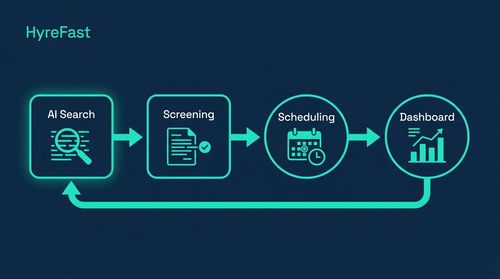
Leading agencies have redesigned their processes around specific technological capabilities that eliminate manual bottlenecks:
- AI-Powered Semantic Search: NLP models understand context, recognizing that "built recommendation engines using collaborative filtering" implies ML expertise even without the exact phrase "machine learning engineer"
- Automated Screening Pipelines: Resume parsing → skill inference → automated ranking → instant client notification happens seamlessly, often triggered the moment an application arrives
- Intelligent Scheduling: AI calendar coordination eliminates the 3-5 email exchanges typically needed to book interview slots
- Real-Time Dashboards: Clients get live views of pipeline status, reducing anxiety and the need for status-checking emails
This automation reduces administrative burden by up to 60%, freeing recruiters to focus on high-value activities like candidate engagement and client consultation.
Dynamic Talent Pool Management
Instead of starting from scratch for every requisition, technologically advanced agencies maintain dynamic talent pools enriched with AI-inferred skills, engagement history, and availability status.
When a new role opens, the system instantly rediscovers and ranks past applicants, silver medalists, and passive candidates who match the new criteria-often delivering a qualified shortlist in under an hour.
One agency in Bengaluru reported that after implementing AI screening, their submission-to-interview ratio improved from 1:8 to 1:3, meaning hiring managers spent less time weeding out mismatches and more time evaluating genuine contenders.
Perception of Competence and Commitment
In professional services, speed is often interpreted as a proxy for capability. When an agency responds rapidly with relevant candidates, it signals that they understand urgency and have the systems to deliver.
Conversely, slowness triggers doubts about whether the agency is overwhelmed, under-resourced, or not prioritizing the client's needs.
This perception extends beyond turnaround time to every touchpoint. An agency that uses AI chatbots to acknowledge applications instantly, schedules interviews via automated calendar sync, and provides proactive status updates projects competence at every interaction.
The manual agency, even if equally skilled, creates friction that undermines client confidence.
Enabling Collaborative, Agile Recruitment
Speed transforms recruitment from a one-shot delivery into a collaborative process. Quick turnaround enables rapid iteration: client feedback on the first candidate batch informs adjustments to search parameters, sourcing channels, or assessment criteria within hours rather than weeks.
This agile approach makes clients feel heard and in control of the process.
Slow agencies, operating on lengthy cycles, often deliver what the client wanted weeks ago, not what they need today. By the time they've screened and presented a batch, the client's priorities may have shifted, or worse-they've already engaged another agency that moved faster.
Beyond Technology Adoption to Process Re-engineering
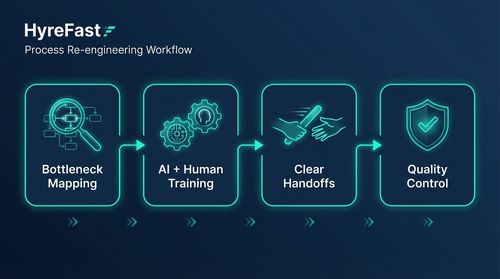
Implementing faster screening isn't just about purchasing software-it requires fundamental process re-engineering.
Successful agencies integrate AI capabilities into their core delivery workflow, making speed a repeatable, scalable outcome rather than a one-off heroic effort. This involves:
- Mapping existing screening bottlenecks and identifying automation opportunities
- Training recruiters to work alongside AI tools rather than being replaced by them
- Establishing clear handoff points between automated and human-driven processes
- Implementing quality control mechanisms to ensure speed doesn't compromise standards
Measuring What Matters: From Time-to-Fill to Time-to-Value
Progressive agencies are shifting their metrics from traditional time-to-fill measurements to more nuanced time-to-value indicators. This includes tracking:
- Time from job requisition to first qualified candidate presentation
- Candidate quality scores from hiring managers
- Client satisfaction with communication responsiveness
- Reduction in hiring manager time spent on screening
These metrics better reflect the client's experience and the agency's actual contribution to speeding up the hiring process.
The Future of Recruitment: Speed as Table Stakes
For recruitment agencies in 2025, screening speed has moved from a nice-to-have differentiator to a fundamental requirement for competitiveness.
Clients aren't asking for magic-they're asking for competence demonstrated through responsiveness. They want partners who understand that in talent acquisition, time truly kills deals.
Agencies that continue to rely on manual, linear processes will find themselves increasingly relegated to handling only the least urgent, least complex requisitions.
Those who embrace intelligent automation to compress screening time from days to hours aren't just improving efficiency; they're aligning their service model with the actual rhythms and pressures of modern business.
The message is clear: in the battle for client retention and growth, the fastest agency doesn't just win the race-it often determines who gets to compete at all.
The future of recruitment belongs to those who understand that screening speed isn't about working harder, but about working smarter with the right technological leverage.