
What to Look for in an AI Interview Platform Before…
Learn the must-have features of an AI interview platform, including scoring, fraud detection, candidate experience, analytics, and recruiter workflow fit.
Table of Contents

Introduction
The market is flooded with AI interview platforms promising to revolutionise hiring. But behind the bold claims, many fail to deliver on predictive validity, fairness, or practical integration.
For startups and hiring managers in India, where speed and cost efficiency are critical, choosing the wrong platform can amplify bias, create compliance risks, and waste budget.
This article cuts through the marketing noise to provide a no-nonsense framework based on academic research, regulatory trends, and real-world deployment lessons.
We will cover validation evidence, bias auditing, transparency, workflow integration, candidate experience, and vendor credibility.
Validation Evidence is the Non-Negotiable Starting Point
If a platform cannot prove its scores correlate with on-the-job success, you are buying expensive guesswork. This is the single most important criterion.
- Demand criterion-related validity studies linking platform scores to your specific job performance metrics. These should include 6-month manager ratings, promotion rates, sales quotas, or code quality scores. Generic hire/no-hire validation from other clients is insufficient.
- Check the training data foundation. Models trained on historical hiring decisions inherit past biases. Look for platforms trained on structured interview ratings or objective performance data, not subjective recruiter judgments.
- Ask for role-specific benchmarks. A platform validated for graduate engineering hiring may fail for sales or customer service. Request validation for your exact role type.
- Red flag: Vendors who only offer face validity or rely solely on client testimonials without statistical evidence.
Bias Auditing is Table Stakes, Not a Differentiator
Bias is not just an ethical issue; it is a legal and financial risk. New York City Local Law 144 requires annual bias audits for AI hiring tools, and the EU AI Act classifies employment AI as high-risk.
- Require recent, third-party bias audit reports measuring selection rates by gender, ethnicity, age, and disability status. Use the 4/5ths rule as the adverse impact threshold. Ask for raw data, not just a summary.
- Check for ongoing monitoring capabilities. The platform should enable you to run disparity analyses on your own data monthly. One-time audits are not enough.
- Evaluate bias mitigation techniques like adversarial debiasing, reweighing, or counterfactual fairness. Ask how they test for and mitigate proxy bias, such as zip codes correlating with race or graduation year correlating with age.
- Red flag: Vendors who say "our AI is unbiased" without providing audit methodology or data, or who refuse to share adverse impact results.
Transparency and Explainability Enable Trust and Action

If you cannot interpret the score, you cannot defend it, improve it, or trust it. Explainability is critical for recruiter adoption, candidate trust, and regulatory compliance.
- Demand feature-level explanations for each competency score. The platform should show which specific inputs drove the rating, such as "Used STAR method in 3/4 answers" or "Quantified impact by stating 30% efficiency increase."
- Look for attention weights or highlight reels that show moments in the video or transcript that contributed to the score. For example, a 15-second clip where the candidate explained trade-offs drove the analytical thinking rating.
- Ensure human override is frictionless. Recruiters must be able to adjust scores with one click and see how it impacts the overall ranking. The platform should log overrides for audit trails.
- Red flag: Black box scores with no breakdown, or explanations that are too vague to be actionable.
Integration Determines ROI
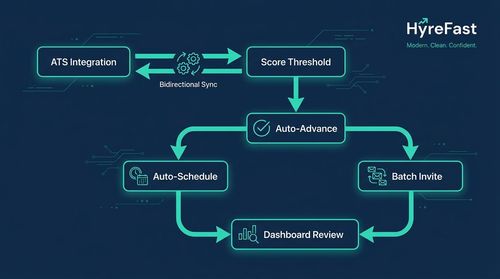
A platform that creates more work than it saves is a failure. Evaluate how it slots into your existing stack and daily routines.
- Look for native ATS/HRIS integration with bidirectional sync. Scores, transcripts, and flags should appear inside the candidate profile in your ATS, not in a separate portal. Ask for a demo showing the exact user flow.
- Automated triggers can auto-advance candidates who score above a threshold, auto-schedule next steps, or trigger reference checks. Manual handoffs kill efficiency.
- Batch processing capabilities are essential for high-volume roles. Can you invite 500 candidates with one click? Can you review 50 screens in under an hour via a dashboard with evidence highlights?
- Mobile and accessibility compliance are non-negotiable. Candidates should complete screens easily on iOS and Android. The platform must meet WCAG 2.1 AA standards.
- Red flag: Requires manual CSV uploads or downloads, forces recruiters to switch between multiple tools, or lacks mobile optimisation.
Candidate Experience Protects Your Brand
A frustrating screening experience increases drop-off and damages your employer brand. This is especially critical for passive or high-demand candidates.
- Asynchronous flexibility allows candidates to record responses on their own time with clear timing expectations. No scheduling hell.
- Practice opportunities let candidates test their camera and microphone and do a dry run before the real screen. Anxiety drops significantly when they know what to expect.
- Provide feedback loops. Even for rejects, offer one sentence of specific, actionable feedback. This turns rejected candidates into brand advocates.
- Be transparent about AI use. Clearly state in invitations that AI will analyse responses for specific competencies and that a human will review all scores. Include a link to your AI ethics policy.
- Red flag: Mandatory live AI-scored interviews, no accessibility options, or vague explanations of how AI is used.
Vendor Credibility Determines Long-Term Success
AI hiring tools require ongoing tuning, bias monitoring, and regulatory updates. Your vendor should be invested in your success beyond the sale.
- Ask for client references in your industry and role type. Speak to their TA leaders, not just sales contacts.
- Check the support structure. Is there a dedicated customer success manager? What is the SLA for technical issues? Do they offer bias audit assistance or validation consulting?
- Review roadmap transparency. Ask to see their 6-12 month product plan. Are they investing in explainability, new validation studies, or regulatory compliance features?
- Clarify data ownership and security. Who owns the video transcripts and scores? Where is data stored? What is their SOC 2 or ISO 27001 status?
- Red flag: High-pressure sales tactics, unwillingness to share client contacts, vague answers about data handling, or no clear path for ongoing validation.
Conclusions
- Prioritise validation over vendor claims. Only buy if they prove predictive validity for your specific context with data you can inspect.
- Bias auditing is table stakes. Demand recent, granular, third-party audit reports and the tools to run your own ongoing monitoring.
- Explainability enables trust and action. If you cannot see why a score was given, you cannot use it responsibly.
- Integration determines ROI. A platform that creates manual work or data silos will fail, no matter how smart the AI.
Future Directions
- Regulatory-driven standardisation will push vendors to offer native, audit-ready explainability features like SHAP values and counterfactual examples.
- Dynamic validation loops will allow platforms to automatically retrain models using your new hire performance data, closing the loop between screening scores and on-the-job success.
- Competency ontology sharing will create industry-specific skill graphs that reduce false negatives from non-traditional backgrounds by recognising equivalent competencies.
- Candidate-controlled data models will emerge, where candidates own their interview data and can grant or revoke access, shifting power dynamics and improving trust.
Want to identify strong candidates before interviews without relying on resumes?
Schedule a walkthrough: Book Demo
Learn more: Read our complete AI interview screening guide for everything you need to know about automating candidate screening with AI.
Explore: See how HyreFast's AI interview bot can automate your first-round screening — book a demo today.
Explore HyreFast Solutions
Interview as a Service
Outsource first-round interviews to AI.
AI Interview Bot
AI bot that conducts and evaluates interviews 24/7.
Video Interview Software
One-way async video interviews with AI scoring.
Phone Screening
Automate first-round phone calls with AI.
Interview Assessment
Structured assessments with AI scoring and reports.
AI Interview Platform
End-to-end platform for AI interviews and analytics.