
The Cost of One Bad Placement: Why Recruitment Agencies Need Structured Screening
Table of Contents

Introduction
In the high-stakes world of recruitment agency-client relationships, trust is the ultimate currency. A single successful placement can cement a partnership for years, while one disastrous hire can unravel months of hard work, damage reputations, and send clients fleeing to competitors. Yet, despite the clear stakes, many agencies continue to rely on ad-hoc, intuition-driven screening processes—treating each candidate evaluation as a unique art form rather than a repeatable, evidence-based science. This approach isn't just inefficient; it's perilously risky. The truth is stark: one bad placement can cost an agency far more than the lost fee from that single requisition. It triggers a cascade of direct financial losses, indirect operational damages, and reputational harm that can take years to overcome. In an era where clients are increasingly data-savvy, speed-conscious, and intolerant of mediocrity, relying on gut feeling and unstructured interviews is no longer a viable strategy—it's a liability waiting to happen. This isn't about eliminating the human element from recruitment. Quite the opposite. It's about recognizing that while human judgment is irreplaceable for assessing nuance, motivation, and cultural fit, it is profoundly fallible when left unstructured. Left to our own devices, even experienced recruiters are susceptible to biases, fatigue, and inconsistent evaluation criteria—all of which dramatically increase the likelihood of a mis-hire. Structured screening isn't about turning recruiters into robots. It's about giving them a reliable, evidence-based framework that enhances their expertise, reduces costly errors, and transforms the screening process from a gamble into a calculated, repeatable advantage. In this article, we'll dissect the true, often hidden, cost of a single bad placement—not just in dollars, but in eroded trust, damaged brands, and lost opportunities. Then, we'll show you exactly how to build a structured screening system that protects your agency's reputation, improves placement quality, and turns consistency into your most powerful competitive weapon.
The True Cost of One Bad Placement: Beyond the Obvious Fee Loss
When a placement goes wrong, the immediate, visible cost is often the replacement guarantee or rebate paid to the client. But this is merely the tip of the iceberg. The real damage extends far deeper, impacting finances, operations, relationships, and your agency's very ability to win future business.
1. Direct Financial Costs: More Than Just the Rebate
The most tangible costs are the immediate financial hits your agency absorbs when a hire fails.
- Replacement Guarantees & Rebates: Most agency contracts include a guarantee period (typically 30-90 days). If the candidate leaves or is terminated for performance reasons within this window, you're obligated to either find a replacement at no additional cost or refund a portion (often 50-100%) of the placement fee. For a mid-level role with a ₹15 LPA fee (equivalent to ~1.25 months' salary), a 100% rebate means losing the entire fee—₹1,87,500—for that requisition.
- Wasted Sourcing and Screening Investment: The time and money spent sourcing, advertising, screening, interviewing, and negotiating for the failed candidate is sunk cost. If your agency spent 10 hours on sourcing and screening at an effective rate of ₹1,500/hour (factoring in recruiter salary, overhead, and tools), that's ₹15,000 lost per failed placement.
- Extended Time-to-Fill: A bad hire doesn't just leave a vacancy—it often creates a negative experience that makes the client hesitant to refill quickly, or necessitates a more cautious, lengthier search process. The opportunity cost of having a role vacant for an extra 15-30 days (at a conservative ₹1,000/day cost of vacancy for many roles) adds another ₹15,000-₹30,000 in indirect financial impact.
- Opportunity Cost of Misallocated Resources: The recruiter hours spent managing the fallout from a bad placement (conducting exit interviews, managing client complaints, sourcing a replacement) are hours not spent on new business development, sourcing for high-margin roles, or building relationships with other clients. Conservative Estimate of Direct Financial Cost per Bad Placement: ₹45,000 - ₹1,00,000+ (and often significantly higher for senior or specialized roles)
2. Indirect Financial and Operational Costs: The Hidden Bleed
The damage doesn't stop at the balance sheet. Bad placements create operational friction and hidden costs that silently erode profitability.
- Client Productivity Loss: A poorly performing employee doesn't just do nothing—they can actively hinder team progress. They might require excessive hand-holding, produce error-prone work that needs rework, or create bottlenecks in workflows. For a role impacting team output, this can translate to measurable losses in productivity, delayed projects, or missed SLAs.
- Team Morale and Disruption: A bad fit can demoralize high-performing team members who feel they're carrying extra weight, create conflict, or even trigger additional turnover as good employees decide they've had enough. The cost of replacing another employee due to morale issues caused by the first bad hire is rarely quantified but very real.
- Managerial Time Drain: Hiring managers often spend significant time coaching, documenting performance issues, and managing the exit process for a bad hire—time taken away from their core responsibilities and strategic work.
- Increased Overtime and Temp Costs: To cover for the underperforming or absent employee, clients may resort to expensive overtime or last-minute temporary staffing—costs that could have been avoided with a better initial hire.
- Training and Onboarding Waste: The resources invested in orienting, training, and integrating the failed candidate (trainer time, materials, system access) are largely wasted. These indirect costs are notoriously difficult to quantify precisely but are consistently cited by HR leaders as substantial—often exceeding the direct financial costs of the bad hire itself.
3. Reputational and Relational Costs: The Erosion of Trust
This is where the damage becomes truly existential for an agency. Trust, once broken, is incredibly hard to rebuild—and in the referral-driven world of recruitment, reputational damage spreads fast.
- Immediate Client Dissatisfaction and Loss of Confidence: The client's trust in your agency's ability to understand their needs and deliver quality talent is shattered. They begin to question your screening rigor, your market understanding, and even your motives.
- Increased Scrutiny and Micromanagement: After a bad experience, clients often impose stricter controls: demanding more interview rounds, insisting on participating in early screens, or requiring additional assessments—all of which slow down the process and increase friction.
- Damage to the Employer Brand (Client's): If the bad hire was visible (e.g., in a customer-facing role), their poor performance can reflect poorly on the client's own brand—something they will not forget or forgive easily.
- Negative Word-of-Mouth and Referral Loss: Unhappy clients don't just leave—they tell others. In an industry where a significant portion of new business comes from referrals and reputation, one vocal detractor can deter multiple potential clients.
- Loss of Future Business with the Same Client: Even if the client doesn't immediately terminate the contract, they are far less likely to give you future requisitions—especially for critical, high-visibility, or hard-to-fill roles. You get relegated to handling only the lowest-priority, lowest-risk orders.
- Impact on Your Agency's Own Brand: If word gets out that your agency has a pattern of bad placements (whether true or perceived), it becomes harder to attract both clients and top-tier recruiter talent. Your ability to command premium fees diminishes.
4. Strategic and Long-Term Costs: The Competitive Disadvantage
The cumulative effect of these costs places your agency at a strategic disadvantage in an increasingly competitive market.
- Inability to Compete on Quality: Agencies known for consistent, high-quality placements can command premium fees and retain clients through market cycles. Those with a reputation for inconsistency are forced to compete primarily on price—a race to the bottom.
- Reduced Client Lifetime Value (LTV): Clients who have experienced a bad placement are less likely to engage in long-term, strategic partnerships. They remain transactional, making your revenue less predictable and stable.
- Higher Sales and Marketing Costs: To replace lost clients and overcome reputational damage, you need to invest more heavily in business development, marketing, and sales efforts—driving up your customer acquisition cost (CAC).
- Difficulty Attracting Top Recruiter Talent: Experienced, high-performing recruiters prefer to work for agencies with strong processes and reputations for quality. A perception of chaotic or unreliable screening makes it harder to hire and retain your own best people.
- Vulnerability to Market Shifts: In downturns, clients first cut ties with agencies they perceive as risky or inconsistent. In upturns, they flock to those with proven reliability. An unstructured screening process makes your agency more vulnerable to economic cycles.
Why Unstructured Screening Fails: The Human Judgment Trap
If the costs are so clear, why do so many agencies still rely on unstructured, intuition-driven screening? The answer lies in a dangerous misconception about human judgment.
The Illusion of the Expert Recruiter
Many experienced recruiters believe that their years of practice have honed their intuition to a near-infallible tool for assessing talent. They trust their "gut feeling" about a candidate's potential, motivation, or fit.
The Reality: Human Judgment is Flawed Without Structure
Decades of research in psychology and hiring science show that unaided human judgment in hiring is highly susceptible to systematic errors—especially when unstructured.
- Confirmation Bias: We seek information that confirms our first impression and ignore contradictory evidence. A candidate who shares our alma mater or hobby might get the benefit of the doubt, while one who doesn't faces a higher bar.
- Halo/Horn Effect: One strong trait (e.g., confidence, prestigious school) can make us view everything else positively (halo), while one weak trait (e.g., nervousness, gap in resume) can taint our entire perception (horn).
- Similarity Bias (Affinity Bias): We tend to favor candidates who are similar to us in background, personality, or interests—mistaking familiarity for competence.
- Contrast Effect: Our evaluation of a candidate is heavily influenced by the ones we just saw. A mediocre candidate looks great after a string of poor ones, and vice versa.
- Fatigue and Inconsistency: After screening 10+ candidates in a day, our ability to focus and apply consistent criteria diminishes. The same candidate might get a different score in the morning vs. the afternoon.
- Overreliance on Unstructured Interviews: Unstructured conversations are notoriously poor predictors of job performance. They often reward charisma and interview skills over actual competence and are highly susceptible to the biases above.
- Lack of Defined Criteria: Without a clear, agreed-upon set of what constitutes success in the role, each recruiter (or hiring manager) evaluates based on their own internal, often unconscious, template. The result is not a holistic, nuanced assessment—it's a noisy, biased, and inconsistent process where the outcome depends as much on the recruiter's mood, the order of candidates, and irrelevant similarities as it does on the candidate's actual suitability for the role.
The Solution: Structured Screening as a Risk Mitigation and Quality Engine
Structured screening isn't about removing the recruiter from the process. It's about augmenting their expertise with a reliable, evidence-based framework that minimizes bias, maximizes consistency, and focuses their judgment where it adds the most value. Think of it like aviation: pilots don't fly by the seat of their pants—they use checklists, instruments, and procedures to enhance their skill and reduce the risk of human error. Similarly, structured screening gives recruiters the tools to make better, more defensible decisions.
Core Principles of Effective Structured Screening
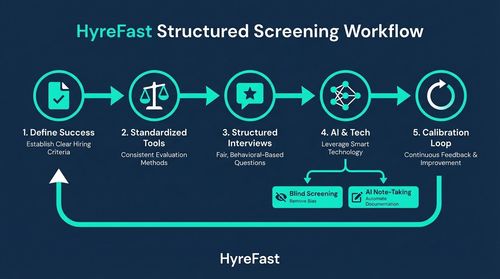
- Define Success Clearly (The Job Analysis): Before screening begins, collaboratively define what success looks like in the role. This isn't just the JD—it's a deep dive into the actual tasks, challenges, and competencies required.
- Ask: What are the top 3-5 problems this person needs to solve in the first 6 months? What skills, behaviors, and attitudes are truly non-negotiable? What would a high performer look like vs. an average one?
- Output: A competency model or success profile that lists the specific, observable capabilities needed (e.g., "Ability to troubleshoot SQL Server performance issues," "Experience managing stakeholder expectations in agile sprints," "Comfort with ambiguity and rapid priority shifts").
- Use Standardized, Job-Relevant Assessment Tools: Match your screening methods to the competencies you've defined. Avoid generic, one-size-fits-all approaches.
- For Knowledge/Skills: Use validated tests, work samples, case studies, or technical challenges that mirror actual job tasks (e.g., a debugging exercise for a dev role, a mock customer call for a support role).
- For Behavioral Traits: Use structured interview questions based on the STAR (Situation, Task, Action, Result) method or situational judgment tests (SJTs) that present realistic scenarios.
- For Cognitive Abilities: Use validated, fair ability tests (numerical, logical, verbal) where relevant to the role.
- Key: Ensure every candidate is assessed against the same criteria using the same tools.
- Implement Structured Interviews (The Gold Standard for Conversational Assessment):
- The Format: Use a consistent interview guide with the same set of questions asked in the same order to every candidate. Focus on behavioral ("Tell me about a time when...") and situational ("What would you do if...") questions tied directly to the defined competencies.
- The Scoring: Use a predefined rating scale (e.g., 1-5) with clear behavioral anchors for each score point (e.g., for "Problem Solving": 1 = "Unable to identify the problem," 3 = "Identifies problem and suggests a basic solution," 5 = "Identifies root cause, evaluates multiple solutions, selects optimal approach").
- The Benefit: This dramatically increases reliability and reduces bias compared to unstructured conversations. Studies show structured interviews are up to 2x more predictive of job performance than unstructured ones.
- Leverage Technology to Enhance Consistency and Reduce Bias:
- Automated Eligibility Gates: Use knockout questionnaires (as discussed previously) to objectively filter candidates on non-negotiable criteria (location, certifications, availability, right to work) before any human judgment is applied.
- AI-Powered Skill Matching (With Caution): Use semantic search and ranking to surface candidates whose resumes conceptually align with the job's requirements—helping to ensure human review time is spent on the most relevant profiles. Crucially, audit these tools for bias.
- Structured Assessment Platforms: Use tools like HireVue (for structured video interviews with AI-assisted scoring only for predefined competencies), Codility/HackerRank (for objective code evaluation), or Harver (for situational judgment and ability tests) to deliver consistent, bias-resistant evaluations.
- Blind Screening: Use NLP to automatically redact names, photos, genders, ages, and university names from resumes before human review to reduce unconscious bias based on demographic factors.
- AI Note-Taking & Summarization: Use tools like Fireflies.ai or Otter.ai to capture key points from interviews, ensuring nothing is missed and enabling fairer post-interview calibration.
- Implement Calibration and Feedback Loops:
- Pre-Hire Calibration: Before starting interviews, have all interviewers (recruiters, hiring managers, panelists) review the competency model, discuss the rating scales, and score a few sample responses together to ensure they're applying the criteria consistently.
- Post-Hire Feedback: After placement (and especially if it doesn't work out), conduct a debrief: What did our screening process predict correctly? What did it miss? How can we improve the competency model or assessment tools for next time?
- Ongoing Audit: Regularly review your hiring data: Are certain demographics consistently scoring lower or higher? Are there surprises in who succeeds vs. who fails? Use this to refine your process.
Building Your Agency's Structured Screening System: A Practical Blueprint
You don't need to boil the ocean. Start where you can get the most impact and build momentum.
Phase 1: Foundational Work - Define What Success Looks Like (Weeks 1-2)
- For Each Recurring Role Type/Family: Conduct a role discovery session with the hiring manager (or use data from past successful placements if internal).
- Ask: What are the non-negotiable hard skills? What are the key behavioral competencies (e.g., problem-solving, communication, resilience, learnability)? What does "good" actually look like in day-to-day work?
- Output: Create a one-page "Success Profile" for each role type (e.g., "Entry-Level Customer Service Agent," "Junior Java Developer," "BPO Team Leader"). This becomes your screening north star.
Phase 2: Build the Assessment Toolkit (Weeks 3-6)
- Match Tools to Competencies: For each Success Profile, decide how you'll assess each competency.
- Hard Skill/Knowledge: Validated test, work sample, technical challenge.
- Behavioral Competency: Structured interview questions (STAR/SJT).
- Cognitive Ability: Validated ability test (if job-relevant).
- Motivation/Fit: Questions about career goals, interest in the specific role/company.
- Build Your Interview Guide: Create a standardized question list and scoring rubric for each role type based on the Success Profile.
- Set Up Eligibility Gates: Design and automate knockout questionnaires for common non-negotiables (location, certifications, availability, right to work, salary expectations).
- Choose Your Tech Stack: Select tools for automated gates, skill matching (if used), structured assessments, and note-taking. Start simple—you can use Google Forms for questionnaires and basic scoring, then upgrade.
Phase 3: Implement and Calibrate (Weeks 7-10)
- Train Your Team: Run workshops on the Success Profiles, structured interviewing techniques, and how to use the scoring rubrics. Practice with role-plays.
- Conduct Calibration Sessions: Before going live, have recruiters and (if possible) hiring managers score the same sample responses (written or video) using your guide. Discuss discrepancies until you reach consensus on what each score point means.
- Launch Pilot: Use the structured process for a few live requisitions. Track time taken, recruiter feedback, and initial hiring manager impressions.
- Refine: Based on pilot feedback, adjust the length of the guide, the clarity of questions, or the scoring anchors.
Phase 4: Embed, Audit, and Improve (Ongoing)
- Make it Standard: Require the use of the Success Profile and structured guide for all requisitions of that type. Integrate it into your ATS workflow if possible.
- Track Metrics: Monitor:
- Time-to-fill (should stabilize or improve as efficiency gains kick in)
- Submission-to-interview ratio (should increase as screening becomes more accurate)
- Hiring manager satisfaction with shortlists and hires
- Offer acceptance rates
- Early turnover/performance of placed candidates (6-month check-in)
- Audit for Bias and Fairness: Regularly review your data:
- Are pass rates similar across demographic groups (gender, ethnicity, education background) for comparable roles?
- Are there surprises in who succeeds vs. who fails?
- Use this to refine your Success Profile, assessment tools, or screening criteria.
- Close the Loop with Clients: Share your structured approach as a value-add: "We use a competency-based, structured screening process to ensure we're presenting candidates who are truly aligned with your needs—not just matching keywords."
- Continuously Improve: Treat your screening system as a living document. Update Success Profiles as roles evolve, refine assessment tools based on feedback, and stay current on best practices in hiring science.
Conclusion: Structure is the Ultimate Risk Management Tool
The cost of one bad placement isn't just a line item on a P&L—it's a potential inflection point that can alter the trajectory of an agency's client relationships, reputation, and competitive standing. In a market where clients are increasingly sophisticated, data-literate, and intolerant of inconsistency, relying on unstructured screening is not a badge of experience—it's a vulnerability. Structured screening isn't about stifling recruiter expertise or turning hiring into a mechanical process. It's about respecting the complexity of human judgment by giving it the right tools to succeed. It's about recognizing that while a recruiter's intuition is valuable, it is far more reliable, fair, and effective when guided by a clear definition of success, standardized assessment methods, and a commitment to consistency and fairness. By implementing structured screening, you don't just reduce the risk of a bad hire—you build a foundation of trust and reliability. You show clients that you don't just guess at talent; you measure it against what actually matters for success in their specific context. You turn screening from a potential liability into a demonstrable strength—a signal that your agency operates with rigor, fairness, and a relentless focus on quality. In the long run, the agencies that win aren't just those with the biggest databases or the loudest marketing. They're the ones that clients trust implicitly to deliver not just candidates, but the right candidates—time after time, requisition after requisition. And that trust is built not on luck or charisma, but on the quiet, consistent power of a well-structured process. Start building yours today. Your reputation—and your bottom line—depend on it.