
Stop Losing Placements to Slow Screening: A Playbook for High-Volume Recruitment Agencies
Struggling with slow screening in high-volume hiring? Learn how recruitment agencies can use AI, automation, and structured workflows to reduce screening time, improve candidate experience, and win more placements faster.
Table of Contents

Introduction
In the high-stakes arena of high-volume recruitment, speed isn't just an advantage-it's the price of entry. Agencies that once competed on relationship depth and sourcing breadth are now discovering that clients measure success in hours and days, not weeks and months.
When a retail chain needs 50 seasonal associates before Diwali, a BPO requires 200 agents for a new campaign launch, or a manufacturing plant must fill 100 operator roles to meet quarterly targets, every hour the screening process lags translates directly into lost revenue, operational strain, and eroded client trust.
The brutal truth is that in high-volume hiring, the agency that screens fastest doesn't just win more placements-it often determines which agency gets to play at all. Clients facing urgent talent needs don't have the luxury of waiting for meticulous, manual processes.
They gravitate toward partners who can deliver qualified candidates at the speed of business, turning recruitment from a cost center into a strategic enabler of operational agility.
This playbook isn't about cutting corners or sacrificing quality. It's about systematically re-engineering the screening process to eliminate waste, leverage intelligent automation, and reclaim recruiter time for high-value activities.
We'll break down exactly where high-volume agencies lose time, diagnose the root causes of slowness, and provide a step-bycket, actionable framework to compress screening cycles from days to hours-without compromising on candidate quality or client satisfaction.
The Financial Bleed of Delayed Screening
In high-volume contexts, the cost of vacancy isn't theoretical-it's immediate, scalable, and devastating to the client's bottom line.
- Operational Disruption: A call center missing its agent target by 20% doesn't just have longer wait times-it risks SLA penalties, lost sales, and damaged customer satisfaction. A warehouse short on pickers and packers misses shipping deadlines, incurs overtime costs, and strains the entire supply chain.
- Overtime and Rush Costs: To cover gaps, clients often pay premium overtime rates or engage expensive last-minute temp agencies-costs that could have been avoided with timely placement.
- Project Delays and Revenue Impact: For time-bound projects (e.g., event staffing, seasonal retail, campaign launches), delayed hiring directly translates into missed opportunities and unrecoverable revenue loss.
- The Math is Unforgiving: If filling 100 roles takes your agency 30 days versus a competitor's 15 days, and each day of vacancy costs the client ₹1,000 per role (a conservative estimate for many entry-level/mid-level positions), you're indirectly responsible for ₹1.5 lakhs in avoidable costs per requisition. Multiply that across multiple clients, and the competitive disadvantage becomes existential.
The Candidate Experience is a Competitive Battleground
In high-volume hiring, especially for entry-level and hourly roles, the candidate experience isn't just about fairness-it's a direct driver of show-up rates, offer acceptance, and employer brand perception.
- Ghosting and Drop-off: A lengthy, opaque screening process frustrates candidates who are often applying to multiple roles simultaneously. If your agency takes 10 days to schedule an initial screen while a competitor does it in 2, you'll lose the most responsive and motivated candidates to faster processes.
- The Application Abyss: Candidates who submit applications and hear nothing for days or weeks assume they've been rejected and disengage. This not only wastes your sourcing effort but damages the talent pool for future requisitions.
- Speed as a Signal of Respect: A rapid, communicative process signals that the agency and client value the candidate's time. In markets where top talent has choices, this perception can be the deciding factor between accepting an offer and continuing the search.
Your Recruiters are Burning Out on Low-Value Work
Perhaps the most insidious cost of slow screening is its impact on your own team. When recruiters spend 60-70% of their time on manual, repetitive tasks-endless resume triage, scheduling ping-pong, and chasing unresponsive applicants-they aren't just inefficient; they're demoralized.
- The Opportunity Cost Trap: Every hour spent manually reviewing a clearly unqualified resume is an hour not spent building relationships with hiring managers, coaching candidates through the process, or sourcing for hard-to-fill, high-margin roles.
- The Quality Decline Spiral: Fatigued, overburdened recruiters are more likely to cut corners, miss subtle cues in candidate interactions, and rely on gut feeling rather than structured assessment-ultimately harming the quality of your placements.
- The Retention Risk: Recruiters stuck in a cycle of monotonous, high-volume screening are prime candidates for burnout and turnover, taking their institutional knowledge and client relationships with them.
Diagnosing the Bottlenecks: Where High-Volume Screening Actually Slows Down
Before fixing the problem, you need to know exactly where the time is going. In high-volume recruitment, the delays aren't usually in one big, obvious place-they're the cumulative effect of multiple small frictions that compound at scale.
1. The Resume Triage Black Hole: Manual Review at Scale
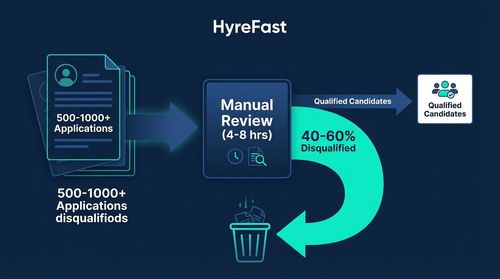
This is the single largest time sink in high-volume screening. When a requisition attracts 500-1000+ applications (common for retail, BPO, or entry-level tech roles), even a "quick" 30-second review per resume adds up to 4-8 hours of pure screening time-before a single human interaction has occurred.
- The Problem: Much of this time is spent on candidates who are immediately disqualifiable by objective criteria: wrong location, insufficient availability (e.g., can't work night shifts), missing mandatory certifications (e.g., for forklift operation), or lacking the legal right to work.
- The Waste: Studies show that 40-60% of applications for high-volume roles fail basic eligibility screens. Yet, recruiters often review these manually because they don't trust automated filters or lack the tools to apply objective gates at scale.
2. The Scheduling Vortex: Coordinating Chaos at Volume
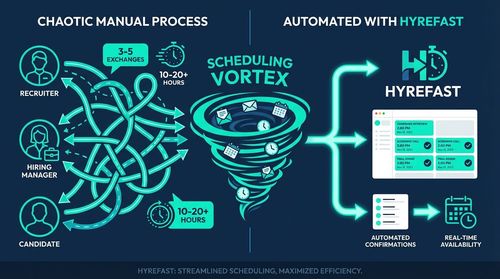
Once you've identified a pool of potentially promising candidates, the logistical nightmare of scheduling interviews begins-and it scales poorly.
- The Problem: Coordinating even a single interview between a recruiter, hiring manager (or hiring manager proxy), and candidate can require 3-5 email or message exchanges. For a high-volume requisition needing to screen 50 candidates for 20 slots, this can easily consume 10-20+ hours of recruiter time.
- The Aggravating Factors: Last-minute cancellations, no-shows, and time zone mismatches (especially if sourcing nationally) turn scheduling into a daily fire drill rather than a predictable process.
- The Waste: This is pure administrative overhead. It doesn't require a recruiter's judgment, expertise, or relationship-building skills-it's a task that is highly susceptible to automation and batch processing.
3. The Communication Black Hole: Lack of Proactive Engagement
High-volume candidates often feel like they've disappeared into a void after applying, leading to frustration, drop-off, and damage to the talent pool.
- The Problem: After submitting an application, candidates frequently receive no acknowledgment, no status update, and no guidance on next steps. They're left wondering: "Did they get it? Am I still in the running? Should I apply elsewhere?"
- The Consequence: This uncertainty drives candidates to pursue other opportunities, increases no-show rates for scheduled interviews, and generates negative word-of-mouth that makes future sourcing harder and more expensive.
- The Waste: The time spent sourcing and attracting candidates is partially or wholly wasted because the process fails to keep them engaged and moving forward.
4. The Inefficient Initial Screen: Talking Without Qualifying
Even after a resume passes muster and an interview is scheduled, the initial screening call often fails to efficiently determine fit, leading to wasted time for both parties.
- The Problem: These calls frequently devolve into unstructured conversations where the recruiter rehashes resume details, fails to ask targeted knockout questions (e.g., "Are you available to work weekends?", "What is your expected salary?", "Do you have reliable transportation?"), or spends too much time building rapport before assessing basic compatibility.
- The Result: A recruiter might spend 15-20 minutes on a call only to discover a fundamental mismatch that could have been resolved in 2-3 minutes with a structured guide.
- The Waste: If 30-50% of initial screens end in early disqualification for avoidable reasons, then a significant portion of that talk time is wasted-time that could have been spent engaging more promising candidates.
5. The Reactive Sourcing Trap: Starting from Scratch Every Time
High-volume agencies often treat each requisition as a brand-new project, ignoring the wealth of data and relationships they've already built.
- The Problem: Instead of leveraging past applicants, silver medalists (strong candidates who just missed out), or engaged talent pools, recruiters start each search with a blank slate, re-sourcing the same channels and re-screening the same types of profiles.
- The Consequence: This ignores the fact that a significant portion of the talent needed for recurring high-volume roles (e.g., monthly BPO hiring, quarterly retail spikes) consists of familiar faces-people who have applied before, know the process, and are often quicker to re-engage.
- The Waste: This represents a double loss: redundant effort in sourcing and screening, and the missed opportunity to build velocity through familiarity and trust.
The Root Causes: Why Slowness Persists in High-Volume Agencies
Understanding where the delays occur is only half the battle. To fix them sustainably, you need to understand why they exist in the first place.
1. Legacy Processes Designed for Low Volume, High Touch
Many high-volume agencies still operate on processes inherited from executive or niche recruitment models, where manual resume review and personalized outreach were feasible due to low applicant numbers.
These processes simply don't scale when faced with hundreds or thousands of applications per requisition.
2. Misplaced Faith in Manual Control
There's a persistent belief that human review is inherently superior to automation, especially for "reading between the lines" on a resume.
While human judgment is irreplaceable for assessing nuance and cultural fit, it's inefficient and error-prone for applying objective eligibility criteria at scale-where machines excel.
3. Activity-Based Metrics Rewarding Busyness, Not Outcomes
Many agencies measure recruiter performance on inputs: number of resumes reviewed, calls made, emails sent. This incentivizes doing rather than achieving.
A recruiter who spends 6 hours manually screening 400 resumes looks "busy" but may be less effective than one who uses automation to screen 1000 resumes in 30 minutes and spends the saved time on candidate engagement and client consultation.
4. Fragmented, Non-Integrated Technology Stacks
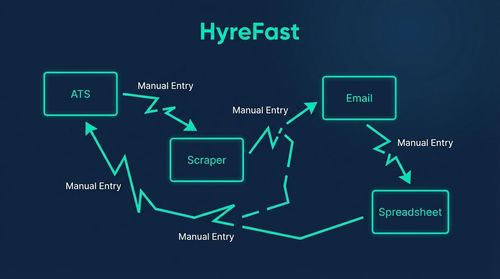
High-volume agencies often rely on a patchwork of tools: an ATS for tracking, a separate LinkedIn or job board scraper for sourcing, basic email for communication, and manual spreadsheets for scheduling.
The lack of integration forces constant context-switching, manual data re-entry, and creates opportunities for errors and delays.
5. Insufficient Investment in Automation for Repetitive Tasks
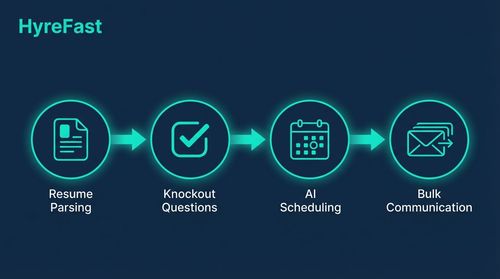
Despite the clear ROI, many agencies hesitate to invest in tools that automate resume parsing, knockout questionnaires, AI scheduling, or bulk communication-seeing them as expenses rather than force multipliers that directly increase placement volume and recruiter productivity.
The Playbook: A Step-by-Step Framework to Screen at the Speed of Business
The solution isn't to work harder-it's to work smarter by redesigning the screening process around elimination, automation, and iteration. Here’s how high-volume agencies can systematically compress screening cycles from days to hours.
Phase 1: Eliminate Waste at the Top of the Funnel (Target: 50-70% Time Reduction in Initial Screening)
Goal: Stop wasting recruiter time on candidates who are objectively unqualified or disengaged.
Tactic 1: Implement Automated Eligibility Gates with Knockout Questionnaires
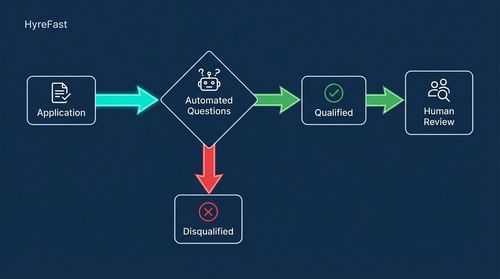
- How: Before any recruiter time is invested, trigger an automated SMS or email with a short, role-specific questionnaire (e.g., "Are you available to work night shifts?", "Do you have a valid forklift license?", "What is your expected monthly salary?", "Can you start within 2 weeks?").
- Tools: Use integrated assessment platforms (e.g., HireVue, Harver, Codility for basic checks) or even sophisticated form tools with conditional logic (Typeform, Google Forms + Apps Script) linked to your ATS.
- Impact: Instantly filters out 40-60% of applicants who fail basic objective criteria. Only those who pass enter the human screening queue. This can reduce initial resume review time by 50-70%.
Tactic 2: Deploy AI-Powered Semantic Search and Ranking
- How: Instead of manual Boolean searches or basic keyword matching, use AI-driven semantic search to parse resumes and applications. These systems understand context-recognizing that "experience with SAP MM" implies logistics expertise, or that "managed a team of 5" suggests supervisory capability-even if the exact phrases aren't present.
- Tools: Platforms like Eightfold, Phenom, or HireVue use NLP and transformer models (BERT, Sentence-BERT) to create semantic embeddings of resumes and JDs, ranking candidates by conceptual fit.
- Impact: Surfaces the top 10-20% of candidates for human review, significantly improving the signal-to-noise ratio. Reduces time spent on irrelevant profiles and increases the quality of the shortlist.
Tactic 3: Automate Resume Parsing and Data Enrichment
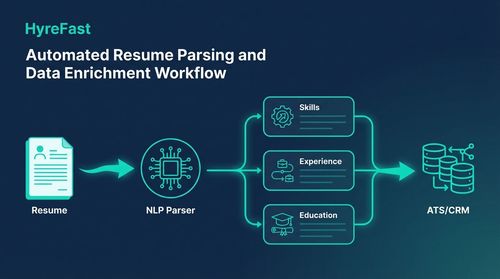
- How: Use NLP-powered resume parsers to automatically extract structured data from applications (skills, titles, companies, dates, education, certifications) and populate your ATS or CRM.
- Tools: Services like Sovren, Textkernel, or built-in ATS parsing engines.
- Impact: Eliminates manual data entry, enables powerful filtering and matching, and creates clean data for analytics and automation downstream.
Phase 2: Eliminate Scheduling Friction (Target: 80-90% Reduction in Coordination Time)
Goal: Turn interview scheduling from a recruiter task into a seamless, automated background process.
Tactic 1: Integrate AI Scheduling Assistants
- How: Deploy tools that sync with recruiters', hiring managers' (or hiring leads'), and candidates' calendars (Google Calendar, Outlook) to autonomously find and book optimal interview slots.
- Tools: Calendly, X.ai, Clara, or integrated scheduling modules within advanced ATS/CRM platforms.
- Features to Look For: Group scheduling (finding mutual availability for multiple panelists), time zone intelligence, automated reminders, and self-service rescheduling links for candidates.
- Impact: Eliminates the 3-5 email/message exchange cycle per interview. Can save 2-4 hours per requisition by turning scheduling into a zero-touch process.
Tactic 2: Implement Batch and Self-Service Scheduling
- How: For high-volume initial screens, offer candidates a personalized link to book into predefined time slots (e.g., "Choose a 15-minute slot between 2-4 PM today"). Use batch scheduling tools to handle multiple bookings at once.
- Impact: Further reduces recruiter involvement and empowers candidates to engage on their terms, improving show-up rates.
Phase 3: Eliminate Communication Black Holes (Target: Near-Zero Candidate Drop-off Due to Lack of Updates)
Goal: Keep candidates informed, engaged, and moving through the process with minimal recruiter effort.
Tactic 1: Implement Automated, Trigger-Based Communication
- How: Set up workflows that send personalized messages based on candidate actions and status changes in your ATS.
- Examples:
- Application received: "Thanks for applying! We'll review your profile and get back to you within 24 hours."
- Passed eligibility gate: "Great news! You've moved to the next step. Please schedule your interview here [link]."
- Interview scheduled: "Your interview is confirmed for [date/time]. Here's what to expect..."
- Post-interview: "Thanks for your time! We'll update you on next steps by [date]."
- Rejected (after screen): "We've decided to move forward with other candidates whose experience more closely matches this role. We'll keep your profile for future opportunities."
- Tools: Marketing automation platforms (HubSpot, Mailchimp), integrated ATS communication features, or tools like Zapier/Make to connect your ATS to email/SMS services.
- Impact: Reduces candidate anxiety, decreases no-show rates, improves offer acceptance, and builds a positive employer brand-all with minimal manual effort after initial setup.
Tactic 2: Use AI Chatbots for Instant FAQ Resolution
- How: Deploy a chatbot on your career page or within your application flow to answer common questions (pay rate, shift timings, location, dress code, process timeline) 24/7.
- Tools: Many ATS platforms have built-in chatbots, or services like Intercom, Drift, or custom solutions using LLMs.
- Impact: Frees recruiters from answering repetitive questions and improves the candidate experience from the first touchpoint.
Phase 4: Eliminate Inefficient Initial Screens (Target: 50% Reduction in Wasted Talk Time)
Goal: Ensure that every minute a recruiter spends on a call is focused on assessing genuine fit, not rehashing resume basics or missing disqualifiers.
Tactic 1: Adopt Structured, Knockout-Driven Call Guides
- How: Provide recruiters with a standardized, 10-15 minute call script focused on verifying objective fit and motivation. Use a simple scoring system or checklist.
- Key Elements to Cover:
- Eligibility re-confirmation (location, availability, right to work)
- Salary/rate expectations
- Notice period / start date availability
- 2-3 critical hard skills or experiences (specific to the role)
- Basic motivation and interest ("What attracted you to this role?")
- Any major red flags from the resume (e.g., frequent job-hopping, unexplained gaps)
- Impact: Ensures consistency, reduces reliance on memory, and allows recruiters to quickly identify mismatches. Can reduce ineffective talk time by 30-50%.
Tactic 2: Integrate Real-Time Skill Validation (Where Applicable)
- How: For roles requiring basic technical or cognitive skills (e.g., data entry accuracy, basic math, language proficiency), embed a short, validated assessment before or during the initial screen.
- Tools: Platforms like Harver, Criteria Corp, or even simple Google Forms with timed quizzes.
- Example: For a data entry role, have candidates complete a 5-minute accuracy and speed test. Results are available instantly for the recruiter to review.
- Impact: Provides objective data on proficiency, reducing the need for subjective assessment and saving time on candidates who lack foundational skills.
Tactic 3: Leverage AI for Note-Taking and Summarization
- How: Use AI-powered transcription and summarization tools (e.g., Fireflies.ai, Otter.ai, or built-in features in conferencing software) to automatically capture key points from screening calls.
- Impact: Frees the recruiter to focus on listening and assessing rather than typing notes, improving engagement and ensuring nothing is missed.
Phase 5: Eliminate Redundant Sourcing (Target: 30-50% Reduction in Sourcing Time per Requisition)
Goal: Leverage past engagements and talent pools to start each search with a head start.
Tactic 1: Build and Maintain Dynamic Talent Pools
- How: Instead of treating each requisition as a blank slate, create segmented talent pools based on role type, location, skills, and engagement history. Continuously enrich these pools with:
- Silver medalists (strong candidates from past requisitions who weren't selected)
- Past applicants who engaged positively but weren't hired
- Candidates who have updated their profiles (indicating active job search)
- Referrals from placed candidates
- Tools: Use your ATS/CRM's tagging, segmentation, and search capabilities. Enhance with AI talent intelligence platforms that infer skills and predict engagement.
- Impact: For recurring high-volume roles (e.g., monthly BPO hiring), you can often source 30-50% of your shortlist from the talent pool, drastically reducing time spent on cold sourcing.
Tactic 2: Implement AI-Powered Rediscovery and Re-engagement
- How: Use AI to analyze your talent pool and identify candidates who are likely to be interested in a new requisition based on their skills, past engagement, and profile updates.
- Example: The system flags a candidate who previously applied for a customer service role, has since added "CRM software" to their profile, and updated their availability-making them a strong match for a new tech-support opening.
- Impact: Increases the yield from your existing database and reduces reliance on expensive job board posts or LinkedIn recruiter seats for every requisition.
Tactic 3: Nurture Pools with Light-Touch, Value-Added Communication
- How: Periodically send non-transactional, valuable content to your talent pools (e.g., "Tips for acing a customer service interview," "Free online course on basic Excel," "Updates on new shift timings at our client sites").
- Impact: Keeps your agency top-of-mind, builds goodwill, and increases the likelihood of rapid re-engagement when a new requisition opens.
Implementing the Playbook: A Phased, Realistic Approach
You don't need to boil the ocean. Start where the pain is greatest and build momentum.
Phase 0: Diagnose Your Specific Bottlenecks (Week 1)
- Time Audit: Have recruiters track their time for 3-5 days in 15-minute increments. Categorize activities (sourcing, resume review, scheduling, calling, admin, client time).
- Process Mapping: Diagram your current screening workflow from application to shortlist. Identify every handoff, wait time, and manual step.
- Data Dive: Pull reports from your ATS: average time-to-screen, drop-off rates at each stage, source of hire, and recruiter activity metrics.
- Identify the 20% of causes creating 80% of the delay. Is it scheduling? Resume triage? Lack of feedback?
Phase 1: Eliminate the Biggest Time Sink (Weeks 2-4)
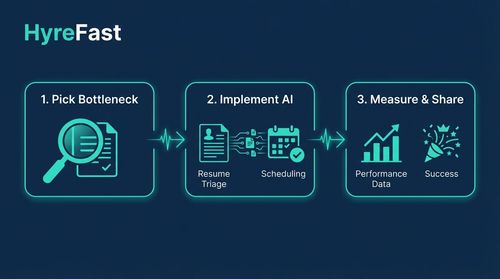
- Pick One: Based on your audit, choose the single biggest bottleneck (e.g., manual resume review or scheduling).
- Implement the Core Solution: If it's resume triage, implement automated eligibility gates + AI semantic search. If it's scheduling, deploy an AI scheduler.
- Measure and Communicate: Track the time saved and share the results with your team. Celebrate the win to build buy-in for further changes.
Phase 2: Build the Communication and Scheduling Engine (Weeks 5-8)
- Layer in Automation: Add automated SMS/email triggers for application receipt, status updates, and interview confirmation.
- Deploy Self-Service Scheduling: Implement batch scheduling links for initial screens.
- Train the Team: Ensure recruiters understand how the new tools work and how their role shifts (e.g., from scheduler to relationship builder).
Phase 3: Optimize the Initial Screen and Rediscover Talent (Weeks 9-12)
- Roll Out Structured Call Guides: Provide templates and practice sessions.
- Integrate Skill Validation: Where relevant, add pre-screen assessments.
- Activate Talent Pools: Start mining your ATS for silver medalists and past applicants for new requisitions.
- Measure Quality Metrics: Track submission-to-interview ratio, hiring manager satisfaction with shortlists, and offer acceptance rates.
Phase 4: Refine, Scale, and Become a Strategic Partner (Ongoing)
- Continuously Improve: Regularly review time metrics, candidate feedback, and hiring manager satisfaction.
- Expand Automation: Look for other repetitive tasks to automate (e.g., offer letter generation, reference checking initiation).
- Shift Recruiter Focus: Use reclaimed time for high-value activities: deep client consultation, proactive talent pool building, candidate coaching, and market intelligence sharing.
- Track Business Outcomes: Measure impact on placement volume, time-to-fill, client retention, and recruiter satisfaction/NPS.
Conclusion: Speed is a System, Not a Sprint
Losing placements to slow screening isn't a failure of effort-it's a failure of system design. In high-volume recruitment, the agencies that win aren't necessarily those with the most recruiters working the longest hours.
They're the ones who have successfully engineered their processes to eliminate waste, leverage intelligent automation, and create a screening machine that operates at the speed of business.
By implementing this playbook-starting with automated eligibility gates, moving through AI-powered scheduling and communication, optimizing the initial screen, and leveraging talent pools-you don't just speed up your process. You fundamentally transform the recruiter's role from a transactional processor into a strategic talent partner.
You free up hours previously lost to manual triage and coordination hell to invest in activities that truly move the needle: building relationships, assessing nuanced fit, and solving your clients' most pressing talent challenges.
The agencies that thrive in 2025 and beyond won't be those clinging to outdated, manual processes.
They'll be the ones who understand that in high-volume recruitment, speed is a systematic advantage-built one automated workflow, one eliminated bottleneck, and one reclaimed recruiter hour at a time. Stop losing placements to slow screening. Start winning them by design.