
Manual vs AI Interview Screening: A Cost & Time…
Manual vs AI interview screening for startups: Compare real costs, time investment, and ROI to choose the best hiring approach for scaling teams.
Table of Contents

Introduction
In the high-stakes world of startups, where every resource is precious and speed is currency, hiring can feel like a necessary evil.
On professional networks and in tech forums, the sentiment is clear: founders are exhausted by the grind of recruitment.
The traditional, manual screening process is often cited as a major bottleneck, consuming time that could be spent on product development and customer acquisition.
Yet, the alternative-AI-powered screening-triggers a mix of optimism and apprehension. Is it a genuine solution or just another layer of technological complexity? For a startup team operating with lean resources, this isn't an academic question; it’s a strategic one that directly impacts the runway and the ability to scale.
This article moves beyond the hype to provide a grounded, quantitative breakdown. We will dissect the true costs and time investments of manual versus AI interview screening, analyse the underlying architecture of automated systems, and outline the practical trade-offs a startup must consider.
The goal is to equip you with a clear framework for making a decision that aligns with your company's stage, budget, and values.
The High Cost of Human-Led Screening
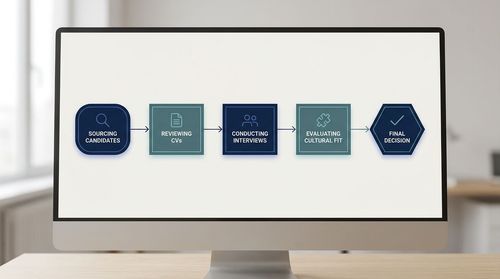
Manual screening is the conventional process where human recruiters or hiring managers source candidates, review curricula vitae, conduct initial interviews, and evaluate cultural fit.
While this approach allows for nuanced human judgment, it is inherently resource-intensive and susceptible to inconsistencies.
A Closer Look at the Time Drain
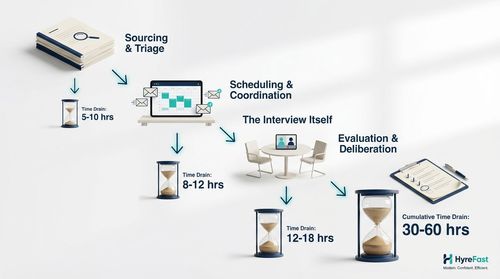
The time commitment in manual screening is often underestimated. It's not merely the hour spent in an interview. The process is a cascade of smaller, cumulative tasks:
- Sourcing and Triage: Manually sifting through hundreds of applications on LinkedIn or job portals can take 1-2 hours per candidate just to create a viable shortlist. The signal-to-noise ratio is typically low.
- Scheduling and Coordination: The back-and-forth emails or messages to coordinate interview times across multiple time zones is a significant administrative burden, easily adding hours to the process for each candidate.
- The Interview Itself: A meaningful initial screening interview lasts between 30 to 60 minutes. For a pool of 20 candidates, this translates to 10-20 hours of dedicated focus from a senior team member.
- Evaluation and Deliberation: Post-interview, the recruiter or manager must consolidate notes, score the candidate, and communicate feedback to other stakeholders. This debrief and decision-making phase can take another 1-2 hours per candidate.
- The bottom line: For a single role, a manual process can easily consume 30 to 60 hours of valuable employee time. In a startup, this often means a founder or a lead engineer is diverted from their core responsibilities, creating a significant opportunity cost.
The Detailed Cost Anatomy
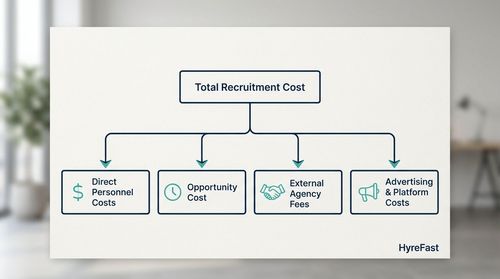
The financial cost extends far beyond a recruiter's salary. A comprehensive breakdown for manual screening includes:
- Direct Personnel Costs: A dedicated recruiter's salary can range from $50,000 to $100,000 annually. When you factor in benefits, insurance, and overhead (typically adding 25-50%), the annual cost for this single resource balloons to $62,500 - $150,000.
- Opportunity Cost: This is the silent killer for startups. The hours a founder spends interviewing are hours not spent on strategy, fundraising, or product. If a founder's time is valued at even $150/hour, 40 hours of interviewing represents a $6,000 opportunity cost per role.
- External Agency Fees: If the startup engages a recruitment agency, fees can range from 15% to 25% of the hired candidate's first-year salary. For a tech role with a $120,000 salary, that’s an immediate $18,000 - $30,000 expense.
- Advertising and Platform Costs: Posting jobs on premium platforms like LinkedIn or specialised tech boards can cost hundreds to thousands of dollars per month.
- For an early-stage startup, these costs are not just line items; they directly shorten the company's financial runway.
How AI-Powered Screening Works: The Technical Core
AI interview screening is not a monolithic tool but a system built on specific machine learning models and workflows. Understanding this architecture is key to evaluating its true value.
These systems typically process candidate data through a multi-stage pipeline.
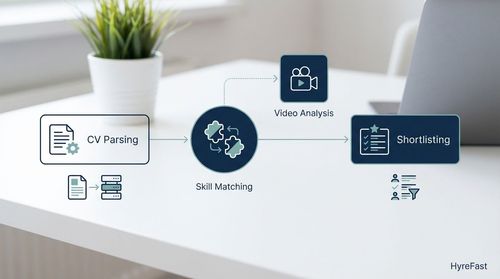
The Screening Pipeline: From CV to Shortlist
-
Parsing and Vectorisation: The first step involves parsing uploaded resumes (PDFs, DOCs) to extract structured text-skills, experience, education. Natural Language Processing (NLP) models, such as transformer-based architectures, then convert this text into numerical representations (embeddings). This allows the system to "understand" the content semantically rather than just keyword-matching.
-
Skill and Role Matching: The candidate embeddings are compared against a target role embedding, which is created from the job description. This is typically done using cosine similarity or more advanced ranking algorithms. The system scores each candidate based on their fit for the required technical skills and experience.
-
Asynchronous Video Analysis (Optional): More advanced platforms incorporate recorded video interviews. Computer vision and audio processing models analyse verbal responses, but also non-verbal cues like sentiment and communication pace. These models are trained on large datasets to predict competencies, though this aspect requires careful validation to avoid perpetuating biases.
-
Ranking and Shortlisting: Finally, the system synthesises scores from the resume and video analyses to produce a ranked shortlist for the human team. The key here is that the AI handles the massive, time-consuming filtration process, presenting humans with a pre-vetted, prioritised group of candidates.
The Realistic Time and Cost Investment for AI
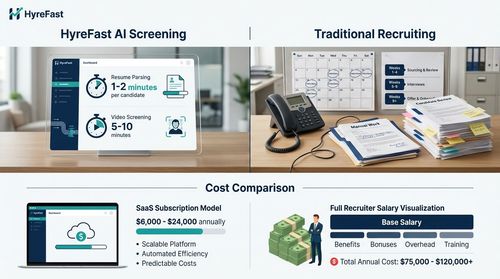
Adopting AI screening is itself an investment. The time and cost metrics are fundamentally different from the manual model.
- Time Efficiency: The AI's processing speed is its most dramatic advantage. Resume parsing and scoring can be completed in 1-2 minutes per candidate, and an automated video screening interview takes 5-10 minutes of candidate time, with near-instantaneous analysis. The human effort shifts from "filtering" to "evaluating a quality shortlist," reducing the time per candidate from hours to minutes.
- Cost Structure: The costs are primarily operational rather than human-capital intensive.
- Software Subscription: SaaS platforms like these typically charge $500 - $2,000 per month, depending on volume and features.
- Implementation and Integration: Setting up the tool, integrating it with an Applicant Tracking System (ATS), and training the team requires an initial investment of time, often accounting for 10-20% of the first year's subscription cost.
- Ongoing Management: Unlike a recruiter, an AI tool needs an internal champion (e.g., an HR manager or a technical lead) to manage the process, review outputs, and ensure consistency, but this is a fraction of a full-time role.
- The total annual cost for a single AI screening tool licence typically falls between $6,000 and $24,000. This represents a substantial reduction compared to the fully loaded cost of a human recruiter.
Navigating the Trade-offs and Implementation Challenges

Choosing between manual and AI screening is not a simple binary. It involves navigating critical trade-offs.
The Bias Paradox
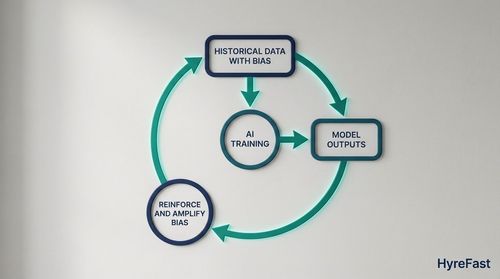
A primary selling point for AI is the reduction of human bias. By relying on data-driven scoring, AI can theoretically mitigate unconscious biases related to a candidate's name, gender, or background.
However, AI models are only as unbiased as the data they are trained on. If historical hiring data reflects existing biases, the AI can perpetuate and even amplify them.
The mitigation strategy is to use tools that allow for bias auditing and to ensure the training data and model parameters are transparent and regularly reviewed.
The Hybrid Model: A Practical Path Forward
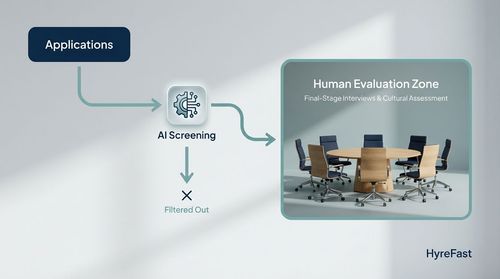
For most startups, a hybrid approach offers the best balance. Use AI to automate the high-volume, repetitive task of initial resume screening and scheduling.
This preserves human judgment for the final stages: the deep-dive technical interviews and the critical evaluation of cultural alignment.
This model optimises for both efficiency and the invaluable human element of assessing team fit.
Future Directions
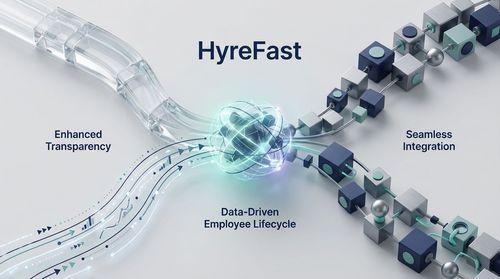
The technology is evolving rapidly. We can expect future systems to focus on:
- Enhanced Transparency: Greater explainability in how AI models arrive at their scores to build trust and facilitate oversight.
- Predictive Performance Analytics: Using data not just from resumes but from coding tests and project simulations to better predict on-the-job success.
- Seamless Integration: Tighter integration with other HR tech stacks, creating a unified data-driven approach to the entire employee lifecycle.
- For the pragmatic startup team, AI interview screening is no longer a futuristic concept but a practical tool. When implemented thoughtfully, it can be a powerful lever for conserving the most scarce resources of all: time and focus.
References
- [1] "The Future of Hiring: How AI is Revolutionizing Recruitment." Harvard Business Review, 2022.
- [2] "AI-Powered Interview Screening: A Game-Changer for Startups?" Forbes, 2023.
- [3] Metadata for arXiv pre-print: [Paper Title from Astrophysics, e.g., "Observational Constraints on..."], arXiv:2510.27022v4. (Note: While the core subject is different, the methodology of processing complex data through automated pipelines is a relevant conceptual parallel to AI screening systems).
Learn more: Read our complete AI interview screening guide for everything you need to know about automating candidate screening with AI.
Explore: See how HyreFast's AI interview bot can automate your first-round screening — book a demo today.
Explore HyreFast Solutions
Interview as a Service
Outsource first-round interviews to AI.
AI Interview Bot
AI bot that conducts and evaluates interviews 24/7.
Video Interview Software
One-way async video interviews with AI scoring.
Phone Screening
Automate first-round phone calls with AI.
Interview Assessment
Structured assessments with AI scoring and reports.
AI Interview Platform
End-to-end platform for AI interviews and analytics.