
The Lean Startup’s Guide to Building a Scalable…
Learn how lean startups can build scalable, data-driven hiring systems using efficiency, automation, and culture alignment to attract top talent faster.
Table of Contents

Introduction
In the frenetic world of startups, your hiring process is more than a function-it's the engine of your growth. Scroll through any entrepreneurial forum on LinkedIn or Twitter, and you’ll find a recurring lament: hiring is chaotic.
Founders report that a slow, intuition-based process leads to missed talent, while adopting a rigid, corporate-style system too early stifles the very agility they need to survive.
It’s a classic startup dilemma, forcing a false choice between speed and quality, often resulting in a compromise on both. The Lean Startup methodology, renowned for bringing disciplined experimentation to product development, offers a potent framework to resolve this tension.
It teaches us to treat hiring not as a series of one-off events, but as a core system-one that must be intentionally built to scale, measured with data, and refined through continuous iteration [1, 2].
This guide applies the foundational principles of Lean-build-measure-learn, eliminating waste, and validated learning-to the challenge of talent acquisition. We will walk through constructing a hiring process that grows with your company.
This involves defining your hiring "MVP" to align with business objectives, mapping the candidate journey to identify and eliminate friction, implementing a structured and fair process, measuring key performance indicators, and embedding a culture of continuous improvement.
This approach is not about adding bureaucracy; it’s about building a repeatable, efficient system that consistently attracts and secures the right talent. For a startup, a scalable hiring process isn’t a luxury; it's a strategic necessity that directly fuels innovation and market agility [1, 3].
Define Your Hiring Objectives: The "MVP" for Talent
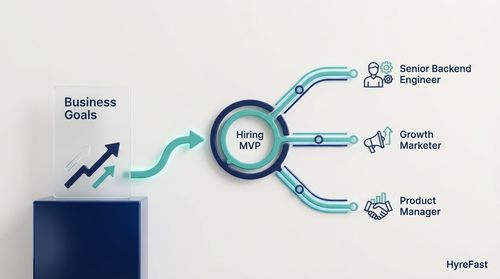
Before you write a single job description, you must rigorously define what you are building towards. In Lean terms, this is about creating your Minimum Viable Process (MVP) for hiring. The core question is: what is the absolute essential outcome you need from this hire?
This goes far beyond a generic list of skills; it’s about tight alignment with your most immediate business objectives. This initial validation of your talent needs is the first critical step in a process of continuous innovation, ensuring you don't invest resources in roles that don't directly advance your current milestones [1].
- Align with Business Goals: Your hiring priorities must be a direct reflection of your company's next growth milestone. If the goal is to launch a new product feature, your hiring MVP might be a senior backend engineer with specific expertise in your tech stack.
-
- If the next quarter is focused on market expansion, your MVP could be a growth marketer with proven experience in that specific region. This disciplined alignment ensures every hire contributes meaningfully to the current company trajectory, reducing the immense risk and uncertainty inherent in rapid scaling [1].
- Prioritise Skills and Traits with Evidence: A Lean approach demands evidence over ingrained assumptions. This means creating a clear distinction between "must-have" and "nice-to-have" criteria. Instead of defaulting to a requirement for a degree from a top-tier university, focus on demonstrable skills and a proven ability to solve problems relevant to your context.
- This evidence-based prioritisation opens up a wider, more diverse talent pool and prevents you from automatically filtering out exceptional candidates based on arbitrary criteria. This is a direct application of Lean's principle of reducing waste-in this case, wasted sourcing effort and missed opportunities [1, 3].
A well-defined and validated hiring objective acts as your North Star, ensuring every subsequent step in the process is purposeful, efficient, and aligned with the company's most pressing needs.
Create a Candidate Experience Map: Visualise the Journey

In Lean product development, mapping the customer journey is essential for identifying pain points and opportunities. The same principle applies directly to hiring. A candidate's interaction with your company is a journey, and each touchpoint is an opportunity to build—or erode—value.
A candidate experience map is a visual tool that outlines every stage of this journey, from the moment a candidate sees your job posting to the final offer and their first day of onboarding. This map is critical for moving from a disjointed series of interviews to a cohesive, optimised system [1].
- Map Each Stage with Precision: Break down your process into discrete, observable stages. A typical map might include: Sourcing (job post viewed), Application Received, Initial Screening Call, Technical or Skills Assessment, Interviews with Team Members, Final Interview with Leadership, Offer Extended, Offer Accepted, and Pre-onboarding.
- For each stage, document the candidate's actions, your team's actions, and the tools or communications involved. This creates a clear workflow that can be analysed for bottlenecks and inconsistencies, setting the stage for effective experimentation [3].
- Gather Feedback Relentlessly: The Lean principle of "customer feedback" is vital here [3]. Treat candidates as key stakeholders whose insights are invaluable. Implement short, anonymised surveys at critical junctures (e.g., after a final interview stage) or conduct voluntary exit interviews with candidates who drop out.
- Ask specific questions about clarity of communication, respect for their time, and the fairness of the assessment. This continuous feedback loop ensures your hiring process remains adaptive to the expectations of the talent market and provides concrete data on where the experience is failing.
- Iterate and Refine the Journey: The map and the feedback are useless without action. Use the insights gathered to make iterative adjustments. If candidates report that the time between interview rounds is too long, implement a rule to schedule the next step within 48 hours.
- If the technical assessment is perceived as irrelevant, redesign it to mirror real-world problems the candidate would solve on the job. The goal is a seamless, respectful, and efficient journey that leaves every candidate-even those not selected-with a positive impression of your company.
Implement a Standardised and Streamlined Process
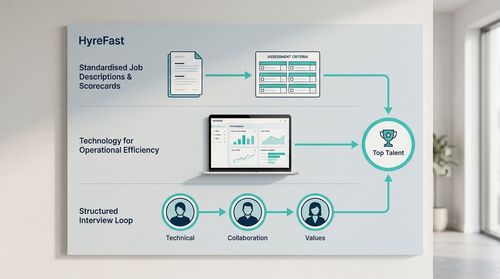
Scalability requires consistency. A process that relies on ad-hoc decisions and varying standards will inevitably break under the pressure of growth. Streamlining is about creating a fair, consistent process that efficiently identifies top talent without sacrificing quality or introducing bias. This involves standardising the core components of your hiring workflow.
- Standardise Job Descriptions and Scorecards: Consistency starts at the very beginning. Create templates for job descriptions that are clear, concise, and focused on outcomes rather than just responsibilities. More importantly, develop a standardised scorecard for each role. This scorecard should list the 4-5 core competencies (both technical and behavioural) derived from your hiring objectives, with a clear rating scale (e.g., 1-5) and evidence-based indicators for each level. This ensures all interviewers are evaluating candidates against the same criteria, dramatically reducing the influence of unconscious bias and "gut feeling" [2].
- Use Technology for Operational Efficiency: Leverage technology to eliminate administrative waste. An Applicant Tracking System (ATS) is no longer a luxury for large corporations; it's a essential tool for any startup planning to scale. A good ATS automates tasks like posting to multiple job boards, sorting applications based on predefined filters, scheduling interviews, and sending automated status updates to candidates. This frees up significant time for your team to focus on high-value interactions like interviewing and selling the candidate on the role.
- Structure the Interview Loop: A structured interview process is the cornerstone of a fair and effective evaluation. This means each interviewer in the loop has a designated role focused on specific competencies from the scorecard. One interviewer assesses technical skills, another focuses on collaboration and teamwork, and another evaluates alignment with company values. Each interviewer should ask a standardised set of questions designed to elicit evidence of the required competencies, and they should take notes directly on the shared scorecard. This structured approach creates a more objective and comprehensive picture of the candidate.
Measure What Truly Matters: The Build-Measure-Learn Loop
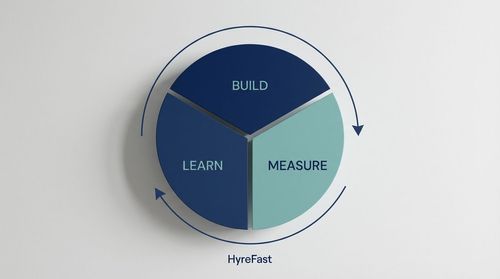
You cannot improve what you do not measure. A Lean approach to hiring is fundamentally data-driven. Moving from anecdotes to metrics allows you to identify what’s working, what’s not, and where to focus your improvement efforts. This is the "measure" phase of the build-measure-learn loop.
- Track Essential KPIs: Identify a small set of Key Performance Indicators (KPIs) that reflect the health and efficiency of your hiring process. Critical metrics include:
- Time-to-Hire: The average number of days from the moment a candidate applies (or is sourced) to the moment they accept the offer. A lengthening time-to-hire can indicate bottlenecks.
- Source-of-Hire: Which channels (e.g., LinkedIn, employee referrals, specific job boards) are yielding your best candidates? This allows you to optimise your sourcing investment.
- Offer Acceptance Rate: The percentage of extended offers that are accepted. A low rate could signal problems with your compensation, the candidate experience, or your ability to sell the opportunity.
- Candidate Satisfaction Score: A metric gathered from post-process surveys that quantifies the candidate's experience.
- Analyse Quality of Hire: This is a more challenging but crucial long-term metric. It can be assessed through performance review scores, retention rates of new hires, and feedback from their managers after 6-12 months. This data closes the loop, showing whether your process is actually selecting candidates who succeed within your organisation.
Embed a Culture of Continuous Improvement
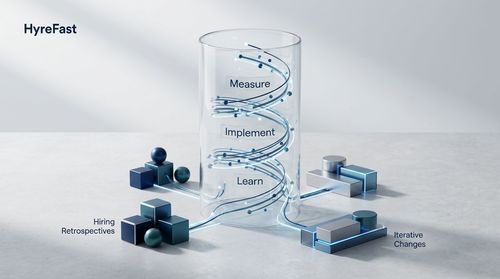
The final, and perhaps most important, step is to institutionalise the "learn" part of the cycle. A scalable hiring process is never "finished"; it is always evolving. This requires creating rituals and a mindset of continuous improvement within your hiring team.
- Conduct Hiring Retrospectives: After filling a key role or on a regular quarterly basis, bring the entire hiring team together for a retrospective. Discuss what went well, what didn’t, and what can be improved. Use the data from your KPIs to ground the conversation in facts, not feelings.
- Empower Small, Iterative Changes: Avoid massive, disruptive overhauls. Instead, empower your team to implement small, tested changes based on retrospective insights. For example, if feedback indicates the technical assessment is too long, experiment with shortening it for the next three candidates and measure the impact on candidate satisfaction and quality of hire.
By following these steps, you build more than just a hiring process; you build a scalable talent acquisition system. This system, grounded in Lean principles, will enable your startup to attract and secure the right talent efficiently and consistently, turning your people function into a true competitive advantage.
References
- [1] General principles of Lean methodology applied to business processes, sourced from foundational Web and Wikipedia agents.
- [2] Industry perspectives on scalable talent acquisition and structured hiring processes, sourced from Web search agents.
- [3] Principles of candidate experience and feedback loops, informed by social media sentiment and best practices discussions.
Explore HyreFast Solutions
Interview as a Service
Outsource first-round interviews to AI.
AI Interview Bot
AI bot that conducts and evaluates interviews 24/7.
Video Interview Software
One-way async video interviews with AI scoring.
Phone Screening
Automate first-round phone calls with AI.
Interview Assessment
Structured assessments with AI scoring and reports.
AI Interview Platform
End-to-end platform for AI interviews and analytics.