
7 Interview Screening Tips Every Founder Should Know…
Discover seven practical screening tips to help startup founders identify the right talent, avoid hiring mistakes, and scale faster with structured interviews.
Table of Contents

Introduction
In the fast-paced startup ecosystem, where a single hire can constitute a significant percentage of your workforce, the cost of a mis-hire is monumental. It’s not just about the salary; it’s about the lost momentum, cultural disruption, and the immense time investment required to course-correct. On professional networks and tech forums, founders often lament how a rushed hiring decision set them back by months. The consensus is clear: the quality of your team is the single greatest predictor of your startup's trajectory. This makes the screening and interviewing process one of the most critical operational systems you will build. A solid screening process moves beyond gut-feel and transforms hiring from an art into a disciplined science. It’s about creating a repeatable, fair, and predictive system that consistently identifies talent that is both capable and congruent with your mission. Drawing from principles in organisational behaviour and data-driven methodologies, we can construct a framework that serves your startup’s unique needs. This article will walk through seven essential tips, synthesising practical advice with insights from research, to help you build a hiring process that scales with your ambition.
1. Begin with a Crystal-Clear Definition of the Role and Criteria
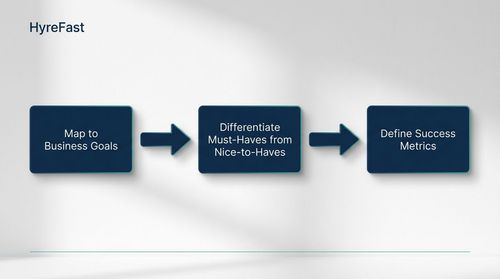
Before you write a job description or post a single listing, the most critical work happens internally. A well-defined role is the foundation of an effective screening process. This goes beyond a list of responsibilities; it’s about understanding the why behind the hire. Actionable Steps:
- Map to Business Goals: How does this role contribute to your key objectives for the next 6-12 months? Is it to accelerate product development, penetrate a new market, or improve customer retention? This clarity ensures the role remains aligned with company priorities.
- Differentiate 'Must-Haves' from 'Nice-to-Haves': Be ruthless in prioritisation. A 'must-have' is a non-negotiable skill without which the candidate cannot perform the core functions of the job. 'Nice-to-haves' are qualities that would be beneficial but can be learned on the job. This prevents you from overlooking excellent candidates who may not tick every box but possess the core attributes for success.
- Define Success Metrics: What does good performance look like in the first 30, 60, and 90 days? Having clear metrics not only guides your evaluation but also sets clear expectations for the new hire upon joining. A precise role definition acts as a compass throughout the interview process, ensuring every interaction is focused on evaluating against a consistent standard.
2. Implement a Structured Interview Process to Ensure Fairness and Consistency
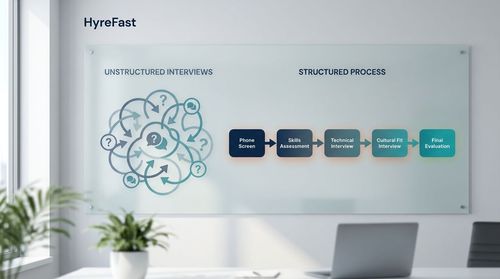
An unstructured, conversational interview is a poor predictor of performance. It is susceptible to unconscious bias—where we naturally gravitate towards candidates who share similar backgrounds or interests—and leads to inconsistent evaluation across candidates. A structured process, as advocated in methodological research, is designed to combat this [arXiv:1907.02081v2]. What is a Structured Process? It means asking each candidate for the same role a core set of predetermined questions, often following a specific rating scale to assess their responses. This doesn’t mean the interview should be robotic; it means the core evaluation criteria are standardized. Benefits:
- Reduces Bias: By focusing on job-relevant questions and answers, you minimise the impact of affinity bias.
- Enables Comparison: You can objectively compare Candidate A's answer to a question with Candidate B's answer, rather than comparing disparate conversations.
- Improves Predictive Accuracy: Structured interviews have been consistently shown to be more accurate in predicting on-the-job performance. Your structure might include a phone screen, a technical or skills assessment, and a series of focused interviews (e.g., one on technical depth, one on cultural fit, one on problem-solving).
3. Use Behavioural Questions to Uncover Past Performance
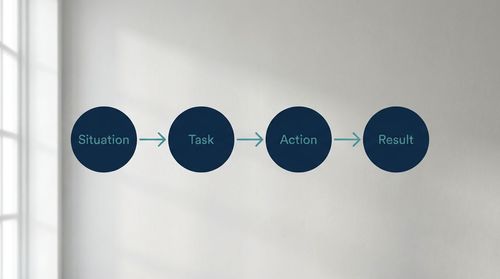
The most reliable indicator of future behaviour is past behaviour. Behavioural questions move beyond hypotheticals ("What would you do?") to evidence-based exploration ("What did you do?"). The underlying principle is that how a candidate handled a situation in a previous role is likely how they will handle a similar situation in your startup. Crafting Effective Questions: Use the STAR (Situation, Task, Action, Result) method as a guide both for asking questions and evaluating answers. Instead of "Are you a good team player?", ask:
"Tell me about a time you had to collaborate with a difficult stakeholder on a project. What was the situation, what was your specific task, what actions did you take to manage the relationship, and what was the final result?" This forces the candidate to provide a specific, structured example, allowing you to assess their thought process, interpersonal skills, and impact.
4. Assess for Cultural Fit Through Values and Work-Style Alignment

In a startup, where resources are thin and teams are small, cultural fit is not about hiring people you’d want to have a beer with. It’s about shared values and complementary work styles that enable the team to function effectively under pressure. As research into online communities highlights, the founder's actions and the initial team's motivations set the cultural trajectory [arXiv:2405.00601v1]. How to Assess Cultural Fit:
- Define Your Culture: Is it autonomy-driven or highly collaborative? Is it a culture of blunt feedback or gentle guidance? Identify 3-4 core values (e.g., "Bias for Action," "Radical Candour," "Customer Obsession").
- Ask Value-Based Questions: "Tell me about a time you had to make a decision with incomplete data. What did you do?" (to assess comfort with ambiguity). "Describe a situation where you received tough feedback. How did you handle it?" (to assess growth mindset).
- Involve the Team: Have the candidate meet with future peers. They are often the best judges of day-to-day compatibility.
5. Validate Skills with Objective Assessments
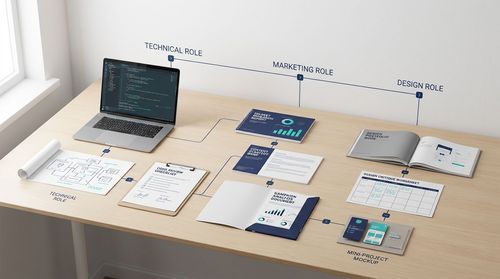
A resume lists qualifications; an assessment demonstrates capability. Depending on the role, a skills assessment provides tangible, comparable data on a candidate’s abilities. Types of Assessments:
- Technical Roles: A timed coding challenge, a system design problem, or a code review exercise.
- Marketing Roles: A brief content strategy for a hypothetical product, or an analysis of a past campaign.
- Design Roles: A portfolio review followed by a design critique or a mini-project. Keep assessments respectful of the candidate's time—they should be a sample of work, not free labour. The goal is to create a level playing field to see how candidates approach and solve problems.
6. Conduct Multi-Round Interviews for a Composite View
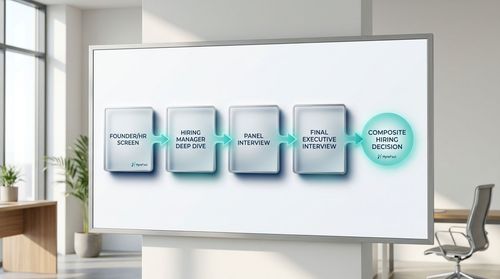
No single interviewer can assess every dimension of a candidate. A multi-round process allows you to gather diverse perspectives. A Typical Flow:
- Founder/HR Screen (30 mins): High-level fit, salary expectations, and motivation.
- Hiring Manager Deep Dive (60 mins): Focus on core skills, experience, and behavioural questions.
- Panel Interview with Team (60 mins): Assess cultural fit, collaboration skills, and technical depth from a peer perspective.
- Final Executive Interview (30 mins): Alignment with company vision and values. Each round serves a distinct purpose and involves different stakeholders, culminating in a holistic view that mitigates individual biases and provides a more robust basis for a hiring decision.
7. Leverage Technology Judiciously to Streamline, Not Dehumanise

Technology should augment your process, not replace human judgement. AI-powered tools can help with initial resume screening for high-volume roles, automate scheduling, and ensure follow-ups are sent. However, the final assessment of cultural fit, complex problem-solving, and communication skills must remain a human-centric activity. Use technology for:
- Scheduling: Tools like Calendly can eliminate email ping-pong.
- Structured Note-Taking: Use a shared template in your ATS or Google Docs to ensure all interviewers capture feedback consistently.
- Video Interviews: For remote candidates, they are essential, but be mindful of creating an equitable experience. The key is to use technology to handle administrative burdens, freeing up your mental energy for what truly matters: connecting with and evaluating potential teammates.
Conclusion

Building a founding team is a mix of science and sensibility. The tips outlined here provide a framework to systematise your approach, making it more rigorous and less prone to error. To recap the core technical learnings:
- Clarity Precedes Evaluation: A poorly defined role leads to a poorly made hire. Invest time upfront.
- Structure Combats Bias: A standardised process is the most effective tool for fair, comparable candidate assessment.
- Behaviour Predicts Behaviour: Past actions are the best available proxy for future performance.
- Culture is a Strategic Advantage: Fit is about functional alignment, not social compatibility.
- Skills Must Be Demonstrated: Move beyond the resume to tangible proof of capability.
- Diverse Perspectives Enhance Decisions: Multiple interview rounds provide a more complete picture.
- Technology is an Enabler, Not a Judge: Automate administration, not evaluation. By adopting these practices, you shift from making hiring decisions based on intuition to building a team through a deliberate, repeatable process. This discipline in your early days will pay compounding returns as your startup grows.
Future Directions
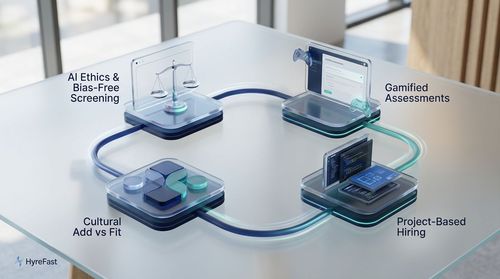
The field of talent acquisition continues to evolve, influenced by technology and deeper psychological insights. Founders should keep an eye on:
- The ethical development and application of AI in bias-free resume screening and initial candidate scoring.
- Advanced gamified assessments that provide richer data on problem-solving and cognitive abilities.
- Increased focus on "Project-Based Hiring," where candidates are evaluated on paid micro-projects rather than interviews.
- Research into quantifying soft skills and cultural add (how a candidate can diversify your culture) versus mere cultural fit.
References
- [arXiv:1907.02081v2] Shao, S., Li, B., Cautun, M., Wang, H., & Wang, J. (2019). Screening maps of the local Universe I -- Methodology. This paper's methodological rigor in creating systematic screening processes provides an analogue for structured human evaluation systems.
- [arXiv:2405.00601v1] Kairam, S. R., & Foote, J. (2024). How founder motivations, goals, and actions influence early trajectories of online communities. This research underscores the profound impact of founding team composition and values on long-term organisational development.
Explore HyreFast Solutions
Interview as a Service
Outsource first-round interviews to AI.
AI Interview Bot
AI bot that conducts and evaluates interviews 24/7.
Video Interview Software
One-way async video interviews with AI scoring.
Phone Screening
Automate first-round phone calls with AI.
Interview Assessment
Structured assessments with AI scoring and reports.
AI Interview Platform
End-to-end platform for AI interviews and analytics.