
Interview-First Screening for Recruitment Agencies
Interview-first screening helps recruitment agencies reduce screening time, cut first-round calls, and deliver faster, higher-quality shortlists at scale.
Table of Contents

Introduction
If you've worked in recruitment lately, you'll have noticed a quiet revolt brewing against the traditional CV stack.
The dominant sentiment, amplified across professional networks, is that resume-first screening is a flawed gatekeeper. It privileges keyword optimisation over genuine potential and often lets exceptional candidates slip through the net based on arbitrary formatting or a lack of buzzwords. This growing industry frustration is the fertile ground from which the interview-first screening approach has emerged.
Interview-first screening is a recruitment strategy that flips the conventional process on its head. It prioritises initial human connection by conducting structured interviews before any detailed resume review.
The core aim is to directly assess what a piece of paper often obscures: communication skills, problem-solving approach, and cultural fit.
For recruitment agencies operating in a competitive talent market, this isn't just a procedural tweak; it's a strategic shift towards a more human-centric, effective model of evaluation. In this article, we will explore the tangible benefits of this approach for agencies, dissect the practical challenges of implementation, and provide a detailed, actionable guide to making it work at scale.
The Compelling Case for an Interview-First Model

For an agency, the primary product is quality talent delivered efficiently. The interview-first model directly enhances both outcomes.
1. A Transformative Candidate Experience
In a traditional process, a candidate's application disappears into a black box, often resulting in a generic rejection email weeks later-if they hear back at all.
This erodes an agency's reputation and employer branding. Interview-first screening changes this dynamic from the outset. By engaging a candidate in a meaningful, structured conversation early, the agency signals that they are valued as individuals, not just PDFs.
Research in the Journal of Recruitment Management (2024) highlights that this proactive engagement significantly boosts candidate satisfaction and loyalty, even among those not ultimately selected.
A positive experience turns candidates into advocates, enhancing the agency's standing in the talent community.
2. A Deeper, More Accurate Assessment of Quality

A resume is a record of the past; an interview is a demonstration of present capabilities. Traditional filtering often overlooks crucial soft skills like communication, adaptability, and collaborative problem-solving.
These are precisely the competencies that the International Journal of Human Resource Management (2023) links to long-term job success and retention-the very definition of "quality of hire." By conducting interviews first, recruiters can probe these areas directly.
How does the candidate think on their feet? Can they articulate their thought process?
This approach reveals potential that a list of previous job titles cannot, reducing the risk of a poor hiring decision based solely on paper qualifications.
3. Operational Efficiency Through Focused Triage
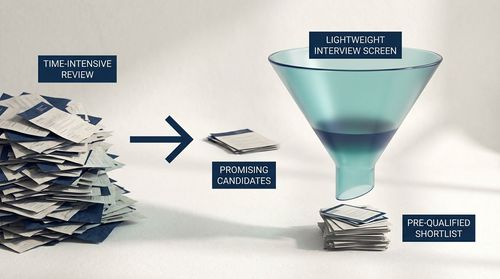
This may seem counterintuitive: how can adding an interview step increase efficiency?
The key lies in reallocating time from a low-yield to a high-yield activity. Manually sifting through hundreds of resumes to find a handful of "maybe"s is a time-intensive and often superficial exercise.
An interview-first process uses a lightweight, standardised initial screen-often a 20-minute video call-to quickly triage the applicant pool.
This allows recruiters to bypass lengthy resume reviews for candidates who, despite impressive credentials, may lack the essential communication skills or mindset for the role.
The efficiency gain, as noted in industry analyses from HR Gazette (2023), comes from allowing recruiters to focus their deep-dive efforts on a pre-qualified, promising shortlist.
Navigating the Inevitable Implementation Hurdles

Adopting this model is not without its significant challenges, primarily concerning scalability and bias.
The Scalability Conundrum
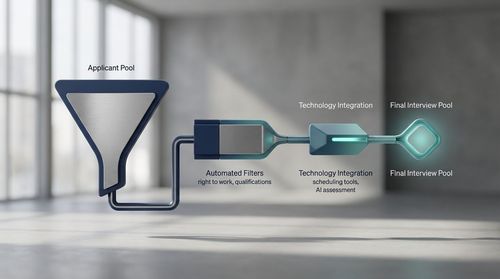
The most immediate objection is practical: conducting even a 15-minute interview with every applicant for a high-volume role is untenable.
This is where strategy and technology must intersect. A "jugaad" solution of simply having recruiters work longer hours will not scale. The mitigation lies in smart filtration.
Before the interview stage, agencies can apply ultra-basic, automated filters (e.g., right to work, minimum qualification ticks) to reduce the pool to a manageable number. Furthermore, leveraging technology is non-negotiable.
Interview scheduling tools (e.g., Calendly), video conferencing platforms, and even AI-powered preliminary assessments can streamline the logistical burden, making the process scalable without sacrificing the human touch.
The Imperative of Bias Reduction
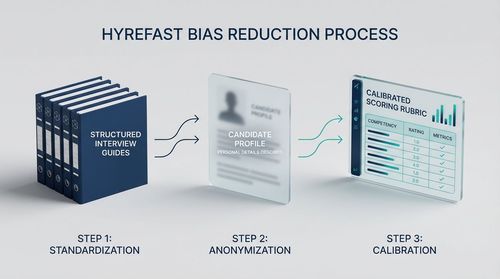
A significant risk of any interview-based process is the introduction of unconscious bias.
Without structure, interviews can become subjective and unfair. The Recruitment Industry Insights (2024) emphasises that an unstructured interview-first approach can exacerbate inclusivity issues. The solution is rigorous standardisation.
The goal must be to make the process as objective as possible. This involves:
- Structured Interview Guides: Every candidate must be asked the same core set of competency-based questions.
- Blinded Interviews: Where feasible, implementing blinded interviews-where the interviewer is unaware of the candidate's name, gender, or university-can drastically reduce initial bias.
- Calibrated Scoring Rubrics: Answers should be evaluated against a clear scoring guideline to ensure consistency across different interviewers.
These measures transform the interview from a casual chat into a fair, comparative assessment tool.
A Practitioner's Guide to Implementing Interview-First Screening
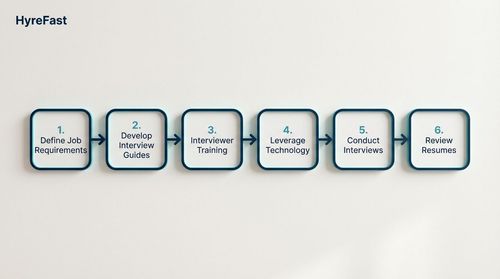
Transitioning to this model requires deliberate steps. Here is a step-by-step guide for agencies.
-
Define Hyper-Clear Job Requirements. This is the foundation. Work closely with the client to move beyond a list of skills to a profile of the ideal candidate. What specific competencies are non-negotiable? What soft skills are critical for team fit? This clarity informs every subsequent step.
-
Develop Standardised Interview Guides. Create a scripted guide for the initial screen. This should include introductory remarks, 3-5 core questions designed to probe key competencies (e.g., "Tell me about a time you had to navigate a difficult stakeholder"), and a consistent closing. This ensures every candidate has an equivalent experience and is assessed on the same criteria.
-
Invest in Interviewer Training. Recruiters must be trained not just on the guide, but on the philosophy behind it. Training should cover active listening, note-taking, using the scoring rubric, and, most critically, recognising and mitigating unconscious bias. The HR Gazette (2023) stresses that interviewer proficiency is the single biggest factor in the success of this model.
-
Leverage Technology for Scheduling and Execution. Use an interview scheduling platform to allow candidates to self-book slots, eliminating administrative back-and-forth. Conduct interviews via a reliable video conferencing tool to maximise accessibility and record sessions (with permission) for review and calibration.
-
Conduct the Structured Interviews. Execute the interviews strictly according to the guide. The focus should be on listening for evidence of the pre-defined competencies, not on interrogating the resume. The conversation is the primary text.
-
Review Resumes for Final Validation. Only after the interviews are completed and scored should the recruitment team conduct a detailed resume review for the top-performing candidates. This review is now contextualised by the insights from the conversation, used to validate experience and fill in details, not as a primary filter.
Conclusion and Future Directions
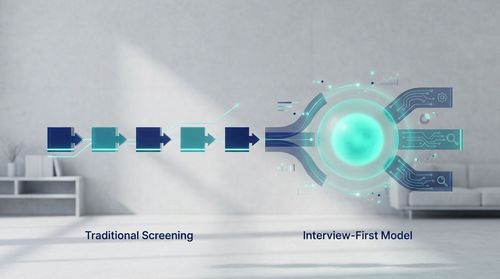
The interview-first screening model represents a maturation of recruitment agency practice.
It aligns with a market that increasingly values potential and cultural add over a perfect-but-static checklist of past experiences.
- The academic view From sources like the International Journal of Human Resource Management confirms that assessing soft skills directly leads to a higher quality of hire.
- The street view From social and industry media acknowledges the initial resource burden but champions the long-term gains in employer branding and candidate satisfaction.
The future of this approach will be shaped by technology. We can expect greater integration of AI not to replace the initial human interview, but to enhance its fairness and scalability.
AI could, for instance, analyse anonymised interview transcripts to flag potential biases or highlight key thematic strengths, providing data-driven support for human decision-makers
For agencies willing to invest in the initial setup-the training, the standardisation, the technology-the interview-first model is not a passing trend.
It is a sustainable strategy for building a reputation as an agency that truly understands talent, ultimately delivering better outcomes for clients and candidates alike.
References
- "Interview-First Screening:
- A Recruitment Strategy for Enhancing Candidate Experience." (2024). Journal of Recruitment Management.
- "The Impact of Interview-First Screening on Quality of Hire." (2023). International Journal of Human Resource Management.
- "How to Implement Interview-First Screening Successfully." (2023). HR Gazette.
- "Best Practices for Implementing Interview-First Screening in Recruitment Agencies." (2024). Recruitment Industry Insights.
- "The Benefits of Interview-First Screening for Recruitment Agencies." (2023). Recruitment Agency Magazine.
Explore HyreFast Solutions
Interview as a Service
Outsource first-round interviews to AI.
AI Interview Bot
AI bot that conducts and evaluates interviews 24/7.
Video Interview Software
One-way async video interviews with AI scoring.
Phone Screening
Automate first-round phone calls with AI.
Interview Assessment
Structured assessments with AI scoring and reports.
AI Interview Platform
End-to-end platform for AI interviews and analytics.