
How to Scale Your Recruitment Agency Without Hiring…
Scale your recruitment agency without increasing headcount. Learn how to boost placements, improve efficiency, and grow profitably using automation, process redesign, and niche specialization.
Table of Contents

Introduction
In the competitive landscape of talent acquisition, growth is often equated with adding headcount-more recruiters, more desks, more overhead. But this linear model of scaling is not only expensive; it's fundamentally flawed.
It assumes that the only way to increase placement volume, enter new markets, or serve more clients is to replicate the same human-intensive process over and over.
The result? Agencies that grow in size but not in efficiency, where profitability plateaus or even declines as the cost of managing more people eats into the gains from additional placements. The most successful recruitment agencies in 2025 and beyond are breaking this pattern.
They're scaling not by hiring more recruiters, but by working smarter-leveraging technology, process redesign, and strategic specialization to increase output, improve quality, and expand reach without a proportional increase in recruiter headcount.
They've realized that the true constraint isn't the number of recruiters on the payroll-it's how effectively those recruiters' time and expertise are utilized.
This isn't about cutting corners or replacing humans with bots. It's about systematically eliminating waste, augmenting human judgment with intelligent automation, and redirecting recruiter energy toward high-value, relationship-driven activities that machines cannot replicate.
By doing so, agencies can dramatically increase their placement volume per recruiter, improve client retention and satisfaction, and open new revenue streams-all while keeping their core recruiter team lean, focused, and energized.
In this article, we'll provide a practical, step-by-step blueprint for scaling your recruitment agency without adding more recruiters.
We'll dissect the hidden inefficiencies that cap your current output, explore the levers of technological and process-driven scale, and show you exactly how to redesign your agency's operations to grow smarter-not just bigger.
Whether you're a boutique firm looking to serve more clients without diluting quality, or a mid-sized agency aiming to enter new verticals or geographies without doubling your team, this guide will give you the tools to scale sustainably, profitably, and on your own terms.
The Scaling Trap: Why Simply Hiring More Recruiters Fails
Before exploring the alternatives, it's essential to understand why the default approach-adding more recruiters-often fails to deliver the expected growth and profitability.
1. The Law of Diminishing Returns on Recruiter Headcount
Simply doubling your recruiter team does not double your placement output-especially if your processes remain inefficient.
- The Reality: If your recruiters are spending 60% of their time on manual resume triage, scheduling ping-pong, and chasing unresponsive candidates, adding more recruiters just means more people are stuck in the same low-value tasks. You're scaling the inefficiency, not the effectiveness.
- The Consequence: Your cost per placement may not decrease-and could even increase-due to:
- Increased overhead (recruitment, training, management, benefits, workspace)
- More time spent on internal coordination and communication as the team grows
- The risk of diluting quality if new hires aren't properly onboarded or if processes aren't standardized
- The potential for increased turnover and associated replacement costs if the work remains monotonous and unfulfilling
- The Bottom Line: You're not scaling a profitable engine-you're scaling a leaky bucket.
2. The Hidden Cost of Process Inefficiency at Scale
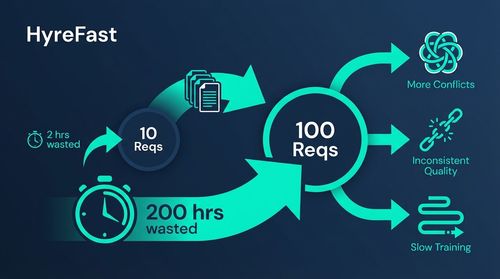
Inefficiencies that are manageable at small scale become catastrophic bottlenecks as volume increases.
- The Reality: A process that wastes 2 hours per requisition on manual scheduling might be annoying with 10 reqs/month-but with 100 reqs/month, that's 200 hours/month (equivalent to 5 full-time recruiters) spent purely on administration.
- The Consequence: As you try to grow by adding recruiters, these inefficiencies multiply:
- More recruiters mean more scheduling conflicts, more communication overhead, and more opportunities for errors and delays.
- The lack of standardized processes leads to inconsistent candidate experiences and variable placement quality, damaging your reputation.
- Training new recruiters on broken or ad-hoc processes takes longer and is less effective, slowing ramp-up time.
- The Result: You hit a scaling wall where adding more people doesn't solve the core problem-it just creates more complexity and frustration.
3. The Talent and Culture Dilution Risk
Rapid headcount growth often comes at the expense of quality and culture.
- The Reality: Finding and onboarding high-quality recruiters who align with your agency's values and standards takes time. When you need to grow quickly, hiring standards can slip, leading to:
- New recruiters who lack the skills or motivation to deliver high-quality placements
- Increased variability in performance and client experience
- A erosion of the agency's reputation for excellence
- The Consequence: You may grow in size, but you shrink in perceived value. Clients begin to see you as a commodity provider rather than a strategic partner, making you vulnerable to price competition and churn.
- The Bottom Line: Scaling by headcount alone risks turning your agency into a high-volume, low-margin operation where the race to the bottom on price becomes inevitable.
4. The Opportunity Cost of Misallocated Recruiter Talent
Perhaps the most significant cost of inefficient scaling is what you don't do with your recruiters' time.
- The Reality: If your recruiters are stuck in repetitive, low-judgment tasks, they're not doing what they do best: building deep client relationships, assessing nuanced candidate fit, providing strategic talent advice, or developing expertise in niche markets.
- The Consequence: As you scale by adding more recruiters doing the same inefficient work, you're not just failing to grow output efficiently-you're missing out on high-impact opportunities:
- Strategic Account Management: Time to understand a client's long-term talent strategy, not just fill today's requisition.
- Niche Specialization: The ability to develop deep expertise in high-margin, hard-to-fill verticals (e.g., AI/ML, cybersecurity, healthcare tech).
- Proactive Talent Pooling: Building long-term relationships with passive candidates in specific communities or skill sets.
- Market Intelligence: Becoming a trusted source of insights on salary trends, availability, and emerging skill demands.
- Candidate Experience Excellence: Investing time in coaching, feedback, and career guidance that builds loyalty and referrals.
- The Result: You scale in size but not in strategic value-becoming bigger, but not better, at what truly matters in recruitment.
The Levers of Scale Without Headcount: Working Smarter, Not Just More
Scaling without hiring more recruiters isn't about doing the same thing with fewer people-it's about fundamentally re-engineering how work gets done to increase output, improve quality, and expand reach. The key levers are:
1. Technological Leverage: Automating the Eliminable
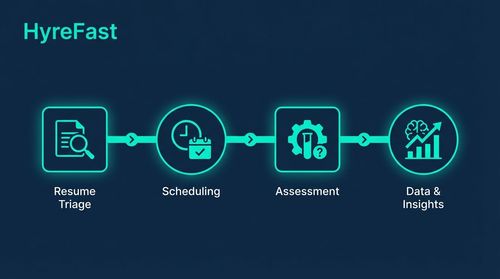
Use AI and automation to handle repetitive, predictable, and low-judgment tasks-freeing recruiters to focus on what humans do best.
- Where It Applies:
- Resume Triage & Initial Screening: AI-powered semantic search and ranking to surface high-potential candidates; automated eligibility gates (knockout questionnaires) to filter out objectively unqualified applicants before human time is spent.
- Scheduling & Communication: AI scheduling assistants (Calendly, X.ai) to automate interview coordination; trigger-based SMS/email workflows for application acknowledgments, status updates, and interview reminders; AI chatbots for FAQ resolution.
- Assessment & Validation: Integrated skill tests, coding challenges, or situational judgment tests (SJTs) for objective proficiency measurement; AI-assisted note-taking and summarization (Fireflies.ai, Otter.ai) to capture key points from interviews.
- Data & Insights: Automated reporting on time-to-fill, submission-to-interview ratio, hiring manager satisfaction, and early turnover; predictive analytics for attrition risk or market trends.
- The Scale Effect: One recruiter using these tools can handle significantly more requisitions-or handle the same volume with far less stress and more time for high-value work-effectively multiplying their output without increasing headcount.
2. Process Redesign: Eliminating Waste and Creating Flow
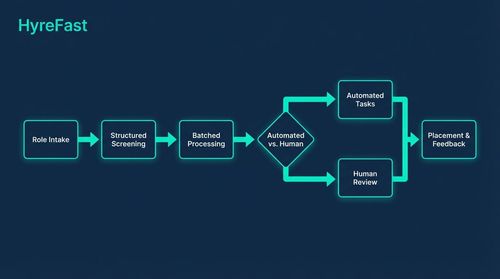
Redesign workflows to remove bottlenecks, reduce handoffs, and create a seamless, efficient process from application to placement.
- Where It Applies:
- Standardized Role Intake: Replace ad-hoc job descriptions with structured role discovery sessions to define clear success profiles (skills, experience, traits needed for success).
- Structured Screening: Use standardized, competency-based interview guides and assessment tools to ensure consistency and reduce bias.
- Batched and Self-Service Workflows: Offer candidates self-scheduling links; batch process eligibility gates and initial communications.
- Clear Handoff Points: Define exactly when a task moves from automated (e.g., parsing, ranking) to human-driven (e.g., final shortlist review, candidate interview).
- Feedback Loops: Implement regular calibration sessions for interviewers and post-placement debriefs to learn and improve.
- The Scale Effect: A well-designed process reduces the time and effort required per placement, increases consistency and quality, and makes it easier to onboard new recruiters or expand into new areas-without needing to add proportional headcount.
3. Strategic Specialization: Increasing Value per Recruiter
Move from being a generalist agency to developing deep expertise in specific niches, allowing you to command higher fees, improve placement quality, and increase client retention-all without needing more recruiters to do the same volume of work.
- Where It Applies:
- Vertical Specialization: Focus on high-demand, high-margin industries (e.g., healthcare IT, fintech, renewable energy, advanced manufacturing).
- Functional Specialization: Develop deep expertise in specific roles or functions (e.g., AI/ML engineers, data scientists, DevOps, cybersecurity analysts, specialized sales or finance roles).
- Geographic or Demographic Niche: Specialize in serving clients hiring in specific regions (e.g., Tier-2/3 cities in India) or for specific talent pools (e.g., women returning to work, veterans, neurodiverse talent).
- Service Model Innovation: Offer specialized services like retained search for leadership roles, RPO (Recruitment Process Outsourcing) for high-volume hiring, or talent advisory and workforce planning.
- The Scale Effect: By becoming the go-to expert in a niche, you can:
- Charge premium fees for your specialized knowledge and networks.
- Improve placement quality and speed due to deeper market understanding and tailored processes.
- Increase client retention and referral rates within the niche.
- Serve more high-value clients with the same number of recruiters-because each placement generates more revenue and requires less effort due to your expertise.
4. Leveraging Technology for Reach and Efficiency
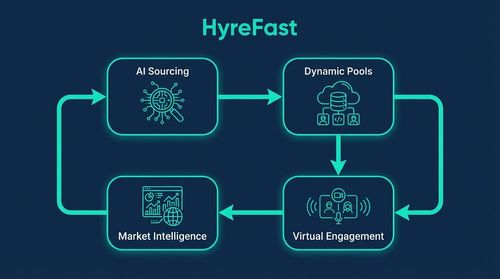
Use technology not just to automate tasks, but to expand your agency's capabilities and market access without adding recruiters.
- Where It Applies:
- AI-Powered Sourcing & Talent Intelligence: Use platforms that aggregate and enrich candidate data from multiple sources (LinkedIn, GitHub, Stack Overflow, professional forums) to identify passive candidates and infer skills-expanding your reach beyond active job seekers.
- Dynamic Talent Pools: Build and maintain living databases of candidates who have previously applied, engaged positively, or been identified as strong fits-continuously enriched with new data. This allows you to start each search with a head start, reducing sourcing time.
- Virtual Recruiting & Engagement: Use video interviewing, virtual career fairs, and online community engagement to connect with candidates globally without the need for physical presence or travel.
- Data-Driven Market Intelligence: Use analytics on your own data (placements, sourcing channels, candidate feedback) and external sources (job boards, salary surveys) to provide clients with insights on trends, availability, and compensation-becoming a trusted advisor.
- Integrated Tech Stack: Ensure your ATS, CRM, sourcing tools, communication platforms, and analytics tools work together seamlessly-reducing context-switching, manual data entry, and errors.
- The Scale Effect: One recruiter using these tools can source more effectively, engage a wider talent pool, and provide more strategic value-effectively increasing their output and impact without needing to be in more places at once or handle more manual work.
The Blueprint: A Step-by-Step Plan to Scale Without Adding Recruiters
Scaling without headcount isn't about a single magic bullet-it's about systematically applying these levers to transform your agency's operations. Here’s how to do it in phases.
Phase 0: Diagnose Your Current Constraints and Opportunities (Weeks 1-2)
- Conduct a Time Audit: Have recruiters track their time in 15-minute increments for 3-5 days. Categorize: sourcing, resume review, scheduling, calling, admin/client time, break, strategic work (client consultation, talent pool building, etc.).
- Map Your Current Workflow: Diagram the steps from application to placement for a typical requisition. Identify every manual step, handoff, wait time, and decision point.
- Analyze Your Current Output: Calculate:
- Placements per recruiter per month/quarter
- Average time-to-fill
- Submission-to-interview ratio (quality indicator)
- Revenue per recruiter
- Client retention rate
- Recruiter satisfaction (via anonymous survey)
- Identify the Biggest Time Sinks and Inefficiencies: Where is recruiter time being wasted? Where are the bottlenecks? Where do you feel underutilized?
- Assess Your Current Specialization: What percentage of your work is in niches vs. generalist? What are your highest-margin, most satisfying requisitions?
- Set a Baseline Goal: Define what "scaling without more recruiters" means for you (e.g., increase placements per recruiter by 50% in 6 months, enter 2 new verticals without adding recruiters, improve submission-to-interview ratio by 30%).
Phase 1: Eliminate the Biggest Time and Energy Drains (Weeks 3-6)
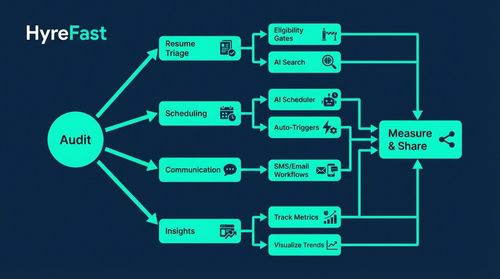
- Pick One or Two: Based on your audit, choose the single biggest source of wasted time and low-value work (e.g., manual resume review, scheduling hell).
- Implement Core Technological Leverage:
- If it's resume triage: Deploy automated eligibility gates (knockout questionnaire via SMS/email) + AI semantic search and ranking (using a tool like Eightfold, Phenom, or even a fine-tuned NLP model via API).
- If it's scheduling: Implement an AI scheduler (Calendly, X.ai) + automated communication triggers (via your ATS, HubSpot, or Zapier/Make) for interview confirmation, reminders, and status updates.
- If it's communication overload: Implement trigger-based SMS/email workflows for application receipt, eligibility gate pass, interview scheduling, post-interview, and rejection (after screen).
- If it's lack of insights: Start using your ATS/CRM to track key metrics (time-to-fill, source of hire, drop-off rates) and explore simple BI tools (Google Data Studio, Power BI) to visualize trends.
- Measure and Share: Track the time saved per requisition and, crucially, ask recruiters: "Do you feel less drained by [task] now? Do you feel you have more time for [meaningful activity]?"
- Celebrate the Win: Use this success to build buy-in for further changes.
Phase 2: Redesign Your Core Process for Efficiency and Quality (Weeks 7-10)
- Standardize Role Intake: Replace the JD briefing with a structured role discovery session. Use a template to capture:
- Top 3-5 problems the hire needs to solve in the first 6 months
- Non-negotiable hard skills and certifications
- Key behavioral competencies (problem-solving, communication, learnability, etc.)
- What a high performer would look like in the first 90 days
- What you're willing to flex on (e.g., exact years of experience vs. demonstrated capability)
- Implement Structured Screening:
- Build a standardized interview guide and scoring rubric for each role type based on the success profile.
- Train recruiters on structured interviewing techniques (STAR/SJT method) and how to use the scoring guide.
- Conduct calibration sessions to ensure consistent application of the rubric.
- Integrate objective assessments where relevant (skill tests, coding challenges, SJTs).
- Optimize the Funnel Flow:
- Ensure automated eligibility gates feed into AI ranking, which feeds into the human review queue.
- Implement self-scheduling links for initial screens.
- Use trigger-based communication to keep candidates informed.
- Define clear handoff points (e.g., "Recruiter does initial screen → hiring manager does technical interview → recruiter coordinates final interview").
- Measure the Impact: Track:
- Time from requisition to first qualified candidate
- Submission-to-interview ratio (should increase as screening becomes more accurate)
- Hiring manager satisfaction with shortlists
- Offer acceptance rate
- Time spent per requisition by recruiters (should decrease or stay flat despite increased volume)
Phase 3: Build Strategic Specialization and Niches (Weeks 11-14)
- Analyze Your Data for Niches: Look at your placements over the past 6-12 months:
- Which industries, functions, or geographies have the highest placement volume?
- Which have the highest fees or margine?
- Which have the highest client satisfaction and retention?
- Where do you see recurring demand or unmet needs?
- Pick One or Two Niches to Develop: Based on the data and your team's interests/strengths, choose one or two areas to deepen your expertise in (e.g., "AI/ML Engineering in Bengaluru," "Healthcare IT Roles," "BPO Team Leads in Tier-2 Cities").
- Build Niche-Specific Assets:
- Develop a detailed success profile template for the niche.
- Curate a list of niche-specific job boards, forums, communities, and events.
- Build a talent pool of candidates in the niche (from past applicants, referrals, silver medalists, and proactive sourcing).
- Develop niche-specific interview guides and assessments.
- Create a simple market intelligence report (e.g., "Monthly Trends in AI/ML Hiring in India") to share with clients.
- Shift Your Marketing and Positioning: Update your website, LinkedIn, and outreach to highlight your expertise in the niche:
- "We specialize in helping [Client Type] find [Specific Talent] in [Niche]."
- Share case studies, insights, and success stories from the niche.
- Target your business development efforts toward clients in the niche.
- Measure the Impact: Track:
- Placement volume and revenue from the niche
- Time-to-fill and submission-to-interview ratio within the niche
- Client satisfaction and retention in the niche
- Recruiter feedback on whether working in the niche feels more meaningful and less commoditized
Phase 4: Leverage Technology for Reach and Strategic Value (Ongoing)
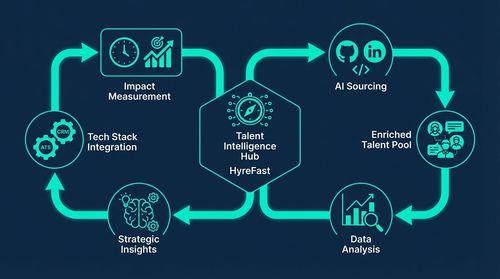
- Expand Your Talent Intelligence Capabilities:
- Use AI-powered sourcing tools to identify passive candidates in your niches (e.g., tools that analyze GitHub, LinkedIn, or professional profiles to infer skills and engagement).
- Continuously enrich your talent pools with data from profile updates, new applications, and referrals.
- Use your ATS/CRM to tag and segment candidates by niche, skills, engagement level, and availability.
- Become a Trusted Advisor with Data:
- Regularly share market intelligence with clients: "We're seeing that candidates with [Skill] are expecting 15% more than 6 months ago-should we adjust the scope?"
- Use data from your placements to advise on hiring strategies: "For roles like this, we're seeing that prioritizing potential over experience leads to faster fills and better long-term retention."
- Offer workforce planning insights: "Based on trends, you might want to consider building a pipeline for [Skill] in the next quarter."
- Integrate Your Tech Stack: Ensure your ATS, CRM, sourcing tools, communication platforms, and analytics tools work together seamlessly-reducing friction and enabling a unified view of the candidate and client.
- Measure the Impact: Track:
- Time spent on sourcing per requisition (should decrease due to talent pools and AI sourcing)
- Quality of shortlists (submission-to-interview ratio, hiring manager satisfaction)
- Client perception of your agency as a strategic partner (via surveys)
- Revenue per recruiter (should increase due to higher-value work and niches)
Phase 5: Embed, Monitor, and Continuously Improve (Ongoing)
- Make the New Process Standard: Require the use of standardized role intake, structured screening, automated gates/scheduling, and niche-focused work for all requisitions.
- Track Key Metrics Religiously: Monitor:
- Placements per recruiter (your primary scaling metric)
- Revenue per recruiter
- Time-to-fill
- Submission-to-interview ratio
- Hiring manager satisfaction with shortlists and hires
- Offer acceptance rate
- Early turnover/performance of placed candidates (3/6-month check-in)
- Recruiter satisfaction and burnout indicators (emotional exhaustion, depersonalization, sense of accomplishment)
- Client retention and referral rates
- Refine and Optimize: Based on the data, continuously adjust:
- Your success profiles and assessment tools
- The weightings and thresholds in your AI scoring models
- The focus of your niches
- Your tech stack and integrations
- Foster a Culture of Efficiency and Excellence: Recognize and reward recruiters who:
- Use technology effectively to eliminate waste
- Deliver high-quality placements in niches
- Build strong client relationships and provide strategic insight
- Contribute to improving the agency's processes and knowledge base
- Stay Ahead of the Curve: Keep an eye on emerging trends in AI, recruitment technology, and talent markets-be ready to adapt your model as the landscape evolves.
Conclusion: Scale is a System, Not a Headcount
Scaling your recruitment agency without hiring more recruiters isn't about cutting corners or working your existing team harder.
It's about working smarter-systematically eliminating waste, leveraging intelligent automation to augment human expertise, and redirecting recruiter energy toward the high-value, relationship-driven activities that truly drive placement quality, client satisfaction, and profitability.
The agencies that will thrive in 2025 and beyond aren't just the ones with the most recruiters on the payroll. They're the ones who have mastered the art of scaling through efficiency, specialization, and technological leverage-turning what was once a linear, cost-heavy growth model into a profitable, sustainable engine of expansion.
You don't need to double your team to double your impact. You need to double your effectiveness-by ensuring that every hour a recruiter spends is an hour spent on the right work: understanding client needs, assessing nuanced fit, building relationships, and providing the strategic counsel that wins the war for talent.
Start not by hiring another recruiter, but by asking: "What is the single biggest waste of time in our current process? What is the single highest-value activity we're not doing enough of?"
Then, use technology and process redesign to eliminate the first and expand the second. Your placements, your profitability, and your recruiter satisfaction will thank you-and you'll prove that in recruitment, true scale isn't about headcount. It's about leverage.
Explore HyreFast Solutions
Interview as a Service
Outsource first-round interviews to AI.
AI Interview Bot
AI bot that conducts and evaluates interviews 24/7.
Video Interview Software
One-way async video interviews with AI scoring.
Phone Screening
Automate first-round phone calls with AI.
Interview Assessment
Structured assessments with AI scoring and reports.
AI Interview Platform
End-to-end platform for AI interviews and analytics.