
How Recruitment Agencies Can Use AI Screening as a Value-Add to Win More Retainers
Use AI-driven recruitment to reduce time-to-hire, improve candidate quality, and win retainers with data-driven, transparent hiring insights.
Table of Contents

Introduction
If you spend any time on LinkedIn or in hiring manager forums, you will notice a recurring complaint: recruitment agencies flood clients with unqualified resumes, take weeks to deliver shortlists, and offer little insight into why candidates were selected.
This frustration is not new, but it is becoming a dealbreaker for retainer negotiations. Clients no longer want vendors who simply forward CVs. They want strategic partners who can demonstrate measurable improvements in time-to-hire, quality-of-hire, and cost efficiency.
Artificial intelligence transforms screening from a cost center into a value-add that directly addresses these pain points.
This article explores how agencies can leverage AI for resume parsing, semantic matching, predictive analytics, and transparent reporting to win more retainers, backed by real-world examples and implementation strategies.
The Strategic Shift from Commodity to Consultant
Traditional recruitment agencies compete on price and volume, positioning themselves as resume suppliers rather than talent advisors. This commoditisation makes it difficult to command retainer fees.
AI screening changes the game by enabling agencies to deliver insights and outcomes that go far beyond simple candidate sourcing. When an agency can prove it reduces time-to-fill by 50 percent, improves quality-of-hire scores, or cuts turnover through predictive analytics, it stops being a vendor and starts being a strategic partner.
Social media conversations among HR leaders consistently highlight frustration with agencies that lack transparency. Clients want to know why a candidate was shortlisted, how match scores are calculated, and where bottlenecks occur in the pipeline.
AI screening platforms provide detailed analytics dashboards that answer these questions. This data-driven approach builds trust and justifies retainer fees by demonstrating concrete improvements in hiring efficiency and effectiveness.
The Technical Engine Behind AI Screening
Modern AI screening tools do more than automate resume parsing. They create a closed-loop system that continuously improves hiring outcomes through data-driven insights. The core technical capabilities include natural language processing for resume parsing, semantic similarity matching for skills assessment, and predictive analytics for retention risk.
Natural language processing models extract skills, experience, and qualifications from unstructured resumes and LinkedIn profiles. Unlike traditional Boolean searches that rely on exact keyword matches, these models understand context and synonyms.
A candidate who describes their experience as "led cross-functional teams" will still be matched to a job requiring "managed multidisciplinary groups." This semantic capability increases the pool of qualified candidates and reduces the risk of missing talent due to phrasing differences.
Machine learning models rank candidates against custom job profiles by weighting factors like technical skills, experience relevance, career trajectory, and cultural fit indicators.
These models can be trained on historical placement data to identify patterns associated with long-term success. For example, an AI model might discover that candidates who have worked in agile environments for at least two years are 30 percent more likely to succeed in a particular tech role.
Predictive analytics go further by analysing historical hiring data, performance metrics, and turnover patterns to flag candidates who are statistically more likely to succeed or leave quickly. Agencies can use these insights to advise clients not just on who to hire, but on who is likely to stay and thrive, directly impacting long-term hiring costs.
Building the Value-Add Offering
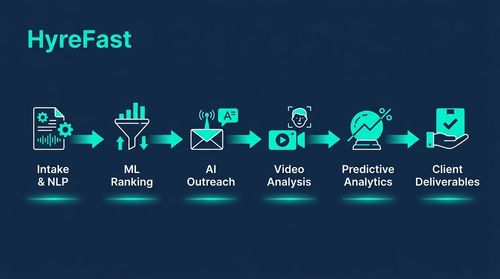
To win more retainers, agencies must position AI screening not as a cost center but as a strategic advantage. This requires embedding AI into the full recruitment lifecycle, not just resume parsing.
Start with intake. Use NLP to extract skills, experience, and qualifications from unstructured CVs and LinkedIn profiles. Deploy ML models that rank candidates against custom job profiles, weighting factors like cultural fit, growth potential, and skill adjacency.
Automate initial outreach with AI-generated personalized messages that reference specific candidate strengths. Use video interview AI to analyse speech patterns, sentiment, and competency indicators, reducing reliance on subjective gut feelings. Apply predictive analytics to estimate candidate likelihood of acceptance, performance, and retention.
Package AI insights as deliverables. Clients pay for clarity, not just candidates. Agencies can deliver skills gap analyses showing how candidate pools compare to role requirements, diversity and inclusion reports that track representation at each funnel stage, predictive turnover scores for shortlisted candidates, and benchmarking data comparing client hiring metrics against industry standards.
These insights transform the agency from a vendor into a strategic talent advisor, justifying premium retainer fees.
Offer flexible, consumption-based pricing. Move beyond flat retainers to hybrid models that align with client usage. A base retainer covers platform access, model maintenance, and a baseline number of screenings.
A variable tier charges per additional resume parsed, per AI interview minute, or per predictive report generated, priced at near marginal cost. A performance kicker pays bonuses when predefined outcomes are met, such as a hire retained for 12 months or a promotion within 18 months. This model reduces client risk while giving agencies upside potential tied to success.
Real-World Impact and Implementation
Several recruitment agencies have already demonstrated the power of AI screening as a retainer-winning tool. One tech-focused agency implemented an AI resume parser that automatically extracted skills from unstructured resumes and matched them against job descriptions using semantic similarity.
This reduced initial screening time from 3 hours per requisition to just 20 minutes, allowing recruiters to handle 3x more open positions without adding headcount. The agency used this efficiency gain to offer clients a guaranteed 2-week time-to-fill for mid-level roles, a promise that helped them win three new enterprise retainers in six months.
Another agency specializing in healthcare staffing used AI predictive analytics to identify candidates most likely to accept offers and stay long-term.
By analysing historical placement data, the AI model flagged candidates with attributes correlated to higher retention, such as specific certifications, commute tolerance, and previous job tenure. Clients reported a 40 percent reduction in early turnover for placements made using the AI-enhanced process, leading to renewed contracts at higher retainer rates.
A third example comes from a diversity-focused recruiting firm that used AI to reduce unconscious bias in screening.
The AI model was trained to ignore demographic information and focus solely on skills and experience metrics. Clients in industries struggling with diversity goals saw a 50 percent increase in underrepresented candidates moving to interview stages, which became a key selling point in retainer negotiations.
To successfully implement AI screening, agencies should follow a phased approach. Start by identifying your most painful screening bottlenecks, whether it is resume parsing, skills matching, or interview scheduling.
Choose AI tools that specifically address those pain points and integrate smoothly with your existing ATS or CRM. Many agencies begin with resume parsing and ranking tools, which offer quick wins in efficiency.
Next, focus on measurement and reporting. Set up dashboards that track key metrics like time-to-screen, submission-to-interview ratio, and offer acceptance rate. Share these insights with clients monthly to demonstrate ongoing value. The ability to show continuous improvement is what turns a one-time project into a long-term retainer.
Finally, consider outcome-based pricing models tied to AI-enhanced results. Instead of charging purely for hours worked, offer retainers that include guarantees like "90 percent of submitted candidates will meet minimum skills thresholds" or "time-to-fill will be reduced by 30 percent within 90 days."
This aligns your incentives with the client's goals and makes the retainer fee feel like an investment rather than a cost.
Overcoming Common Objections
Clients often raise concerns about AI replacing human judgment or introducing bias. Address these directly by emphasizing that AI augments recruiters, not replaces them.
The AI handles repetitive tasks like initial resume screening, freeing recruiters to focus on relationship building, interview coaching, and negotiation, activities that require human empathy and judgment.
For bias concerns, highlight that well-designed AI systems can actually reduce human bias by applying consistent criteria to all candidates. Many agencies conduct regular bias audits of their AI models and share the results with clients to build trust.
Cost is another frequent objection. Counter this by showing the total cost of ownership. While there may be an upfront investment in AI tools, the long-term savings from reduced time-to-fill, lower turnover, and higher placement rates often outweigh the costs.
Many agencies offer a pilot period where clients can test the AI-enhanced process at reduced risk before committing to a full retainer.
Conclusions
- AI screening transforms recruitment agencies from resume suppliers into strategic hiring partners by delivering measurable improvements in speed, quality, and transparency.
- The technical capabilities of NLP, semantic matching, and predictive analytics enable agencies to guarantee outcomes like 24-hour shortlists and 30 percent reduction in time-to-fill.
- Outcome-based pricing models that align agency incentives with client goals make retainer fees feel like investments rather than costs.
- The academic view confirms that AI reduces marginal screening costs to near zero, while the street view from social media shows clients are actively seeking agencies that use AI effectively.
Future Directions
- Research gaps remain in bias detection and mitigation for AI screening models, particularly for underrepresented groups in technical roles.
- Predictive analytics for retention risk will become more sophisticated as agencies accumulate larger datasets on placement outcomes.
- Integration of video interview AI with resume screening will create end-to-end automated assessment pipelines.
- FinOps tools for tracking cloud compute and API costs will become essential for agencies offering consumption-based pricing models.
Schedule a walkthrough: Book Demo