
How Recruitment Agencies Are Wasting 60% of Recruiter Hours on the Wrong Candidates
Recruiters waste up to 60% of their time on unqualified candidates. Learn how AI-powered screening, automated scheduling, and structured hiring workflows can reduce inefficiencies, improve candidate quality, and boost recruitment agency productivity.
Table of Contents

Introduction
Recruitment agencies operate in a high-pressure environment where time is literally money. Every hour a recruiter spends reviewing resumes, conducting initial screens, or chasing uninterested candidates is an hour not spent building relationships, negotiating offers, or sourcing for hard-to-fill roles.
Yet, industry data and internal audits consistently reveal a startling inefficiency: recruiters are wasting approximately 60% of their working hours on candidates who are fundamentally mismatched for the roles they're trying to fill.
This isn't merely a productivity issue-it's a strategic liability. In a market where speed-to-hire and candidate quality are paramount differentiators, agencies that continue to pour recruiter energy into low-yield activities are eroding their profitability, damaging client trust, and putting themselves at a competitive disadvantage against more technologically savvy peers.
The good news is that this waste is largely preventable. By understanding where the time drains occur and implementing targeted, technology-driven solutions, agencies can reclaim those lost hours and redirect them toward high-impact, revenue-generating activities.
1. Manual Resume Triage: The Black Hole of Initial Screening
The single largest time sink for most recruiters is the initial resume review. Despite advances in applicant tracking systems (ATS), many agencies still rely on recruiters to manually open, read, and make binary decisions (yes/no/maybe) on hundreds of applications per requisition.
- The Problem: A typical mid-level tech role in India might attract 200-300 applications. Even at a conservative 2 minutes per resume (which is often optimistic for a meaningful review), that's 6.5-10 hours of pure screening time per role-before a single conversation has happened.Much of this time is spent on candidates who are clearly unqualified (wrong location, insufficient experience, missing mandatory skills) or overqualified (likely to leave quickly or demand unsustainable compensation).
- The Waste: Studies suggest that 40-50% of applications for any given role are immediately disqualifiable based on objective criteria (e.g., not authorized to work in the required location, lacks a non-negotiable certification, has less than the minimum years of experience). Yet, recruiters often review these manually out of habit or lack of trust in automated filters.
2. Scheduling Hell: The Coordination Tax
Once a recruiter identifies a potentially promising candidate, the next major time drain is interview scheduling. This seemingly simple task becomes a complex negotiation involving multiple calendars, time zones, and last-minute changes.
- The Problem: Coordinating a single interview between a recruiter, hiring manager, and candidate can easily require 5-7 email or message exchanges. For a shortlist of 5 candidates needing two rounds of interviews each, this can consume 3-5 hours of recruiter time per requisition-time spent not on evaluating talent, but on logistics.
- The Waste: This is pure administrative overhead. While necessary, it doesn't require a recruiter's judgment, expertise, or relationship-building skills. It's a task that is highly susceptible to automation.
3. Chasing Ghosts: Low-Intent and Unresponsive Candidates
A significant portion of recruiter effort is wasted on candidates who show little to no genuine interest in the opportunity or the agency's process.
- The Problem: Recruiters invest time in initial outreach, leave voicemails, send follow-up emails, and attempt to build rapport with candidates who never respond, repeatedly reschedule, or ultimately ghost the process. This is especially prevalent when sourcing from open job boards or LinkedIn InMails without prior intent signals.
- The Waste: Industry benchmarks indicate that only 20-30% of cold outreach attempts result in a meaningful conversation. The remaining 70-80% represent sunk time with zero return on investment. Recruiters often persist due to activity-based metrics (e.g., "calls made") rather than outcome-based ones.
4. Misaligned Sourcing: Fishing in the Wrong Pond
Agencies frequently waste recruiter hours by sourcing candidates from channels or using search strings that are unlikely to yield relevant talent for a specific role.
- The Problem: A recruiter might spend hours manually searching LinkedIn for "data scientists" using broad Boolean strings, only to find that the majority of results are junior analysts, professionals in unrelated fields (e.g., data entry), or individuals located in regions where the client cannot hire. This misalignment happens when sourcing strategies aren't data-driven or when recruiters lack real-time market intelligence.
- The Waste: This represents a double loss: time spent sourcing irrelevant profiles and the opportunity cost of not using that time to search more effectively in niche communities, alumni networks, or talent pools where the right candidates actually congregate.
5. Inefficient Initial Screening Calls: The Qualification Gap
Even after a resume passes muster, the initial screening call often fails to efficiently determine fit, leading to wasted time for both recruiter and candidate.
- The Problem: These calls frequently devolve into unstructured conversations where the recruiter rehashes information already on the resume, fails to ask targeted knockout questions, or spends too much time building rapport before assessing basic compatibility. Without a structured guide, recruiters may talk for 20-30 minutes only to discover a fundamental mismatch (e.g., salary expectation too high, unwilling to relocate, lacks a critical hard skill).
- The Waste: If 30-40% of initial screens end in early disqualification for avoidable reasons, then a significant portion of that talk time is wasted. A well-designed, 10-minute structured call could achieve the same outcome with far less effort.
1. Legacy Processes and Comfort with the Familiar
Many agencies operate on processes designed for a pre-digital, low-volume hiring world. Recruiters are trained to manually review every resume because "you never know what you might miss." This mindset, while well-intentioned, is incompatible with today's volume and velocity.
2. Lack of Trust in Automation
Past experiences with brittle keyword-based ATS filters that accidentally screened out qualified candidates (e.g., missing a resume because it said "ML" instead of "Machine Learning") have bred skepticism. Recruiters often prefer the illusion of control from manual review over the perceived risk of automation, even when modern tools are far more sophisticated.
3. Misaligned Incentives and Metrics
Agencies frequently measure recruiter performance on activity-based KPIs (number of calls made, emails sent, resumes reviewed) rather than outcome-based metrics ( quality of shortlist, time-to-present, client satisfaction). This incentivizes busyness over effectiveness, rewarding the very behaviors that create waste.
4. Fragmented Technology Stacks
Many agencies use a patchwork of tools-an ATS for tracking, a separate LinkedIn recruiter seat for sourcing, a basic calendar tool for scheduling, and email for communication. The lack of integration forces recruiters to constantly switch contexts, manually copy-paste data, and re-enter information, creating friction and errors.
5. Insufficient Training on Modern Tools
Even when agencies invest in AI-powered sourcing or screening tools, recruiters often receive inadequate training on how to use them effectively. They may default to old habits (e.g., ignoring AI-generated scores and re-reading every resume) or use the tools suboptimally (e.g., relying solely on keyword matches instead of leveraging semantic search).
The Solution: Reclaiming Time Through Intelligent Automation and Process Design
The path to eliminating this 60% waste isn't about working harder-it's about working smarter by redesigning the recruiter's role around high-value activities and delegating low-value, repetitive tasks to technology. Here’s how agencies can systematically reclaim those lost hours.
1. Automate the Top of the Funnel: Smart Screening and Ranking
- Implement AI-Powered Semantic Search: Replace manual keyword boolean searches with AI-driven semantic matching. Tools that use NLP to understand the meaning behind skills and experience (e.g., recognizing that "built recommendation engines" implies ML expertise) can instantly rank candidates by conceptual fit, surfacing the top 10-20% for human review.
- Deploy Automated Knockout Questionnaires: Use integrated assessment tools to send candidates a short, role-specific questionnaire (e.g., "Are you authorized to work in India without sponsorship?", "Do you have 3+ years of experience with AWS?", "What is your expected CTC?") before any recruiter time is invested. Only candidates who pass these objective gates enter the human screening queue.
- Leverage AI Resume Parsing and Enrichment: Use NLP models to automatically extract and structure data from resumes (skills, titles, companies, dates, education) into a searchable format. This eliminates manual data entry and enables powerful filtering and matching. Impact: This can reduce initial resume review time by 50-70%, shifting the recruiter's focus from volume triage to quality assessment of a pre-vetted pool.
2. Eliminate Scheduling Friction with AI Coordinators
- Integrate AI Scheduling Assistants: Deploy tools that sync with recruiters', hiring managers', and candidates' calendars (Google, Outlook) to autonomously find and book optimal interview slots. These tools handle time zones, send invites, and manage rescheduling requests.
- Enable Self-Service Scheduling: Provide candidates with a personalized link to book interviews directly into the recruiter's or hiring manager's calendar based on pre-set availability windows. Impact: This can save 2-4 hours per requisition by eliminating the back-and-forth email chain, turning scheduling from a recruiter task into a seamless background process.
3. Focus Outreach on High-Intent Signals
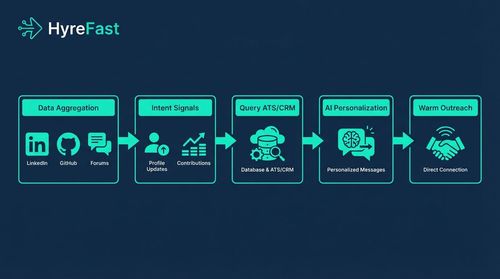
- Leverage Talent Intelligence Platforms: Use platforms that aggregate and enrich candidate data from multiple sources (LinkedIn, GitHub, Stack Overflow, professional forums) to identify not just skills, but also engagement and intent signals (e.g., recent profile updates, open-source contributions, participation in relevant webinars).
- Prioritize Warm and Silver-Medalist Candidates: Before launching a new search, query the agency's own ATS and CRM for past applicants who were strong but not selected (silver medalists) or candidates who have previously engaged positively. These individuals already have familiarity with the agency and often higher intent.
- Use AI for Personalized, Scalable Outreach: Instead of generic templates, use LLMs to generate highly personalized outreach messages that reference specific aspects of a candidate's background (e.g., "I saw your talk on MLOps at the XYZ conference...").
Impact: This shifts the recruiter's effort from low-yield cold calling to higher-conversion warm outreach, significantly improving the ratio of meaningful conversations to time invested.
4. Implement Structured, Data-Driven Initial Screens
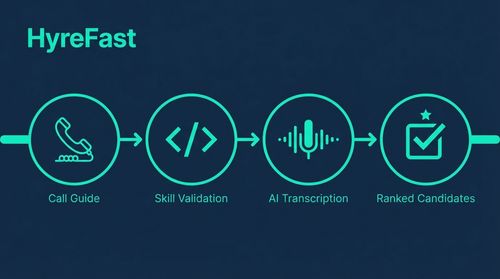
- Adopt Knockout-Driven Call Guides: Provide recruiters with a standardized, 10-15 minute call script focused on verifying objective fit: location authorization, salary expectations, notice period, and 2-3 critical hard skills or experiences. Use a simple scoring system.
- Integrate Real-Time Skill Validation: For technical roles, use embedded coding challenges or scenario-based questions (via platforms like HackerRank or Codility) that candidates complete before or during the initial screen, providing objective data on proficiency.
- Record and Transcribe (with Consent): Use AI-powered note-taking tools (e.g., Fireflies.ai, Otter.ai) to automatically capture and summarize key points from screening calls, freeing the recruiter to focus on listening and assessing rather than typing. Impact: This ensures that recruiter time is spent only on candidates who have a genuine chance of progressing, reducing wasted talk time by 30-50%.
5. Redesign the Recruiter Role Around High-Value Activities
The ultimate goal is to shift the recruiter from a transactional processor to a strategic talent advisor. Reclaimed hours should be invested in:
- Deep Client Consultation: Spending more time understanding the hiring manager's team dynamics, unspoken needs, and long-term talent strategy.
- Proactive Talent Pooling: Building and nurturing long-term relationships with passive candidates in niche communities (e.g., specific tech meetups, alumni groups, professional associations).
- Candidate Experience Management: Investing time in providing thoughtful feedback, coaching candidates through the process, and acting as a true career advisor.
- Strategic Sourcing: Using market intelligence and AI insights to identify unconventional talent channels (e.g., returning professionals, freelancers transitioning to full-time, internal talent marketplaces).
Measuring the Reclamation: From Waste to Value
Agencies should track the impact of these changes not just in time saved, but in tangible business outcomes:
- % Reduction in Time Spent on Initial Screening: Target a 50-70% decrease.
- Increase in Submissions-to-Interview Ratio: Aim to improve from 1:8 to 1:3 or better, indicating higher quality shortlists.
- Reduction in Time-to-First-Qualified-Candidate: Measure the speed at which a viable candidate is presented.
- Increase in Recruiter Satisfaction: Survey recruiters on whether they feel their time is better spent on meaningful work.
- Improvement in Client NPS: Track whether clients perceive the agency as more responsive, strategic, and valuable.
Conclusion: The Recruiter as a Talent Strategist, Not a Screener
The revelation that recruiters waste 60% of their hours on the wrong candidates is not an indictment of their effort or skill-it's a diagnosis of a broken process. The modern recruitment landscape demands speed, precision, and a focus on human judgment where it matters most.
Agencies that continue to treat recruiting as a manual, volume-driven slog are not just inefficient; they are fundamentally misaligned with the needs of their clients and the expectations of top talent.
By intelligently automating the top of the funnel, eliminating scheduling friction, focusing outreach on high-intent signals, and structuring initial screens for efficiency, agencies can reclaim those lost hours. The true value isn't just in the time saved-it's in what recruiters do with it.
When freed from the tyranny of manual triage and coordination hell, recruiters can become the strategic partners clients actually need: trusted advisors who understand business context, assess nuanced fit, and build the relationships that win the war for talent.
The agencies that thrive in 2025 and beyond won't be those with the most recruiters working the longest hours.
They'll be the ones who have successfully re-engineered their processes to ensure that every hour a recruiter spends is an hour spent on the right candidate-moving from wasted effort to focused, high-impact talent strategy.