
How Indian Recruitment Agencies Are Using AI to Win…
Discover how AI-powered recruitment agencies in India are outperforming global consultancies through faster candidate screening, smarter hiring automation, personalised engagement, and generative AI-driven recruitment workflows.
Table of Contents

Introduction
The recruitment landscape in India is shifting. Small and mid-sized agencies are quietly taking mandates that once belonged to global consultancies, and they are doing it with AI.
The reason is not just lower fees-it is speed, precision, and a level of service that legacy firms struggle to deliver. For a hiring manager in Bangalore or a founder in San Francisco, this means access to better talent faster, without the premium price tag.
This article explores how AI-powered screening, relationship management, and generative content creation are enabling Indian agencies to outmanoeuvre the big players.
The Legacy Bottleneck: Why Big Consultancies Lose
Large consultancies rely on branded methodologies and senior relationship managers. But their recruitment delivery remains labour-intensive and slow.
Manual resume screening takes days, keyword-bound searches miss strong candidates, and each mandate requires hours of repetitive preparation.
Clients grow frustrated with inconsistent slates and long turnaround times. Indian agencies, unburdened by legacy processes, are using AI to flip the script-turning speed and precision into their competitive edge.
AI Screening That Augments, Not Replaces
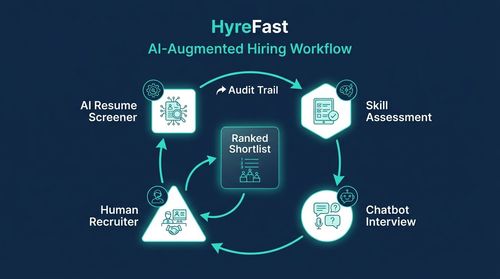
Research on meaningful human control in AI systems provides a framework for deploying hiring tools that augment recruiters rather than replace them.
The key properties are clear moral responsibility, compatible human-AI representations, proportional human authority, and explicit links between AI and human actions.
Indian agencies apply these principles through AI resume screeners and skill-assessment tools that process five to ten times more mandates per team member while maintaining auditability and reducing bias.
- AI screeners rank candidates by skill fit, not just keyword matches.
- Chatbot interviewers handle initial screening, freeing recruiters for deeper conversations.
- Audit trails ensure every decision can be reviewed, building client trust.
Agencies using platforms like HirePro or Aspiring Minds deliver candidate slates 40% faster than consultancies that rely on manual screening.
Clients frustrated by slow big-firm processes switch to agencies that can present qualified candidates while the consultancy is still scheduling intake calls.
Relationship Building at Scale
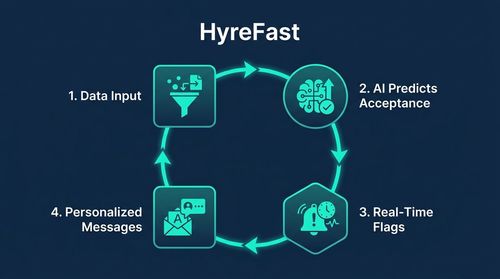
Another stream of research focuses on equity-centred outreach and structured relationship-building in AI projects.
These insights transfer directly to recruitment: transparent communication of role expectations, iterative feedback loops, and personalised candidate nurturing are critical for agency-client trust. Indian agencies deploy AI-powered CRM tools that automate these activities at scale.
- The CRM predicts offer acceptance likelihood based on historical data and candidate behaviour.
- Real-time engagement flags identify when a candidate is losing interest, allowing recruiters to intervene.
- Personalised messages are generated for each candidate, mimicking the attention of a dedicated consultant.
This lets agencies provide consultancy-level relationship depth at agency speed and cost. Mid-market clients, tired of paying premiums for relationship managers who lack technical recruiting agility, find this combination irresistible.
Generative AI for Content and Synthesis
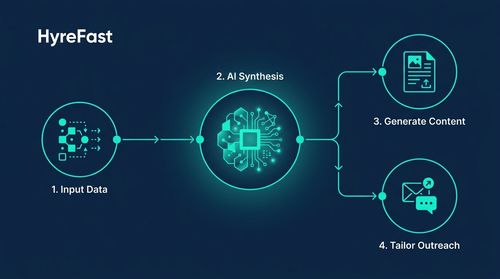
Generative information retrieval (GenIR) enables two capabilities: information generation (creating tailored content) and information synthesis (reorganising existing knowledge with grounding).
In recruitment, this translates to AI that writes role-specific job descriptions, generates customised outreach messages, synthesises candidate profiles from fragmented data, and creates interview guides based on real-time skill gap analysis.
- A Java developer brief can be instantly adapted for fintech versus healthcare contexts.
- Outreach messages are personalised using a candidate’s GitHub profile or published work.
- Interview questions are generated from the candidate’s project history, reducing bias and improving relevance.
Indian agencies eliminate hours of manual prep work per mandate. They respond to urgent client requests in hours, not days. Consultancies, with their rigid, process-heavy models, cannot match this responsiveness without massive cost increases.
End-to-End System Flow
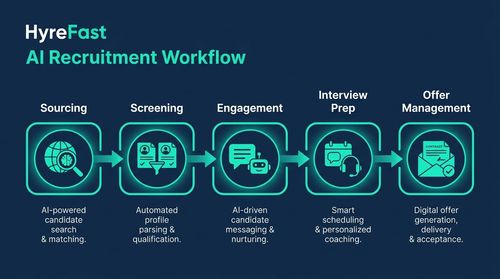
A typical AI-powered recruitment pipeline in an Indian agency looks like this:
- Sourcing: AI scrapes multiple platforms (LinkedIn, Naukri, GitHub) and enriches profiles with public data.
- Screening: Semantic matching and skill extraction rank candidates. Human recruiters review the top tier.
- Engagement: AI chatbots conduct initial conversations, schedule interviews, and answer candidate queries.
- Interview Prep: GenIR generates custom interview guides and technical assessments based on the role and candidate background.
- Offer Management: Predictive models flag acceptance risks and suggest counter-offer strategies.
Each stage is designed to reduce recruiter workload while improving candidate experience. The result is a lean team that handles ten times more mandates than a traditional consultancy team of the same size.
Challenges and Mitigations
AI in recruitment is not without friction. Bias in training data, lack of transparency in model decisions, and client scepticism are real concerns. Indian agencies address these by:
- Using explainable AI models that provide reasons for each ranking or recommendation.
- Regularly auditing screening outcomes for demographic parity.
- Offering clients the option to review raw AI outputs alongside human decisions. The meaningful human control framework ensures that recruiters remain in the loop. Agencies that invest in these safeguards build trust faster than consultancies that treat AI as a black box.
Trade-offs: Cost, Performance, and Complexity
For startups and mid-market clients, the trade-off is clear. AI-powered agencies offer faster, more precise results at lower cost. But they require upfront investment in technology and training.
Consultancies still win when clients need a full suite of services (strategy, employer branding, executive search) under one roof. However, for pure recruitment delivery, the AI-driven agency is increasingly the better choice.
- If speed and cost are the primary constraints, pick an AI-powered agency.
- If you need deep industry consulting and a single point of contact for multiple HR functions, a consultancy may still be appropriate.
Conclusions
- AI screening, grounded in meaningful human control principles, lets agencies process mandates five to ten times faster than manual methods.
- AI-powered CRM and generative content tools enable relationship depth and personalisation at scale, matching consultancy quality at agency cost.
- The academic view emphasises auditability and bias reduction; the market view confirms that speed and precision win clients.
- Indian agencies are proving that AI-powered agility beats branded bureaucracy in recruitment delivery.
Future Directions
- Research into bias mitigation in Indian multilingual resumes will further improve screening accuracy.
- Integration of voice-based AI for asynchronous interviews could reduce scheduling delays even more.
- Predictive models for candidate retention and cultural fit are still nascent but hold promise for reducing attrition.
- Smaller agencies will need open-source AI stacks to avoid vendor lock-in and keep costs low.
Want to identify strong candidates before interviews without relying on resumes?
Schedule a walkthrough: Book Demo
Explore HyreFast Solutions
Interview as a Service
Outsource first-round interviews to AI.
AI Interview Bot
AI bot that conducts and evaluates interviews 24/7.
Video Interview Software
One-way async video interviews with AI scoring.
Phone Screening
Automate first-round phone calls with AI.
Interview Assessment
Structured assessments with AI scoring and reports.
AI Interview Platform
End-to-end platform for AI interviews and analytics.