
Hiring Your First 10 Employees: A Screening Playbook…
A founder-friendly hiring playbook for screening early employees without a large HR team, ATS complexity, or endless resume reviews.
Table of Contents

Introduction
Your first 10 hires aren’t just employees-they’re the architects of your company’s culture, productivity, and survival. A single misstep here can derail product velocity, erode trust, or create toxic patterns that scale with you.
Yet most founders approach this critical phase with ad-hoc methods: relying on gut feel, skipping structured screening, or over-indexing on pedigree. The result is costly turnover, misaligned teams, and wasted runway.
This playbook gives you a battle-tested system to screen for the right traits-learning agility, ownership mindset, and complementary strengths-without needing an HR team or expensive tools.
Phase 0: Before You Screen-Define What “Good” Really Means
Founders often jump straight to resumes without clarifying what success looks like in the role. For early hires, this is especially dangerous because job descriptions evolve rapidly.
Start with a 90-Day Impact Statement instead of a generic job description. Answer: “If this person is exceptional, what specific, measurable outcomes will they have achieved in their first 90 days?”
For a founding engineer, that might be “Shipped core MVP feature X handling 1K+ DAU with <2% error rate” or “Reduced AWS costs by 30% through infrastructure optimization.” This forces you to screen for impact potential, not just activity.
Next, identify your Non-Negotiable Trinity for every early role:
- Learning Velocity: How fast do they acquire and apply new knowledge in ambiguous settings? This matters more than their current skill stack.
- Owner’s Mindset: Do they treat problems as theirs to solve, not just tasks to complete? Look for evidence of initiating without permission.
- Complementary Friction: Do they challenge your thinking in constructive ways? Avoid hiring clones-you need people who see your blind spots. If a candidate doesn’t demonstrate at least two of these in your process, reject them-even if they’re “qualified” on paper.
Finally, apply the Founder’s Time Budget Rule. Allocate your limited hours ruthlessly: 20% to sourcing and initial filtering, 60% to deep screening (work samples and conversations), and 20% to reference checks and decision calibration. Never skip the 60% deep work-this is where you signal that excellence matters.
Phase 1: Sourcing-Leverage Your Unfair Advantage
Founders overcomplicate sourcing. Your first 10 hires should come 70% from your network and 30% from targeted outreach-not job boards.
Start with the Warm Introduction Funnel. List 20 people who know your work ethic and vision-ex-colleagues, advisors, past collaborators.
Ask each: “Who’s the one person you’ve worked with who would thrive in our early-stage chaos?” Not “Do you know anyone looking?” Prioritise those who name someone unprompted-this signals strong recall. Warm referrals from people who know your context yield 3x higher retention than cold sources.
For gaps your network can’t fill, use Targeted Cold Outreach. Search LinkedIn for people who’ve built similar things at comparable stages-for example, “grew user base 10x at Seed-stage SaaS.”
Message with specificity: “I saw you grew X from 0 to Y at Z-we’re tackling a similar problem. 15 mins to swap war stories?” Never lead with a job description. Lead with curiosity about their craft.
Watch for red flags in sourcing: candidates who only apply via cold LinkedIn messages (low signal of genuine interest), referrals from people who can’t name a specific impact the candidate had, and over-reliance on “name brand” employers without probing for actual contribution.
Phase 2: Screening-Replace Resumes with Evidence
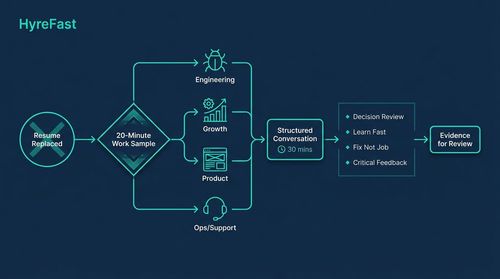
Resumes are terrible predictors for early-stage hires. They show what someone claims to have done, not how they think or operate. Replace them with a 20-Minute Work Sample for every role.
Design a task that mirrors real early work, scoped to 20-30 minutes of effort. For an engineer: “Here’s a bug in our staging env-fix it and explain your approach.” For growth: “Our landing page converts at 2%. Give me one test to run and why.”
For product: “Sketch how you’d improve our onboarding flow for a specific user type.” For ops or customer success: “Role-play handling an angry user who says a common complaint.”
Critical rules: time-box it strictly-if they ask for more time, it’s a red flag. Focus on process, not perfection. Ask: “What would you do next if you had two more hours?” This reveals learning agility.
Do it live or via async video-watching them think is more valuable than the final output. Work samples are 5x more predictive of job performance than interviews alone, according to the Schmidt & Hunter meta-analysis.
After the work sample, have a Structured Conversation (not a chat) lasting 30 minutes. Focus only on four areas:
- Walk me through your decisions in the work sample. What would you change?
- Tell me about a time you had to learn something completely new fast to deliver a result.
- Describe a time you fixed something that wasn’t your job.
- What’s one thing you think we’re getting wrong about our product or market?
Avoid “Tell me about yourself” (wastes time), hypotheticals (they elicit idealised self-images), and culture-fit questions that veer into similarity bias. Record the conversation with permission and transcribe key moments-founders miss nuances when relying on memory.
Use AI sparingly for high-volume roles. Let it flag keywords from work samples or identify sentiment shifts, but never let AI make pass/fail decisions. Use it to surface evidence for your review.
Phase 3: References-The Founder’s Secret Weapon
References aren’t a formality-they’re your best predictor of how someone will actually behave under pressure. But most founders do them wrong: asking for generic strengths or calling only the names candidates provide.
Do this instead. Ask the candidate: “Give me two people who’ve seen you under pressure—one who loved working with you, one who found it challenging.” This gets past the “only give me fans” problem. Then ask each reference:
- What’s the one thing the candidate consistently underestimated about themselves? (Reveals self-awareness)
- Tell me about a time they had to pivot fast when priorities changed. What did they do? (Tests learning agility in ambiguity)
- If you were building a startup team, what role would you not put them in-and why? (Uncovers lethal weaknesses)
- On a scale of 1-10, how likely are you to rehire them for a high-stakes, ambiguous project? What would move it to a 10? (Forces honesty and reveals coachability)
Call references yourself-don’t delegate. Your tone and follow-up questions will uncover more than an HR assistant ever could. Block 20 minutes per reference and treat it like a critical customer discovery call.
Phase 4: Decision-Making-Avoiding Founder Bias
Founders often hire based on chemistry or similarity. Combat this with a Pre-Mortem before you offer. Ask: “If this hire fails in 6 months, what’s the most likely reason?” Then screen your notes for evidence against that failure mode.
If you fear they’ll lack owner’s mindset, re-check: Did they show initiative in the work sample? Did references cite self-starter behaviour?If you have a co-founder, use the Silent Read-Out.
Each writes down their hire/no-hire recommendation and one piece of evidence supporting it before discussing. Share simultaneously, then discuss only where evidence conflicts. This prevents anchoring on first impressions or charisma.
Your offer strategy must reflect speed and clarity. Decide within 72 hours of the final interview-delay signals disorganisation. State equity vesting, salary, and explicit first-90-day goals tied back to your Impact Statement.
The founder calls the candidate personally to share the offer-no recruiter middleman. Never negotiate equity down to “save money.” If you’re hesitating over 0.1%, you’re not convinced they’re a 10x hire-and you shouldn’t hire them.
Phase 5: Onboarding-Screening Doesn’t End at Offer
The first 30 days are your final screening phase. Set up a tiny, shippable task in Week 1 tied to their 90-day impact goal-for example, “Fix this UX flow that’s confusing users.”
In Week 2, hold a feedback session: “What’s one thing we should stop, start, or do differently based on your first impressions?” This tests owner’s mindset and complementary friction.
In Week 4, have a candid chat: “If you were advising a friend about joining us, what would you say?” This reveals true sentiment.If they’re not showing owner’s momentum or learning velocity by day 30, act fast-don’t wait for 90 days.
What to Avoid at All Costs
| Founder Trap | Why It’s Deadly | How to Prevent It |
|---|---|---|
| Hiring for “culture fit” as similarity | Creates echo chambers; misses complementary skills | Screen for “culture add”: “What perspective do you bring we lack?” |
| Over-indexing on pedigree | Ivy League or ex-Google doesn’t equal startup fit | Ask: “What did you build there, not just what was your title?” |
| Skipping references to move fast | One bad hire can kill early momentum | Treat references as non-negotiable—block time for two references |
| Letting candidates interview the team unstructured | Wastes time, creates inconsistent signals | Give interviewers 1-2 specific things to assess, like learning agility |
| Making offers based on gut feel after one chat | Ignores red flags; overvalues charisma | Require work sample + structured convo + references before deciding |
Measuring Success: Beyond Retention
Track these leading indicators for your first 10 hires:
- 90-day impact achievement: Percentage who hit at least two of their 90-day goals. Target: ≥70%.
- Manager velocity score: Survey team leads: “How much has this person increased your output?” Target: ≥4 out of 5.
- Learning velocity proxy: Number of new skills or tools they’ve independently applied by month 3. Target: ≥3.
- Founder time saved: Hours per week you’re not firefighting due to their ownership. Target: ≥5 hours per week by month 2. If these are strong, retention will follow.
The Founder’s Mindset Shift
Your job isn’t to find the “perfect” candidate-it’s to find someone whose growth trajectory aligns with your company’s needs for the next 18 months.
The first 10 hires aren’t just employees; they’re the architects of your culture and the force multipliers for your vision. Screen not for who they are today, but for who they’ll become when faced with your specific brand of chaos.
Start small: pick one open role. Apply the work sample, structured conversation, and two deep references. You’ll make a better hire in 5 hours than most founders make in 20. Then repeat.
Conclusions
- A structured, evidence-based screening process taking under 30 minutes per candidate prevents costly mis-hires while respecting everyone’s time.
- Focus on non-negotiable behaviours-learning velocity, ownership mindset, and complementary friction-not skills lists or pedigree.
- Work samples are 5x more predictive of job performance than interviews alone; use them as your primary screening tool.
- Treat every candidate with transparency and specific feedback-even rejects become brand ambassadors who can refer future talent.
Future Directions
- Founder-specific screening playbooks will emerge, tailoring rubrics to predict success in the first five engineering hires at a B2B SaaS startup versus a consumer app.
- Lightweight predictive validation methods will let founders correlate screening scores with 90-day impact without needing an HRIS.
- Anti-ghosting networks within founder communities may share verified “do not hire” lists for toxic early-stage behaviours like chronic rescheduling or disrespect to junior staff.
- Candidate co-designed screens-involving your first five hires in refining questions-will ensure the process reflects what actually matters in your specific context.
Want to identify strong candidates before interviews without relying on resumes?
Schedule a walkthrough: Book Demo
Explore HyreFast Solutions
Interview as a Service
Outsource first-round interviews to AI.
AI Interview Bot
AI bot that conducts and evaluates interviews 24/7.
Video Interview Software
One-way async video interviews with AI scoring.
Phone Screening
Automate first-round phone calls with AI.
Interview Assessment
Structured assessments with AI scoring and reports.
AI Interview Platform
End-to-end platform for AI interviews and analytics.