
Highest rated video interviewing for streamlining candidate screening at scale efficiently
Table of Contents

Introduction
Every hiring team that processes thousands of applications knows the pain: phone screens that take days to schedule, recruiters spending hours on calls that could be automated, and candidates dropping off because the process is too slow. Video interviewing platforms have emerged as the answer, but not all are built for scale. The highest-rated tools combine asynchronous video capture with AI-assisted analysis to cut screening time by 50 to 75 percent while maintaining predictive accuracy. This article explores the technical foundations that make this possible, compares the top platforms, and provides a practical framework for choosing the right solution for your volume and compliance needs.
The Screening Bottleneck: Why Manual Review Fails at Scale
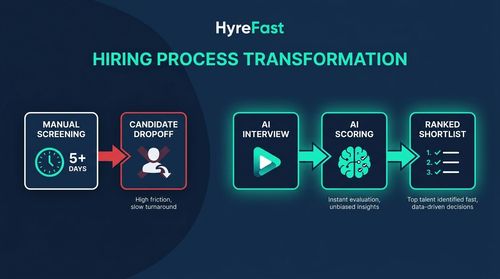
When a single requisition attracts 500 or more applicants, manual phone screening becomes a bottleneck. Recruiters spend an average of 15 to 20 minutes per phone screen, and scheduling conflicts add another day or two. The result is a time-to-screen that often exceeds five days, causing top candidates to accept offers elsewhere. Video interviewing solves this by allowing candidates to record responses on their own time, eliminating scheduling entirely. But recording alone is not enough. The real efficiency gain comes from AI that can automatically surface the most relevant evidence from each response, reducing manual review time to under five minutes per candidate.
- Time-to-screen reduction is the primary metric. Top platforms report a drop from five days to under 24 hours for asynchronous interviews.
- Recruiter hours saved per 100 screens range from 15 to 25 hours when AI assists with scoring and transcript search.
- Completion rates above 85 percent are critical for maintaining pipeline volume. Mobile-first design and clear timing expectations drive this.
How AI Understands Video Interviews: The Technical Core

The academic research behind modern video interviewing platforms reveals sophisticated models that go far beyond simple keyword matching. A hierarchical attention neural network, for example, processes thousands of asynchronous interview recordings by jointly modeling verbal content, audio cues, and visual social signals. This approach predicts recruiter-rated hirability with accuracy comparable to human reviewers, while operating at machine speed. The key innovation is the attention mechanism, which learns to focus on the most informative temporal slices of a candidate’s answer.
- Hierarchical attention works at two levels: word-level attention within each sentence, and sentence-level attention across the entire response. This captures both local phrasing and overall narrative structure.
- Temporal attention identifies moments of high verbal or non-verbal relevance, such as when a candidate uses the STAR method or demonstrates enthusiasm through tone. These slices carry significantly more signal for hirability than random clips.
- Multimodal fusion combines text transcripts, audio features like pitch and pace, and visual cues such as facial expressions. The model learns which modalities matter most for each competency being assessed. These techniques enable a compact, efficient representation of each candidate’s response. Instead of watching the full video, recruiters can jump to the highlighted moments or rely on an overall score that correlates with job performance. Validation studies show that structured video interviews using such models demonstrate comparable validity to in-person interviews when properly implemented.
Building a Scalable End-to-End System
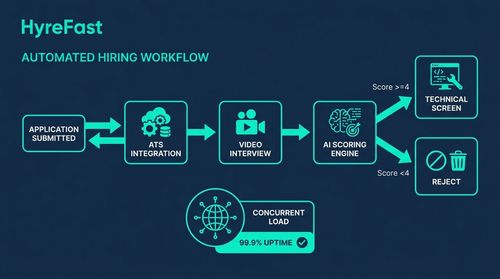
A production-grade video interviewing platform is more than just a recording tool. It must integrate with applicant tracking systems, handle concurrent sessions across global regions, and provide automated workflows that trigger based on application status. One research paper describes an intelligent recruitment management system built on Java that automates resume parsing, candidate-position matching, and interview scheduling. The video interview module records candidate responses and feeds them to AI-driven scoring engines, delivering a fully automated screening pipeline.
- ATS integration must be bidirectional and native. The platform should push video playback and AI scores into the candidate profile within the ATS, and pull status updates to trigger next steps.
- Concurrent load handling requires a global CDN and automated bandwidth adjustment. Top platforms maintain 99.9 percent uptime even during peak hiring seasons.
- Automated progression triggers allow rules like “if communication score is four or above, move to technical screen.” This eliminates manual handoffs and reduces time-to-next-stage.
Balancing Speed and Fairness: The Human Oversight Imperative
The highest-rated platforms explicitly state that AI does not make hire or no-hire decisions. Instead, it surfaces evidence for human review. This is not just a compliance checkbox; it is a practical necessity. Bias audits must be available by gender, ethnicity, and age for each use case. Emerging regulations like New York City Local Law 144 and the EU AI Act require transparency in automated employment decision tools. Platforms that publish bias audit reports and allow human override at any stage are better positioned for long-term adoption.
- Bias-mitigated algorithms must include audit trails and adverse impact reporting. Ask vendors for validation studies linking scores to six-month job performance for your specific role type.
- Human review override should be available at every stage. Recruiters must be able to see why a candidate scored high or low on a competency, and to adjust scores based on context.
- Candidate experience must not be sacrificed for speed. Accessibility compliance, mobile-first design, and clear feedback loops keep completion rates high and protect your employer brand.
Choosing the Right Platform for Your Context
No single platform fits every need. The choice depends on your volume, industry, compliance requirements, and budget. Based on enterprise adoption patterns and user reviews through 2024, here are the top contenders and their ideal use cases.
- HireVue is the market leader for enterprise-scale AI-assisted screening. It processes over 20 million interviews annually and offers validated predictive models. Best for Fortune 500 companies and high-volume technical or graduate hiring. G2 rating: 4.3 out of 5 from over 1,200 reviews.
- Spark Hire excels in speed and simplicity for mid-market teams and agencies. Its bulk-invite feature sends 1,000 interview links in one click, and average time-to-screen drops to under 24 hours. G2 rating: 4.7 out of 5 from over 1,000 reviews.
- VidCruiter is built for regulated industries like healthcare and government. It offers highly customizable workflows and strong compliance tools. Capterra rating: 4.6 out of 5 from over 400 reviews.
- Willo focuses purely on asynchronous video with a mobile-first design that achieves 90 percent completion rates. Its AI-assisted transcript search lets recruiters find skill mentions across thousands of videos. G2 rating: 4.8 out of 5 from over 600 reviews.
- Harver combines video responses with situational judgment tests and cognitive ability assessments for predictive screening. Used by Volkswagen and Coca-Cola for volume hiring. TrustRadius rating: 8.9 out of 10.
Conclusions
- Hierarchical attention models that process verbal, audio, and visual signals can predict hirability with accuracy comparable to human reviewers, enabling automated screening at scale.
- The academic research validates that structured video interviews, when combined with AI-assisted scoring, reduce manual review time by 50 to 75 percent without sacrificing predictive validity.
- The industry consensus, reflected in user reviews, is that the highest-rated platforms use AI as an assistive tool, not a decision maker, and provide bias audit reports and human override options.
- Platform choice must be driven by your specific volume, compliance needs, and candidate experience goals. A 30-day pilot with one high-volume requisition is the best way to validate fit.
Future Directions
- Explainability in AI scoring remains a research gap. Future models will need to provide natural language justifications for each score, not just attention weights.
- Multimodal fusion techniques are still evolving. Better integration of prosody, facial micro-expressions, and contextual language understanding will improve accuracy for complex competencies.
- Real-time adaptive questioning, where the AI adjusts follow-up questions based on previous responses, could make asynchronous interviews more conversational and reduce candidate anxiety.
- Integration with other pre-employment assessments, such as cognitive tests and work samples, will create a unified predictive score that goes beyond video alone.