
The Hidden Cost of “Quick Hiring” in Early-Stage Startups
Quick hiring in early-stage startups can lead to poor fits and higher turnover. Learn the hidden costs of rushed hiring and how founders can avoid them.
Table of Contents

Introduction
In the frenetic world of early-stage startups, the drive to ship product, secure funding, and outmanoeuvre competitors often creates a pervasive sense of urgency.
This "entrepreneurial logic," a focus on opportunistic agility, frequently extends to hiring. The prevailing sentiment, amplified on founder-focused social media and forums, glorifies speed:
"Move fast and break things." In this context, hiring can feel like a necessary evil-a process to be expedited at all costs. The fear is palpable: a single day with an open role is a day of lost productivity, a missed opportunity.
However, this "quick hiring" approach carries a significant, often hidden, technical debt for the organisation.
Research, including studies from the Journal of Software Engineering, indicates that a lack of structured process, exacerbated by cognitive biases and an over-reliance on narrow technical metrics, systematically undermines hiring quality.
This article will dissect the recurring failure modes of hasty hiring, drawing on academic research and industry data.
We will move beyond anecdotes to explore the structural flaws-from ambiguous job descriptions to uncalibrated interviewers-and outline a pragmatic, data-informed framework for building a resilient, high-performing team capable of driving genuine innovation, not just filling seats.
The Compounding Costs of a Mis-Hire
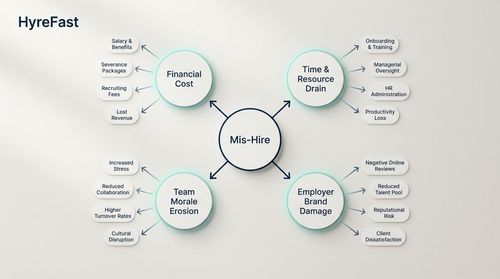
The most immediate and quantifiable cost of a bad hire is financial. While a figure like a $14,000 average cost (as cited by sources like Glassdoor) is a starting point, the true expense for a startup is far more multifaceted and corrosive.
- The Multiplier Effect on Time and Resources: A mis-hire consumes disproportionate resources. The time spent by the founding team on recruiting, onboarding, and training is a massive sunk cost. Replicating this process to find a replacement diverts critical attention from product and growth. Furthermore, the time spent by teammates mentoring or correcting the work of a mismatched employee is an often-overlooked productivity drain.
- Erosion of Team Morale and Culture: The impact on team morale is perhaps the most damaging hidden cost. An underperforming or culturally misaligned employee can create tension, foster resentment among high performers who must shoulder extra work, and slowly erode the trust and collaborative spirit essential for a startup's survival. Research from the Journal of Entrepreneurship and Innovation consistently shows that a strong company culture, built on shared values, is a stronger long-term predictor of success than technical skill alone. A single mis-hire can act as a toxin, undermining this fragile cultural foundation.
- Damage to Employer Brand: A rushed process often leads to a poor candidate experience-ghosting, disorganised interviews, vague feedback. In an interconnected industry, a negative reputation spreads quickly, making it harder to attract top talent in the future. The very speed you gain today can throttle your hiring pipeline tomorrow.
Deconstructing the Five Recurring Failure Modes

The problems with quick hiring are not random; they are predictable symptoms of an unstructured process. Analysis points to five interconnected failure modes that plague early-stage companies.
1. The Ambiguity Trap: Vague Job Descriptions
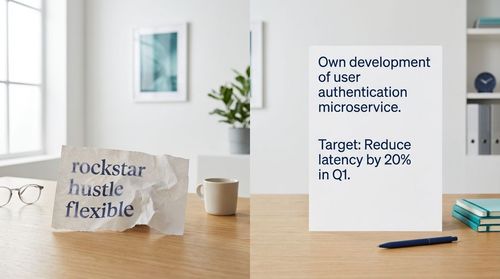
In a startup, where roles are fluid, there's a temptation to write broad job descriptions to attract a "flexible" candidate. However, this lack of rigour at the outset is a critical point of failure.
An ambiguous job description, filled with buzzwords but lacking specificity, attracts a mismatched candidate pool. It wastes valuable interview cycles on unsuitable candidates and, crucially, sets the new hire up for confusion and underperformance.
The solution is to define the role in terms of outcomes and core responsibilities, not just skills. Instead of "looking for a rockstar engineer," specify: "Own the development and deployment of our new user authentication microservice, aiming to reduce latency by 20% within the first quarter."
This clarity aligns expectations and provides a clear benchmark for success.
2. The Myopia of Technical Chops: Overemphasising Technical Skills

Tech startups, in particular, often prioritise narrow technical prowess above all else. While coding tests and system design interviews are essential, an overemphasis on this single dimension is a form of myopia.
It neglects essential soft skills like communication, adaptability, and collaborative problem-solving.
Academic research on Employee-Driven Innovation (EDI) links traits such as cooperative orientation and autonomy to better problem-solving and innovation-traits not revealed through a purely technical grilling.
A team of brilliant individual contributors who cannot work together effectively is a liability. The goal is to build a team, not just a collection of talents.
A study prioritising cultural fit over pure technical skill found that such startups tend to perform better in the long run, as alignment on values drives engagement and productivity.
3. The Uncalibrated Interviewer: Inadequate Interviewer Training
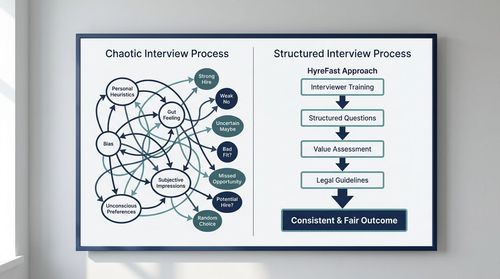
This is perhaps the most underestimated flaw. In a resource-constrained environment, anyone available-a founder, a lead engineer-is thrust into the interviewer role with little to no guidance.
These untrained interviewers inevitably rely on "personal heuristics" and gut feelings.
One interviewer's "strong hire" based on a stimulating technical debate is another's "weak no" due to a perceived lack of humility.
Without calibration, the process becomes unpredictable and deeply biased. The fix is not onerous: it involves creating a brief interviewer training programme.
This would cover the basics of structured interviewing, the company's core values and how to assess for them, and legal guidelines to avoid discriminatory questions.
A small investment in training pays massive dividends in consistency and fairness.
4. The Bias Amplifier: Unstructured Interviews

Unconscious bias is a human constant, but unstructured interviews act as an amplifier.
When interviews are free-form conversations without a standardised set of questions or a clear scoring rubric, biases based on similarity (the "like me" bias), educational pedigree, or first impressions creep in unconsciously. A structured process is the primary mitigant. This involves:
- Standardised Questions: Each candidate for a role is asked the same core set of behavioural and situational questions.
- Clear Rubrics: A scoring guide defines what a 1, 3, or 5 looks like for each question or competency.
- Independent Assessment: Interviewers score candidates immediately after the interview, before a debrief meeting, to avoid groupthink. This structure replaces subjective opinion with comparative, objective data, moving the decision from "I liked them" to "They demonstrated competency X at level Y."
5. The Data Deficit: Ignoring Process Metrics
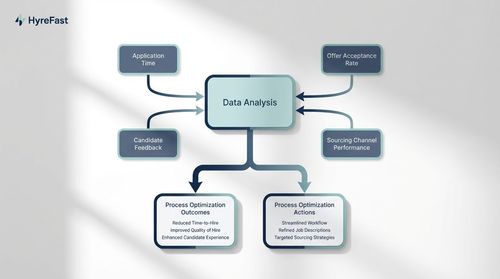
Finally, quick hiring rarely involves looking at the data. Startups meticulously track product KPIs but often ignore hiring metrics.
How long does our hiring process take? What is our offer acceptance rate? What are the primary reasons candidates decline our offers? Which sourcing channels yield our highest-performing employees?
Without this data, hiring decisions are made in a vacuum. A data-informed approach means treating hiring like a product-iterating, A/B testing, and optimising based on feedback and outcomes.
It allows you to identify bottlenecks, improve the candidate experience, and double down on what actually works.
A Pragmatic Framework for Quality-Conscious Hiring
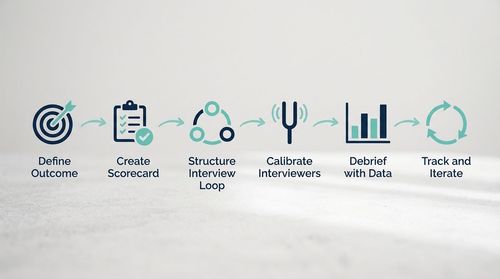
For a startup, the answer isn't to adopt the bloated, multi-month processes of a large corporation. It's to build a lean, rigorous framework that prioritises quality without sacrificing all speed.
- Define the Outcome First: Before posting a job, the team must agree on the 3-5 key outcomes for the role in the first 6-12 months. This becomes the foundation for everything else.
- Create a Scorecard: Develop a simple interview scorecard that balances technical skills (e.g., coding ability, system design) with core competencies (e.g., collaboration, ownership, communication) aligned with company values.
- Structure the Interview Loop: Design a consistent loop (e.g., recruiter screen, technical interview, values/collaboration interview, hiring manager wrap-up). Use structured questions and rubrics for each stage.
- Calibrate the Interviewers: Conduct a 60-minute training session for all interviewers on the scorecard, the questions, and how to avoid common biases. Re-calibrate periodically.
- Debrief with Data: In the hiring debrief, require each interviewer to present their scores and evidence before discussion. This forces objective assessment before subjective persuasion.
- Track and Iterate: Maintain a simple dashboard with key hiring metrics (time-to-hire, source quality, acceptance rate) and review it quarterly.
Conclusion and Future Directions

The hidden cost of "quick hiring" is a systemic risk that can cripple an early-stage startup's culture, productivity, and long-term viability.
The trade-off is not between speed and quality, but between short-term illusion and sustainable growth.
By recognising the failure modes-ambiguity, technical myopia, uncalibrated interviewers, amplified bias, and data deficit-founders can take deliberate steps to build a more robust system.
The future of startup hiring lies in applying the same rigorous, iterative mindset used in product development to the people function. This involves:
- Leveraging people analytics to move from gut-feel to data-driven decisions.
- Exploring structured assessment tools that evaluate problem-solving in realistic, collaborative scenarios.
- Continuously refining the definition of "culture fit" to ensure it promotes diversity and inclusion, rather than homogeneity. Building a company is ultimately about building a team. Investing in a thoughtful hiring process is not a distraction from the journey; it is the most critical investment a founder can make in the destination.