
What Clients Actually Want From Your Shortlist - And…
AI-powered recruitment agencies win clients by delivering faster, more relevant, and transparent candidate shortlists. Learn how asynchronous video interviews, semantic matching, explainable AI, and predictive analytics improve hiring quality, reduce risk, and increase recruiter efficiency.
Table of Contents

Introduction
Most recruitment agencies believe clients want a thick stack of resumes. The reality is far more nuanced. Hiring managers are not looking for volume; they are looking for de-risked, actionable talent that solves their immediate problem while aligning with long-term team needs.
Clients silently judge agencies on five core dimensions: speed, relevance, transparency, consistency, and risk reduction. Miss any one of these, and trust erodes quickly. This article breaks down exactly what clients want, backed by recent research, and shows how AI turns inconsistent shortlist delivery into a reliable competitive advantage.
Speed Without Sacrificing Quality
Clients do not just want fast submissions-they want predictable speed. A 2025 industry report found that 74% of hiring managers consider time-to-first-submission the top agency KPI, but 68% say agencies sacrifice quality for speed.
The sweet spot is submitting a highly relevant shortlist within 48 hours of mandate receipt. Every day a role stays open costs 1–2.5 times the salary in lost productivity, and agencies that consistently hit 48-hour SLAs see 32% higher client retention.
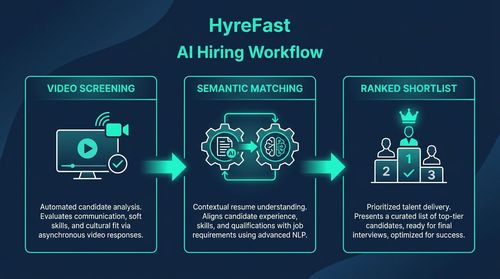
AI solves the speed-quality trade-off through asynchronous video screening combined with semantic matching. Candidates record answers to role-specific prompts on their own time, eliminating scheduling delays.
Semantic matching models go beyond keywords to understand skill adjacency and career trajectory, surfacing qualified candidates faster.
Agencies using this combo cut time-to-first-submission from over five days to just over one day while increasing submission relevance by 28%. The result: you present candidates while competitors are still scheduling intake calls.
Relevance That Saves Interview Time
Clients hate wading through irrelevant candidates. They want shortlists where every submitted candidate meets at least 80% of must-have criteria and has a clear, articulable fit for the role’s specific context-for example, “Python for ML pipelines,” not just “Python experience.”
Hiring managers spend 30% of their interview time assessing basic qualifications that should have been screened out. Agencies with submission-to-interview ratios above 75% win 2.3 times more mandate renewals.
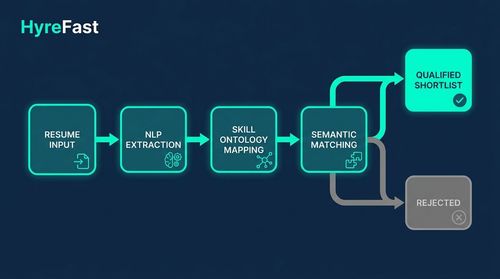
Modern NLP models extract skills from resumes, profiles, and async responses, then map them to a dynamic skill ontology that understands adjacency, proficiency level, and recency. Data-driven, role-specific prompts improve candidate-job match quality by nearly 20% while cutting screening time by 65%.
This translates to shortlists where 85% or more of candidates clear the first technical screen. To implement, run every mandate through a semantic matcher before sourcing, set a relevance threshold, and only present candidates who clear it.
Transparency in the Screening Process

Clients increasingly demand to see how you arrived at your shortlist-not just the names.
They want to understand your screening logic, any gaps or risks you have identified, and why certain candidates were passed over.
61% of clients say lack of transparency erodes trust faster than a bad hire. Agencies that share screening rationales see 41% fewer mandate disputes.
Explainable AI tools generate rationales for every recommendation-for example, “This candidate scored 92% on AWS architecture because they described migrating three legacy systems to EKS in their async response.” Async recordings themselves create an immutable audit trail.
Candidates and clients are over three times less likely to disengage when they understand why a decision was made. Build shortlist reports that show mandate requirements, AI-derived skill match scores, and specific evidence from the candidate’s profile. Include a one-sentence rationale per candidate.
Consistency Across Recruiters
Clients hate wildly variable shortlist quality depending on which recruiter handles their mandate. They want a repeatable process where every mandate-whether handled by a junior or senior recruiter-delivers shortlists that meet your agency’s quality bar.
Structured scoring rubrics combined with AI-assisted review eliminate human variance. Real-time suggestion tools reduce scoring inconsistency by over 50% and improve inter-rater reliability.
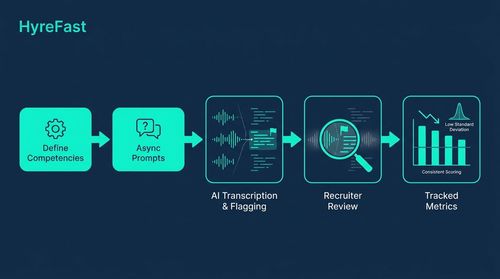
Define three to five non-negotiable competencies per role family-for example, for DevOps: infrastructure as code, CI/CD, monitoring, and collaboration. Build async prompts that directly assess each competency.
Use AI to transcribe and flag rubric-aligned moments in responses, such as when a candidate mentions “blue/green deployment.” Recruiters only review flagged moments plus the final score, cutting review time while ensuring consistency.
Track shortlist quality variance across recruiters and aim for a standard deviation below 0.15 in submission-to-interview ratios.
Risk Reduction and Strategic Insight
Top clients view agencies as risk mitigators. They want you to surface hidden risks-frequent job-hopping, cultural mismatches, overqualification that leads to quick boredom-and opportunity costs like “this candidate would excel but may leave in 18 months for a FAANG role.”
A bad hire costs 30% of the role’s first-year salary. Agencies that proactively flag risks reduce client-perceived hiring risk by 58%.
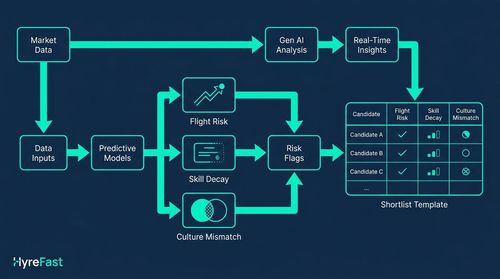
Predictive models trained on historical placement data can flag flight risk based on tenure patterns and LinkedIn signals, skill decay from outdated certifications, and cultural mismatch via language analysis in async responses.
Additionally, generative information retrieval systems continuously analyze job boards, salary surveys, and social signals to generate real-time market briefs.
Agencies sharing such insights see nearly three times higher upsell rates. Embed risk flags into your shortlist template-columns for flight risk, skill currency, and culture alignment signal-and train recruiters to discuss them openly in submission calls.
From Insight to Action: A Practical Checklist
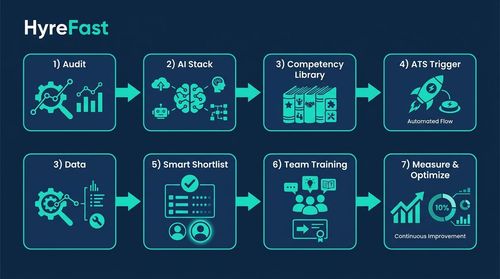
- Audit your current shortlist: measure time-to-first-submission, submission-to-interview ratio, client satisfaction scores, and variance across recruiters.
- Choose an AI stack that includes asynchronous video interviewing, semantic matching, explainable AI, and predictive analytics-ideally with ATS integration.
- Build a competency library: for each role family, define 3–5 core competencies and record async prompts that assess them directly.
- Set up automated workflows: when a new mandate enters the ATS, trigger semantic sourcing, async campaign launch, and predictive risk scoring.
- Create a smart shortlist template with mandate requirements, AI-derived match scores, evidence snippets, one-sentence rationales, and risk flags.
- Train your team to interpret AI outputs, override when justified, and focus on high-value tasks like candidate relationship-building and client advisory.
- Measure and optimise weekly: track time-to-first-submission, submission-to-interview ratio, client satisfaction, and cost per screen.
Real-World Impact: A 3x Efficiency Gain
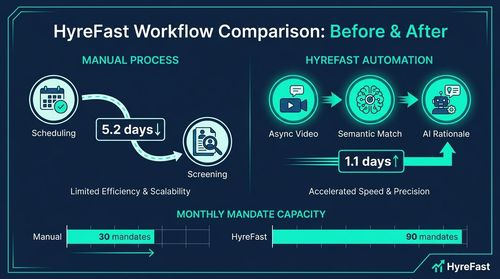
A mid-sized IT staffing agency in Bangalore was stuck at 30 active mandates per recruiter. Recruiters spent 60% of their time on scheduling and manual screening.
They implemented asynchronous video screening for first-round interviews, added a semantic matcher to surface hidden-gem candidates, and used explainable AI to generate one-sentence rationales for each submission.
After three months, each recruiter handled 90 active mandates, time-to-first-submission dropped from 5.2 days to 1.1 days, and client satisfaction rose from 3.4 to 4.6 out of 5. The agency won two enterprise contracts previously held by global consultancies.
Conclusions
- Clients don’t want more resumes-they want de-risked, transparent, relevant talent delivered fast, paired with strategic insight that makes them better hiring managers.
- AI delivers this by handling repetitive tasks (sourcing, initial screening, scheduling) so recruiters can focus on high-value activities: understanding nuance, managing risk, and advising on talent strategy.
- The academic view aligns with the street view: agencies that systematize speed, relevance, transparency, and consistency consistently outperform those relying on recruiter heroics.
- When you consistently deliver shortlists where clients think “I’d hire any of these,” you stop being a vendor and become a trusted talent partner.
Future Directions
- Real-time skill gap analysis: AI that compares a candidate’s async response to the team’s current project tech stack and suggests targeted upskilling paths.
- Dynamic shortlist optimisation: Systems that re-rank candidates in real time as new mandate details emerge, such as a client adding a Kafka requirement mid-process.
- Client-facing AI dashboards: Secure portals where hiring managers can view submission rationales, async responses, and market insights without recruiter intermediation.
- Bias-aware explainability: Tools that not only show why a candidate was selected but also audit for disparate impact across demographic groups, proactively addressing fairness concerns.
Want to identify strong candidates before interviews without relying on resumes?
Schedule a walkthrough: Book a Demo
Explore HyreFast Solutions
Interview as a Service
Outsource first-round interviews to AI.
AI Interview Bot
AI bot that conducts and evaluates interviews 24/7.
Video Interview Software
One-way async video interviews with AI scoring.
Phone Screening
Automate first-round phone calls with AI.
Interview Assessment
Structured assessments with AI scoring and reports.
AI Interview Platform
End-to-end platform for AI interviews and analytics.