
Candidate Screening 2.0: How to Combine AI and Behavioral Interviews for Better Hiring
Candidate Screening 2.0 combines AI and behavioral interviews to reduce bias, improve quality of hire, and build scalable, data-driven hiring processes.
Table of Contents

Introduction
In today's talent market, hiring isn't just about filling vacancies-it's a strategic function that can define a company's trajectory. Yet, many organisations find themselves caught between two paradigms.
On one hand, AI-powered tools promise unprecedented efficiency, sifting through thousands of resumes in minutes.
On the other, the timeless wisdom of behavioral interviews reminds us that hiring is fundamentally about human potential and team dynamics.
The real breakthrough, what we might call Candidate Screening 2.0, isn't choosing one over the other, but intelligently combining both to create a process that is both scalable and deeply human.
This synthesis is particularly crucial for startups and scaling companies where every hire has an outsized impact. The goal is to build a system that is robust, fair, and insightful-one that leverages technological precision without losing the nuanced judgment that defines great hiring decisions.
In this article, we will explore the mechanics of this integration, drawing on systematic methodologies from academic research and translating them into actionable steps for hiring managers and founders.
The Case for a Hybrid Approach: Beyond Manual Screening and Pure Automation
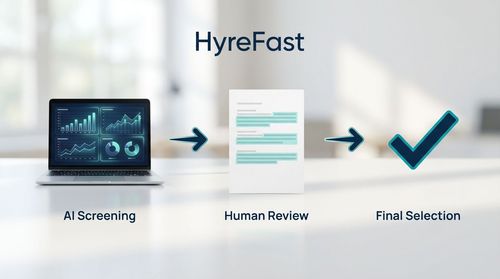
Traditional hiring processes are buckling under volume and velocity. Manual resume screening is not just time-consuming; it's notoriously inconsistent and susceptible to unconscious bias.
Two hiring managers reviewing the same set of resumes can easily shortlist different candidates based on subjective preferences or fleeting impressions. This lack of standardisation is a significant risk.
Enter AI-powered screening. Using Natural Language Processing (NLP) and machine learning, these systems can parse resumes, extract skills, years of experience, and educational qualifications, and rank candidates against predefined job criteria with remarkable speed.
This is the first critical filter. However, treating AI as the final arbiter is a dangerous oversimplification. AI models are only as unbiased as the data they are trained on, and they struggle to assess intangible qualities like cultural add, resilience, and collaborative spirit.
This is where the structured, human-led behavioral interview becomes non-negotiable. Behavioral interviews are based on a simple, powerful premise: past behaviour is the best predictor of future performance.
By asking candidates to describe specific situations, tasks, actions, and results (the STAR method), we gain insights into their problem-solving approach, not just their technical skills.
The challenge has been scaling this intensive process. Candidate Screening 2.0 solves this by using AI to handle the initial, high-volume screening, ensuring that human interviewers can dedicate their valuable time to a curated shortlist of promising candidates.
Architecting the Integrated Screening Pipeline
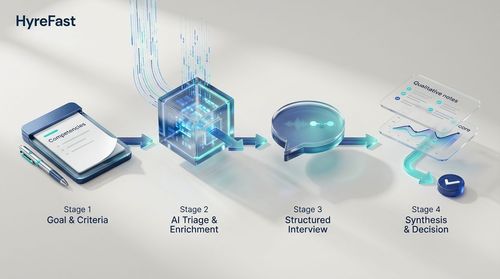
Building an effective hybrid system requires careful planning. It's not about bolting a tool onto an existing process; it's about redesigning the workflow from the ground up.
The methodology must be as rigorous as those used in scientific screening processes, akin to the systematic approaches seen in other fields.
For instance, the methodological rigor demonstrated in creating screening maps for complex systems offers a valuable analogue for structuring human evaluation pipelines [1].
A robust pipeline typically follows these stages:
-
Goal and Criteria Definition: Before a single resume is reviewed, the hiring team must align on the core competencies for the role. This goes beyond a list of programming languages or tools. It includes defining key behavioral indicators: Is this role primarily about collaborating cross-functionally? Does it require navigating ambiguity? These defined criteria become the rubric against which both the AI and the human interviewers will assess candidates.
-
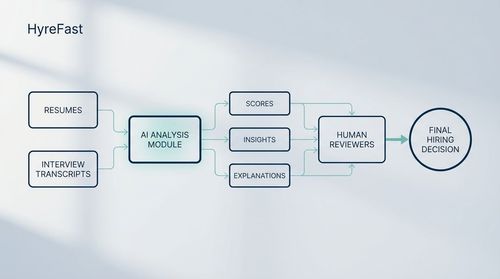
AI-Powered Triage and Enrichment: In this stage, an AI tool processes incoming applications. Its primary jobs are:
- Parsing and Standardisation: Extracting structured data (skills, experience, education) from unstructured resumes and profiles.
- Initial Ranking: Scoring candidates based on their fit against the predefined technical and experiential criteria.
- Bias Mitigation: Configuring the tool to anonymise data (e.g., redacting names, universities) to reduce initial demographic bias.
- Structured Behavioral Interviewing: The top-tier candidates from the AI screening are invited to a behavioral interview. This must be structured to ensure fairness and consistency. Every candidate for the same role should be asked the same core set of questions designed to probe the key behavioral competencies.
The focus is on depth, not breadth. For example, instead of asking "Are you a good team player?", a behavioral question would be: "Tell me about a time you had a significant disagreement with a colleague on a technical approach. What was the situation, and how did you resolve it?"
- Synthesis and Decision: Here, the human insight from the interview is combined with the AI-generated data. The interviewer's qualitative assessment is recorded using a scoring system aligned with the initial competencies.
Some advanced platforms can even use AI to analyse video interview transcripts for keyword usage, communication clarity, and sentiment, providing the human interviewer with additional data points. The final decision, however, should rest with the hiring team, using the combined data as a guide, not a verdict.
Navigating Implementation Challenges and Trade-offs
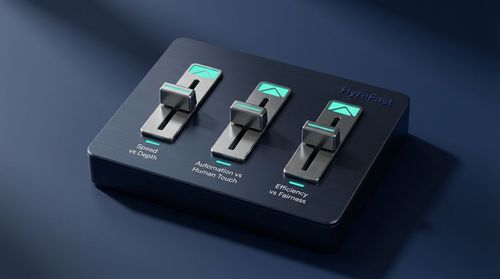
No system is without its trade-offs. The primary challenge in implementing this model is ensuring the quality and fairness of the AI component. If the training data for the AI is skewed, its recommendations will be too.
A tool trained primarily on resumes from a specific demographic or industry might undervalue non-traditional career paths or transferable skills. This necessitates a continuous monitoring and evaluation loop, regularly checking the AI's shortlists for unintended bias.
Another critical consideration is the candidate experience. An overly automated process can feel impersonal and cold. The key is to use automation to create efficiency behind the scenes, not to remove human interaction.
Clear communication, timely updates, and a respectful, well-conducted interview are essential to maintain a positive candidate journey.
The trade-off between speed and depth is also real. A pure-AI system is faster but shallow. A pure-behavioral interview process is deep but slow. The hybrid model intentionally sacrifices some speed at the top of the funnel to gain immense depth and accuracy at the final decision stage.
For most roles, this is a worthwhile trade-off, as the cost of a mis-hire far outweighs the cost of a slightly longer screening cycle.
A Practical Implementation Framework
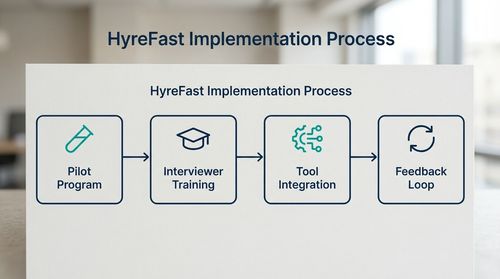
For teams ready to adopt this approach, here is a condensed action plan:
- Start with a Pilot: Run the hybrid process for a single role. Compare the candidates selected by the AI-plus-interview method with those who would have been chosen by the old method. Track outcomes like time-to-hire, quality of hire (e.g., performance at 6 months), and candidate feedback.
- Invest in Interviewer Training: The effectiveness of the behavioral interview is entirely dependent on the interviewer's skill. Train your team on asking probing questions, active listening, recognising bias, and using a consistent scoring rubric.
- Choose Tools for Integration, Not Just Features: Select an AI screening platform that integrates smoothly with your Applicant Tracking System (ATS) and provides transparent, auditable results. The tool should be a partner in building a fair process, not a black box.
- Create a Feedback Loop: The system should learn and improve. Gather feedback from hiring managers on the quality of candidates presented by the AI. This data can be used to refine the AI models and the behavioral questions over time.
Conclusion and Future Directions
Candidate Screening 2.0 represents a maturation of hiring practices. It acknowledges that while technology can take over repetitive, data-intensive tasks, the final judgment of human potential requires human wisdom.
This balanced approach is especially critical in the formative stages of a company, where the founding team's composition and values profoundly influence the organisation's long-term trajectory, a factor highlighted in research on team dynamics [2].
The future of this field will likely focus on enhancing the integration between AI and human judgment. We can anticipate:
- More sophisticated NLP models capable of analysing the subtleties in behavioral interview transcripts, providing richer context to human reviewers.
- A stronger emphasis on explainable AI (XAI), where tools don't just score candidates but explain the 'why' behind their rankings, building trust and enabling better human oversight.
- The integration of predictive analytics to correlate interview performance and resume data with long-term job success, creating a continuous learning loop for the hiring system.
By embracing a hybrid, methodical approach, organisations can move beyond the inefficiencies of the past and the impersonal pitfalls of full automation.
They can build hiring processes that are not only smarter and faster but also more fair and insightful, ultimately leading to teams that are truly built to last.
References
[1] Shao, S., Li, B., Cautun, M., Wang, H., & Wang, J. (2019). Screening maps of the local Universe I -- Methodology. arXiv:1907.02081v2. [2] Kairam, S. R., & Foote, J. (2024). How founder motivations, goals, and actions influence early trajectories of online communities. arXiv:2405.00601v1.