
Are You Pricing Your Screening Services Wrong? What…
AI is reshaping screening with pay-as-you-use pricing-cutting costs, improving transparency, and scaling hiring, tenant, and claims processes efficiently.
Table of Contents

Introduction
If you are still charging per license or per seat for your screening service, you are likely leaving money on the table or overcharging your customers. Social media conversations among hiring managers and startup founders reveal growing frustration with opaque pricing models that hide multipliers and fail to align with actual usage.
The reason is simple: artificial intelligence is rewriting the economics of screening, shifting the cost structure from fixed, license-based fees to variable, consumption-based models that scale with volume.
In this article, we will explore how AI tools change your cost structure, examine the new pricing models emerging across tenant, recruitment, healthcare, and claims screening, and discuss what you need to implement these changes effectively.
The Old Model is Broken
Traditional screening services operate on a fixed-cost licensing model. You pay a flat fee for a software license, a per-seat charge, or a monthly subscription regardless of how many candidates, tenants, or claims you process.
This model works well when volumes are predictable and stable. But in practice, screening volumes fluctuate seasonally, with hiring surges, rental cycles, or claim spikes. When volumes drop, you are still paying the same license fee. When volumes spike, you may hit caps or incur overage charges that are not transparent.
Social media threads are filled with complaints about hidden multipliers, per-report add-ons, and surprise bills. The core problem is misalignment: the cost to the provider is largely fixed, but the value to the customer is variable.
AI tools break this misalignment by introducing near-zero marginal cost for additional screenings. Once the AI model is trained and deployed, each extra resume parsed, each extra background check initiated, costs only the compute resources consumed. This fundamental shift demands a corresponding shift in pricing.
The New Economics of AI Screening
Academic research from ArXiv and core literature confirms that AI transforms screening from a fixed-cost service to a consumption-based utility. Instead of paying for software licenses, companies now pay for compute resources, API calls, and system actions.
The marginal cost of screening one additional candidate can be as low as $0.10 to $5, with many providers charging around $1 per resume screened. This is a dramatic reduction compared to traditional per-report fees that often range from $30 to $150 for background checks.
The concept of near-zero marginal cost is critical. It means that after the initial investment in model development and infrastructure, the incremental cost of processing one more application approaches zero. This allows providers to offer tiered consumption models where customers pay only for what they use, with clear thresholds and volume discounts.
It also enables outcome-based pricing, where payment is tied to results such as successful hires or reduced turnover, rather than just access to the tool. Outcome-based pricing aligns incentives: the provider only gets paid when the customer gets value.
How AI Screening Systems Work End to End
To understand the cost implications, it helps to walk through the architecture of a modern AI screening system. The pipeline typically starts with application intake, where resumes, rental applications, or claim forms are ingested via API or web upload.
Natural language processing models parse unstructured text, extract key fields, and standardise the data. Machine learning models then rank candidates or applications based on predefined criteria, such as skills match, credit score thresholds, or claim validity indicators.
Automated ranking reduces the need for human reviewers to manually screen each application.
For recruitment, AI interviews can cut time-to-hire by 50% by using speech recognition and sentiment analysis to assess candidate responses. For tenant screening, instant application processing and automated ranking eliminate days of manual work. For claims processing, AI enables profitable handling of previously abandoned low-value claims because the cost per claim drops to a fraction of a dollar.
The system flow ends with integration into downstream workflows: interview scheduling, background check initiation, or payment processing. Each step involves API calls that incur compute costs, but these costs are predictable and scale linearly with volume.
FinOps tools like Holori, WrangleAI, and LiteLLM have become essential for tracking these costs across cloud services, ensuring that pricing remains aligned with actual consumption.
Real World Impact Across Domains
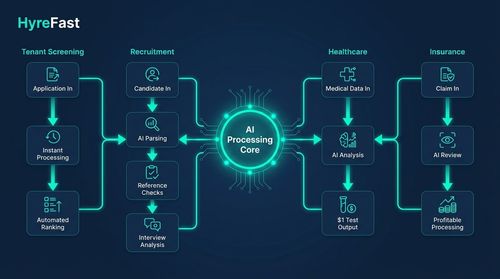
The shift to consumption-based pricing is not theoretical. In tenant screening, AI automation reduces administrative and service costs through instant application processing and automated ranking.
Property managers can now screen hundreds of applicants in minutes, paying only for the number of applications processed. In recruitment, background checks that used to cost $30 to $150 per hire are now bundled into per-candidate screening fees that include AI parsing, reference checks, and interview analysis.
Healthcare screening presents a particularly compelling case. Grand Challenges are actively seeking cost-disruptive tools that enable $1 class tests in low and middle income countries.
AI models that can analyse medical images or lab results at near-zero marginal cost make this possible.
Similarly, in claims processing, insurers are using AI to profitably process claims that were previously abandoned because the manual cost exceeded the claim value. Healthy margins are maintained because the variable cost per claim is now a fraction of what it was.
Implementation Considerations and Trade Offs
Adopting a consumption-based pricing model requires careful planning. First, you need to understand your own cost structure. Development costs for custom AI screening systems vary widely, but they can be offset by long term operational savings.
If you are a startup with low initial volume, a hybrid model combining a base subscription with usage based components may be more appropriate than pure consumption pricing. If you are a high volume enterprise, tiered consumption models with clear thresholds and volume discounts build trust and avoid hidden multipliers.
Second, pricing strategy must align with your specific hiring needs, volume, and talent strategy. For example, if you are screening for niche roles where quality matters more than speed, outcome based pricing tied to successful hires may be more attractive than per resume fees. If you are screening high volumes of entry level candidates, a low per candidate fee with a cap may work better.
Third, you need FinOps tools to track AI costs across cloud services. Without visibility into compute, API, and storage costs, you risk underpricing or overpricing your service. The trade off between cost, performance, and complexity is real.
Optimising for lowest marginal cost may require investing in more efficient models or dedicated hardware, which increases upfront development cost. Choose the approach that matches your volume and growth trajectory.
Conclusions
- The shift from fixed license fees to consumption based pricing is driven by AI's near zero marginal cost for additional screenings, making per candidate fees of $0.10 to $5 viable.
- Outcome based pricing aligns provider and customer incentives, tying payment to successful hires, reduced turnover, or other measurable results.
- FinOps tools are essential for tracking variable costs and ensuring pricing remains transparent and profitable.
- Academic research and industry practice both confirm that AI enables scalable, cost effective screening across recruitment, tenant, healthcare, and claims domains.
Future Directions
- More granular pricing models will emerge, such as per skill match, per interview minute, or per claim complexity tier, enabled by finer grained cost tracking.
- Integration of blockchain for transparent, auditable cost records could reduce disputes over usage and billing.
- Real time cost dashboards will become standard, allowing customers to see exactly what they are paying for and adjust usage dynamically.
- Research into smaller, more efficient models will further reduce marginal costs, making screening affordable even for very low volume use cases.
Ready to see how this works?
Schedule a walkthrough: Book Demo
Explore HyreFast Solutions
Interview as a Service
Outsource first-round interviews to AI.
AI Interview Bot
AI bot that conducts and evaluates interviews 24/7.
Video Interview Software
One-way async video interviews with AI scoring.
Phone Screening
Automate first-round phone calls with AI.
Interview Assessment
Structured assessments with AI scoring and reports.
AI Interview Platform
End-to-end platform for AI interviews and analytics.