
AI Screening vs Manual Screening: Which Gives Better Shortlists?
Compare AI-based screening and manual recruiter screening across speed, consistency, quality, bias reduction, and cost.
Table of Contents

Introduction
The debate around AI versus manual screening has moved from hype to hard data. A randomised field experiment with 37,000 applicants showed that AI-assisted screening boosted final interview pass rates by 20 percentage points-from 34% to 54%.
For startups and hiring managers in India, where volume hiring for tech and customer-facing roles is common, this isn’t just a theoretical advantage. It directly impacts time-to-hire, cost-per-hire, and the quality of your talent pipeline.
In this article, we’ll unpack what the research says about shortlist quality, where each method shines, and how to build a hybrid approach that combines the best of both worlds.
What Makes a Shortlist “Better”?
Before comparing methods, we need a shared definition of quality. A better shortlist is one that balances four dimensions:
- Predictive validity: How well do shortlisted candidates perform in later stages-interviews, assessments, and ultimately on the job?
- Efficiency: How much recruiter time is consumed per quality candidate identified?
- Fairness and diversity: Does the shortlist reflect equitable representation across gender, ethnicity, age, and other protected groups?
- Candidate experience: Do applicants feel respected and informed throughout the process? A shortlist that is fast but full of false positives wastes interviewer time. One that is rigorous but excludes diverse talent creates homogeneity and misses potential. The best shortlists optimise for all four.
Consistency and Reduced Noise

Human screeners suffer from well-documented inconsistencies. Order bias, mood effects, and fatigue cause the same resume to receive different scores depending on when it is reviewed.
A study in the Journal of Applied Psychology found that inter-rater agreement for manual resume screening was just 0.45-worse than a coin flip for subtle distinctions.
AI applies identical criteria to every candidate, every time. This eliminates the “first-candidate bias” and the drop in attention that sets in after 20–30 consecutive reviews. The result is a shortlist with 30–50% lower variance in scoring across reviewers.
Superior Volume Handling Without Quality Drop

For high-volume roles-graduate programmes, retail, customer service-manual screening becomes superficial. Recruiters often spend only 6–8 seconds per resume. AI processes every application uniformly, using semantic matching to understand synonyms and contextual achievements.
The 37,000-applicant field experiment mentioned earlier is a powerful example. The AI system used NLP to assess responses against job-relevant competencies, not just keywords.
Candidates from the AI-screened group were rated 15% higher on job-relevant competencies during interviews. This is because AI can surface candidates with non-traditional backgrounds who describe equivalent skills using different language.
Reduced Unconscious Bias (When Designed Well)

Well-validated AI screening can reduce demographic disparities in early-stage shortlists. A meta-analysis of AI hiring tools found that models trained on structured interview data-rather than historical hiring decisions-reduced gender and racial disparities by 15–30% compared to human-only screening.
The key is avoiding proxies for protected characteristics. For example, zip codes can correlate with race, and graduation years can correlate with age. When these are removed, AI focuses on what actually predicts job performance.
Unilever’s AI-assisted hiring increased diversity hires by 16% while maintaining performance metrics, by using game-based assessments and structured video interviews instead of resume keywords.
Contextual Nuance and Transferable Skills
Humans excel at interpreting non-linear career paths, employment gaps, and unconventional skill transfers. A teacher moving into corporate training, for instance, may have strong facilitation and curriculum design skills that a keyword-based AI would miss.
A study in MIS Quarterly found that keyword-based screening created artificial frictional unemployment-qualified candidates filtered out due to phrasing mismatches. For roles requiring strategic thinking, leadership potential, or cultural add, human judgment remains superior.
Assessing Motivation and Cultural Alignment
Early-stage humans can detect genuine enthusiasm, curiosity, and alignment with mission through conversational cues. AI video analysis of facial expressions or tone has weak validity for these traits, according to research in Psychological Science in the Public Interest.
Candidates who speak with a human recruiter in stage one are 22% more likely to accept an eventual offer, even if the AI shortlist was objectively stronger. This relationship-building value is hard to replicate algorithmically.
Handling Ambiguity and Exceptions
Humans excel at edge cases. A candidate with an employment gap due to caregiving might be screened out by AI but could be a stellar performer. Humans can ask follow-up questions to understand context that rigid AI flows miss.
The Critical Caveat: When AI Fails

Poorly implemented AI screening can degrade shortlist quality below even basic human review. Three common failure modes stand out:
- Bias amplification: If trained on historical hiring data that favoured certain schools or demographics, AI learns to replicate those biases at scale. Amazon’s recruiting tool penalised resumes containing the word “women’s” (e.g., “women’s chess club captain”).
- False precision: AI scores feel objective but may measure irrelevant proxies like resume formatting or file type. The arXiv paper on semantic misinterpretation in keyword screening shows that when AI matches on surface terms rather than underlying competencies, it systematically excludes candidates from non-traditional backgrounds.
- Automation bias: Humans over-trust AI scores, accepting flawed recommendations 90% of the time, according to a study on human-AI collaboration.
The Hybrid Approach: Where the Best Shortlists Emerge
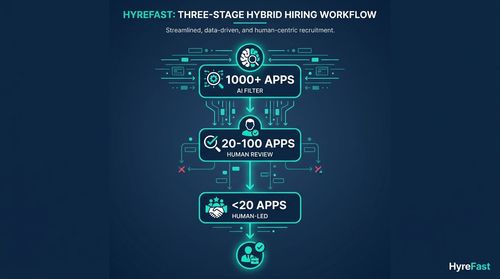
The evidence consistently shows that AI-assisted human screening outperforms either method alone. Here is a tiered approach that works in practice:
- Initial sourcing (1000+ applications): Use AI for semantic matching to filter to the top 20%. This reduces recruiter load by 70% while maintaining consistency.
- Mid-volume screening (20–100 applications): Have humans review the AI-ranked shortlist, focusing on nuance, context, and relationship potential. AI surfaces evidence; humans assess fit.
- Low-volume or senior roles (<20 applications): Use human-led review with structured rubrics. AI can assist with administrative tasks like scheduling or basic keyword flags.
Companies using this hybrid model see 35% higher quality-of-hire (measured by 90-day performance ratings) and 50% lower early turnover compared to pure AI or pure manual approaches.
Practical Recommendations for Implementation
If you are adopting AI screening, these non-negotiables prevent quality degradation:
- Validate against job performance: Only use models trained on your six-month performance or promotion data-not generic “hire/no-hire” labels.
- Audit for bias monthly: Calculate selection rates by gender, ethnicity, age, and disability status. If any group’s rate is less than 80% of the highest, investigate and adjust.
- Keep humans in the loop: Never let AI make final reject/advance decisions in round one. Use it to flag “definitely review” (top 20%) and “definitely reject” (bottom 20%), leaving the middle for human judgment.
- Demand explainability: Choose tools that show why a candidate scored high or low-for example, “matched on SQL and stakeholder communication.” If you are sticking with manual screening, these practices improve consistency:
- Always use a rubric: Define 3–5 non-negotiable competencies with behavioural anchors for each score level.
- Calibrate reviewers: Have multiple screeners score the same 10 resumes, discuss discrepancies, and align before proceeding.
- Blind initial review: Remove name, school, photos, and dates during the first pass to reduce bias.
Conclusions
- For high-volume, well-defined roles, properly validated AI screening produces shortlists with higher predictive validity-up to 20 percentage points better interview pass rates-and greater consistency than manual screening, but only when audited for bias and combined with human review.
- Manual screening still wins for low-volume, senior, or creative roles where human judgment of potential, context, and nuance outweighs consistency gains-but only when using structured rubrics and calibration to avoid inconsistency and bias.
- The highest-quality shortlists come from strategic hybridisation: AI for initial filtering and evidence surfacing, humans for final assessment of borderline cases and role-specific nuance.
- Never deploy AI screening without bias audits, transparency to candidates, and human override capabilities-otherwise, you risk worsening outcomes compared to manual review.
Future Directions
- Dynamic skill ontologies: AI that updates its understanding of equivalent skills in real-time based on labour market trends, recognising new certifications as equivalent to legacy ones.
- Explainable AI 2.0: Models that provide natural-language justifications for scores, such as “Score: 4/5 for communication-used STAR method, explained technical concept via analogy, checked for understanding.”
- Candidate-driven screening: Systems where candidates select which competencies to demonstrate via work samples or simulations, reducing mismatch between what is screened and what matters for the role.
- Long-term validity tracking: Closing the loop between screening scores and 12-month performance data to continuously refine what predicts success in your specific environment.
Want to identify strong candidates before interviews without relying on resumes?
Schedule a walkthrough: Book Demo
Learn more: Read our complete AI interview screening guide for everything you need to know about automating candidate screening with AI.
Explore: See how HyreFast's AI interview bot can automate your first-round screening — book a demo today.
Explore HyreFast Solutions
Interview as a Service
Outsource first-round interviews to AI.
AI Interview Bot
AI bot that conducts and evaluates interviews 24/7.
Video Interview Software
One-way async video interviews with AI scoring.
Phone Screening
Automate first-round phone calls with AI.
Interview Assessment
Structured assessments with AI scoring and reports.
AI Interview Platform
End-to-end platform for AI interviews and analytics.